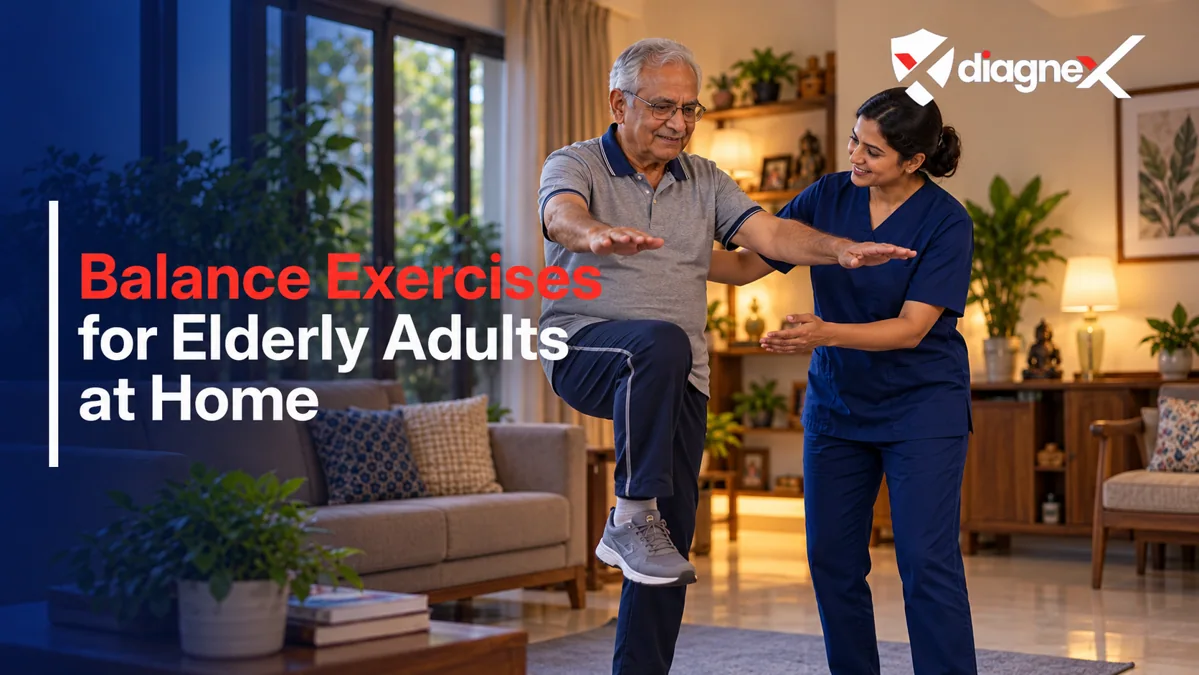
Balance exercises for elderly adults can support safer walking, steadier transfers, better confidence, and lower fall risk when they are chosen appropriately for the person's ability. For many older adults, the goal is not athletic performance. It is being able to stand from a chair, turn safely, walk through the home, use the bathroom, and recover from small losses of balance without falling.
For related context, read Attendant vs Nurse for Elderly Care at Home and Strength Exercises for Seniors at Home.
For related context, read Attendant vs Nurse for Elderly Care at Home and Strength Exercises for Seniors at Home.
Balance usually declines because several factors change together. Leg strength may reduce, reaction time may slow, vision may be poorer, medicines can cause dizziness, and confidence may fall after an illness or previous fall. This is why elderly balance training works best as part of a wider plan that also considers strength, walking, footwear, vision, medicines, home hazards, and the use of walking aids.
The National Institute on Aging recommends combining balance work with aerobic and muscle-strengthening activity rather than treating balance as a separate skill. For older adults who are frail, have fallen recently, use a walker, or have neurological or joint problems, a physiotherapist should help choose the right starting level.
Why Balance Training Matters as We Age
Good balance helps the body stay stable when standing still and when moving. Everyday tasks such as turning, reaching, getting out of bed, stepping into a bathroom, or walking on an uneven surface all depend on balance.
The CDC recommends that adults aged 65 and older include balance-improving activity in their weekly routine, alongside aerobic activity and muscle strengthening. Regular activity can help preserve physical function and reduce the risk of falls and fall-related injury.
For families, this means balance training is not only an exercise programme. It is part of maintaining independence and making ordinary movement at home safer.
Who May Benefit From Balance Exercises at Home?
Balance training can be useful for many older adults, including those who have become less active, feel unsteady while turning, use furniture for support, have become weaker after hospitalisation, or are nervous about falling.
It may be particularly useful after a period of bed rest, recovery from illness, early mobility decline, or a minor fall that has reduced confidence. However, generic exercises are not suitable for everyone. Someone with repeated falls, severe dizziness, new weakness, significant joint pain, recent fracture, or major neurological disease should be assessed before starting an unsupervised programme.
Diagnex's Physiotherapy at Home pathway may be relevant when an older adult needs an individual mobility and balance assessment rather than a generic exercise list.
What Should Be Checked Before Starting?
Before beginning elderly balance training, think about what is making the person unsteady. A recent fall, medication change, poor vision, low blood pressure, foot pain, weakness, or a new walking aid can all change what is safe.
The exercise space should be well lit and free from loose rugs, wires, slippery surfaces, pets, and clutter. A sturdy chair, kitchen counter, or another stable support should be close enough to reach if the person loses balance.
Fall Prevention at Home for Elderly Parents explains why balance training works best when physical and environmental fall risks are addressed together.
How Often Should Older Adults Practise Balance?
The National Institute on Aging suggests aiming for about three balance-training sessions each week. The exact duration can be short at first, especially for a beginner.
Consistency matters more than doing a long session once in a while. A few carefully performed exercises several times a week can be more useful than an ambitious routine that causes fatigue or is abandoned. For more on the practical service arrangements, review physiotherapy at home before deciding what information the care team needs.
Older adults with medical limitations should be as physically active as their abilities and conditions allow. The starting level should match the person's current function, not their age alone.
A Safe Starting Point: Supported Standing
For someone who is mildly unsteady, the safest first step may simply be practising upright standing near a stable surface. The person can stand with feet comfortably apart and lightly hold a counter or sturdy chair.
As confidence improves, the amount of hand support can gradually reduce if this is safe. The goal is to notice posture, weight distribution, and control rather than to remove support quickly.
If the person cannot stand safely without strong assistance, exercise progression should be guided by a physiotherapist or another appropriate rehabilitation professional.
Weight-Shifting Exercises
Weight shifting is a useful way to practise controlling the body's centre of gravity. Standing near a stable support, the older adult gently moves body weight from one foot toward the other without lifting the feet.
A similar forward-and-backward shift can be practised by moving weight slightly toward the toes and then toward the heels while keeping the body controlled.
This exercise can help with everyday movements such as reaching, turning, or stepping. Movements should stay small and comfortable rather than exaggerated.
Sit-to-Stand Practice
Standing up from a chair combines leg strength, balance, and coordination, making it one of the most practical exercises for older adults.
The person should use a firm chair that does not slide. If needed, the armrests can be used initially. The movement should be slow and controlled, with the person coming fully upright before sitting down again.
Repeated sit-to-stand practice can support everyday transfers, but the number of repetitions should match the person's ability. Someone who becomes very breathless, dizzy, or unstable should stop and be assessed.
Heel Raises for Ankle Strength and Balance
Heel raises strengthen the calf and ankle muscles that help control posture during standing and walking.
While holding a stable surface, the older adult slowly lifts the heels so the weight moves toward the front of the feet, then lowers the heels with control. The movement should remain small if ankle strength is limited.
This exercise can support steadiness during walking, but it may not be suitable for someone with severe foot pain, recent ankle injury, or marked instability.
Marching in Place
Supported marching can help practise single-leg loading and weight transfer. Standing beside a counter or sturdy chair, the person alternately lifts one foot a small distance from the floor.
The aim is not to lift the knees high. The movement should stay controlled and the trunk should remain upright.
If one side is much weaker, the person drags a foot, or balance deteriorates quickly, physiotherapy assessment may be useful before progressing.
Heel-to-Toe Standing
Heel-to-toe standing narrows the base of support and makes balance more challenging. One foot is placed directly or almost directly in front of the other while the person remains close to a stable support.
For a beginner, a small gap between the feet may be safer than a true tandem position. Over time, the feet can move closer to a straight line if control improves.
This exercise should not be attempted without support by someone with a high fall risk.
Heel-to-Toe Walking
Heel-to-toe walking uses the same narrow base of support while adding forward movement. It can be useful for selected older adults who already have reasonable standing balance.
The person should practise near a counter, railing, or another secure support. Steps should be slow and deliberate, with each foot placed close to the line of the previous step.
Because this exercise is more challenging, it is not an appropriate starting point for everyone.
Side-Stepping
Side-stepping can help strengthen the hip muscles and improve control during sideways movement, which is important when moving around furniture or stepping into a bathroom.
The person can practise a few small steps in each direction while facing a kitchen counter or railing. The feet should not cross unless a physiotherapist has specifically advised that progression.
The movement should remain slow, with the person maintaining upright posture.
Single-Leg Standing
Standing on one foot is a recognised balance exercise, but it is more advanced than it appears. The National Institute on Aging includes it as an example of balance training for older adults. If the family is considering support at home, the Diagnex guide to home nursing explains the service pathway and its limits.
A person who is ready for this exercise should stay beside a stable surface and lift one foot only slightly. Even a few seconds may be enough initially.
Someone who has frequent falls, significant weakness, or relies heavily on a walker should not attempt unsupported single-leg standing without professional guidance.
Can Tai Chi Help With Balance?
Tai chi combines slow controlled movement, weight shifting, posture, and concentration. Both the CDC and National Institute on Aging include tai chi as an example of an activity that can support balance.
For older adults who enjoy group or guided movement, tai chi can be a useful option. It should still be adapted for joint problems, severe frailty, or limited standing tolerance.
The advantage of tai chi is that it trains balance in motion rather than only while standing still.
Why Strength Training Matters for Balance
Balance and strength are closely connected. Weak hip, thigh, calf, and trunk muscles make it harder to correct the body when balance is lost.
The CDC recommends muscle-strengthening activity at least two days each week for older adults, alongside balance activity. This does not necessarily mean lifting heavy weights. Appropriate chair exercises, resistance bands, controlled sit-to-stand movements, or other physiotherapist-directed exercises can build functional strength.
Rehabilitation at Home may be relevant when an older adult needs a structured programme that combines strength, mobility, and balance rather than isolated exercises.
How Walking Fits Into Balance Training
Walking is important for endurance, confidence, and everyday mobility, but walking alone may not fully train balance. A good programme often combines walking with strength and balance-specific exercises.
Older adults who walk with a cane or walker should use the aid recommended for them rather than trying to remove it during exercise to make the activity harder.
If walking has recently become slower, more shuffling, or less stable, the change should be assessed rather than treated only with more exercise.
What About Balance Exercises After a Fall?
A fall is a reason to understand why the fall happened before increasing exercise difficulty. If the older adult hit their head, lost consciousness, has new pain, cannot stand, has new weakness, or is taking blood thinners and had a significant fall, medical assessment may be needed first.
After immediate concerns are addressed, balance and strength exercises may be part of recovery. What to Do After an Elderly Parent Has a Fall explains the wider follow-up steps families should consider after a fall.
When Should Exercise Stop?
Exercise should stop if the older adult develops chest pain, severe breathlessness, fainting, new neurological symptoms, severe dizziness, sudden weakness, or acute pain.
The session should also stop if the person becomes progressively less steady or needs much more support than usual. Fatigue can change balance quickly in frail adults.
Mild effort is expected during exercise, but loss of control is not the goal.
How Can Families Make Balance Training Safer?
A caregiver can make practice safer by staying nearby when supervision is needed, keeping the exercise area clear, making sure stable support is available, and encouraging slow controlled movement rather than rushing.
Stable footwear is usually important. The National Institute on Aging recommends comfortable, stable footwear or another safe surface with good grip.
Patient Care at Home may be useful when an older adult needs day-to-day assistance with mobility, transfers, or supervision in addition to clinical rehabilitation.
Why Fear of Falling Matters
After a fall or near-fall, some older adults reduce activity because they are afraid of falling again. This can start a cycle in which less movement leads to more weakness, which then makes movement even less secure.
A gradual and supervised return to activity can help rebuild confidence. The exercise should feel achievable enough that the person is willing to continue.
Families should avoid pressuring an older adult into difficult exercises simply to prove independence.
Balance Training for Older Adults With Stroke or Neurological Conditions
Older adults recovering from stroke, Parkinson's disease, neuropathy, or another neurological condition may need more specialised balance training because weakness, sensation, coordination, and reaction time can be affected differently on each side.
Generic exercises may still be useful later, but the starting programme should usually come from a physiotherapist who understands the neurological condition. For care planning beyond this article, compare medical caretaker support with the instructions already given by the treating professional.
Diagnex's Stroke Recovery care pathway describes how prescribed physiotherapy exercises can be supported safely at home between formal rehabilitation sessions.
How Balance Fits Into Elder Care at Home
Balance is only one part of safe ageing at home. Falls can also be influenced by medicines, vision, footwear, toileting urgency, blood-pressure changes, dementia, poor lighting, or environmental hazards.
The broader Elder Care at Home pathway can help families think about mobility, medicines, monitoring, fall risk, and day-to-day support together rather than treating exercise as an isolated task.
What Is Geriatric Care at Home? also explains why mobility, rehabilitation, medication review, cognition, and fall prevention often need to be considered as one coordinated plan.
How to Arrange Balance and Mobility Support With Diagnex
To arrange support for elderly balance training, share the older adult's main mobility problem, recent falls or near-falls, current walking aid, relevant medical history, recent hospitalisation, and locality.
Diagnex can review whether the requirement is best routed to Physiotherapy at Home, rehabilitation, elder care, or another appropriate pathway based on the person's condition and goals.
For service coordination, use the Diagnex Contact page.
Frequently asked questions
What are good balance exercises for elderly adults at home?
Common examples include supported standing, weight shifting, sit-to-stand practice, heel raises, marching in place, side-stepping, and selected heel-to-toe exercises. The right starting level depends on the person's mobility and fall risk.
How often should elderly adults practise balance exercises?
The National Institute on Aging suggests about three balance-training sessions each week. Frequency and duration should be adjusted for the person's ability and medical condition.
Can balance exercises prevent falls?
Balance and strength training can help reduce fall risk, especially when combined with safe footwear, medication review, vision care, appropriate walking aids, and home-safety changes.
Should an elderly person exercise alone?
Some independent older adults can practise safely alone, but anyone with a high fall risk, recent falls, significant weakness, or neurological problems may need supervision or physiotherapy guidance.
Is walking enough for balance?
Walking is valuable, but balance-specific and strength exercises can address skills that ordinary walking may not train sufficiently.
What should I do if my parent is afraid of falling?
Start with simple supported movements and consider a physiotherapy assessment. Confidence often improves when exercises feel safe and achievable rather than challenging.
When should a physiotherapist assess balance?
Assessment is useful after repeated falls, new mobility decline, recent hospitalisation, severe dizziness, a new walking aid, significant neurological disease, or when generic home exercises do not feel safe.
References and further reading
This article provides general education and does not replace an individual physiotherapy or medical assessment. Clinical points were cross-checked against current CDC guidance on physical activity and fall prevention for older adults and National Institute on Aging guidance on balance and strength exercise.
Related Diagnex services and guides
Explore the Elder Care service pathway and the Elder Care article library for more information.
Diagnex publishes general healthcare information to support care planning. Individual decisions about diagnosis, prescriptions and treatment remain with the treating professional. Read our medical content policy and editorial standards.