dialysis water quality at home is an important part of planning safe home hemodialysis. Families researching home dialysis water quality, dialysis water treatment, and home dialysis water requirements should understand how these issues connect with home hemodialysis safety. The exact treatment, equipment and safety process should always follow the patient's nephrology and home dialysis team.
Dialysis water quality at home is one of the most important technical parts of a safe home hemodialysis setup. When a dialysis machine uses household water to prepare dialysate, that water must pass through an approved treatment system before it becomes suitable for the dialysis pathway.
The reason is simple: water that is safe to drink is not automatically suitable for hemodialysis. Drinking water can legally contain disinfectants, minerals, trace chemicals and microorganisms at levels that are acceptable for ordinary consumption but still require tighter control when water is used repeatedly to prepare dialysis fluid.
A home dialysis water-treatment setup is therefore designed to do more than make water look clean. It is intended to reduce specific chemical and microbiological risks, protect the dialysis equipment and help produce water that meets the requirements of the selected home dialysis system.
What Does “Dialysis Water Quality” Mean?
Dialysis water quality refers to the chemical and microbiological quality of the water used to prepare dialysis fluid. International dialysis-water standards distinguish this from ordinary drinking-water quality because hemodialysis creates a much greater and more direct exposure to water across the dialyzer membrane.
The patient does not receive household water directly into the bloodstream. However, blood passes very close to the dialysate across a semipermeable membrane, and this happens repeatedly for many hours over many treatment sessions. That is why dialysis programmes treat water quality as a clinical safety issue rather than a household plumbing issue.
Current international standards for hemodialysis water focus on controlling both chemical contaminants and microbiological contamination. The home dialysis provider and equipment manufacturer are responsible for translating those requirements into the actual treatment system installed in the home.
Why Ordinary Tap Water Is Not Enough
Municipal drinking water is treated to make it safe for the general population to drink. That often includes the deliberate use of disinfectants such as chlorine or chloramine. Drinking water can also contain naturally occurring minerals, trace metals and other dissolved substances within limits considered acceptable for consumption.
Hemodialysis is different. The treatment repeatedly exposes the patient to large volumes of water through the dialysate pathway, so contaminants that may be tolerated in drinking water need much tighter control. A dialysis water-treatment system is designed around this higher level of exposure.
This is also why bottled water, filtered drinking water or water from a household RO purifier should not be assumed suitable for dialysis. The question is not whether the water tastes clean. The question is whether the complete system has been designed, monitored and maintained to produce water suitable for the dialysis machine.
What the Home Dialysis Water Setup Is Designed to Control
A well-designed home dialysis water system is built to manage several different categories of risk. No single filter controls everything, which is why dialysis water treatment often uses several stages working together. The main categories include:
- Disinfectants such as chlorine and chloramine
- Water hardness and mineral load
- Sediment and particulate matter
- Dissolved chemicals and trace metals
- Microorganisms
- Bacterial by-products such as endotoxins
The exact treatment sequence depends on the household water source, the dialysis machine and the water-treatment equipment selected for that home. This detail should be confirmed with the home dialysis team because the exact process depends on the patient's machine, vascular access and prescription.
Chlorine and Chloramine
Chlorine and chloramine are widely used to disinfect public water supplies. Their presence is useful for controlling microorganisms in municipal water, but they must be adequately removed before water is used for hemodialysis.
Dialysis water systems commonly use activated carbon as part of the pretreatment pathway because carbon is effective at removing these disinfectants. The system may also require specific testing to confirm that chlorine or chloramine breakthrough has not occurred.
This is an important example of why drinking-water safety and dialysis-water safety are not the same. A substance can be intentionally present in drinking water and still need to be removed before dialysis.
Water Hardness
Hardness mainly reflects minerals such as calcium and magnesium in the source water. Hard water can contribute to scale formation and can reduce the efficiency or lifespan of downstream equipment, particularly reverse-osmosis membranes. For more on the practical service arrangements, review dialysis on wheels before deciding what information the care team needs.
Some dialysis water systems therefore include water softening before reverse osmosis. The need for a softener depends on the local water supply and the equipment design rather than on a universal rule for every home. For families, the practical point is that a home water source may need to be assessed before installation even when it causes no obvious problems in ordinary household use.
Sediment and Particles
Household water can carry sediment, rust or other particulate material, especially where water passes through older pipes, storage tanks or variable municipal systems. These particles can interfere with filters and damage downstream components.
Sediment filtration is therefore often used early in the water-treatment pathway. Its job is not to make water dialysis-ready on its own, but to protect later stages so they can perform consistently.
Dissolved Salts, Chemicals and Trace Metals
A central function of reverse osmosis is to reduce a wide range of dissolved substances. The RO membrane rejects many salts, minerals, metals and other contaminants that would otherwise remain in the source water.
The exact chemical profile of household water varies by location and source. That is why a home dialysis setup may require source-water assessment before installation and ongoing monitoring according to the programme's protocol.
Families do not need to interpret a long list of chemical limits themselves. What matters is that the dialysis system has been selected and validated for the actual water entering the home.
Microorganisms
Water can support bacterial growth even when it looks clear and has no unusual smell. A dialysis water system must therefore control microbiological contamination throughout the pathway, not just remove visible particles.
Microbial control depends on system design, filtration, regular disinfection and ongoing maintenance. A well-installed system can still become unsafe if filters, hoses, tanks or internal pathways are not maintained according to the required schedule. This is one reason home dialysis training includes water-system care rather than treating the RO unit as a device that can simply be installed and forgotten.
Endotoxins
Endotoxins are bacterial components that can remain a concern even when live bacterial counts are low. Dialysis-water standards therefore address not only microorganisms themselves but also microbial by-products.
The system may use additional filtration or ultrafiltration to help control these contaminants, depending on the dialysis machine and water-treatment design. The important point for families is that clear-looking water is not proof of safe dialysis water. Chemical and microbiological quality has to be controlled through the system and its monitoring process.
What Reverse Osmosis Actually Does
Reverse osmosis is a key treatment stage in many home hemodialysis systems. It uses pressure to push water through a semipermeable membrane. Many dissolved contaminants are rejected, while treated product water passes through to the next stage of the dialysis-water pathway.
RO is effective because it can reduce a broad range of dissolved substances rather than targeting only one chemical. This makes it particularly valuable in dialysis, where the source water may contain a mixture of minerals, salts and trace contaminants.
However, reverse osmosis is not the complete water-treatment system. If chlorine reaches the membrane, for example, it can damage some RO systems. Hardness and sediment can also reduce performance. Pretreatment exists partly to protect the RO stage so it can work reliably.
Why a Dialysis RO System Is Different From a Household RO Purifier
Both devices may use reverse osmosis, but they are designed for different purposes. A household RO purifier is designed to improve drinking water. A dialysis water-treatment system must support the flow, monitoring, chemical control, microbiological quality, disinfection and maintenance requirements of the dialysis pathway.
A domestic purifier may not provide the required water flow for a dialysis machine. It may also lack the pretreatment, monitoring, alarm systems or maintenance controls expected in a medical dialysis setup.
For that reason, families should never substitute a household purifier because it appears technically similar. The approved system must match the dialysis machine and the home dialysis programme.
Pretreatment: What Happens Before RO
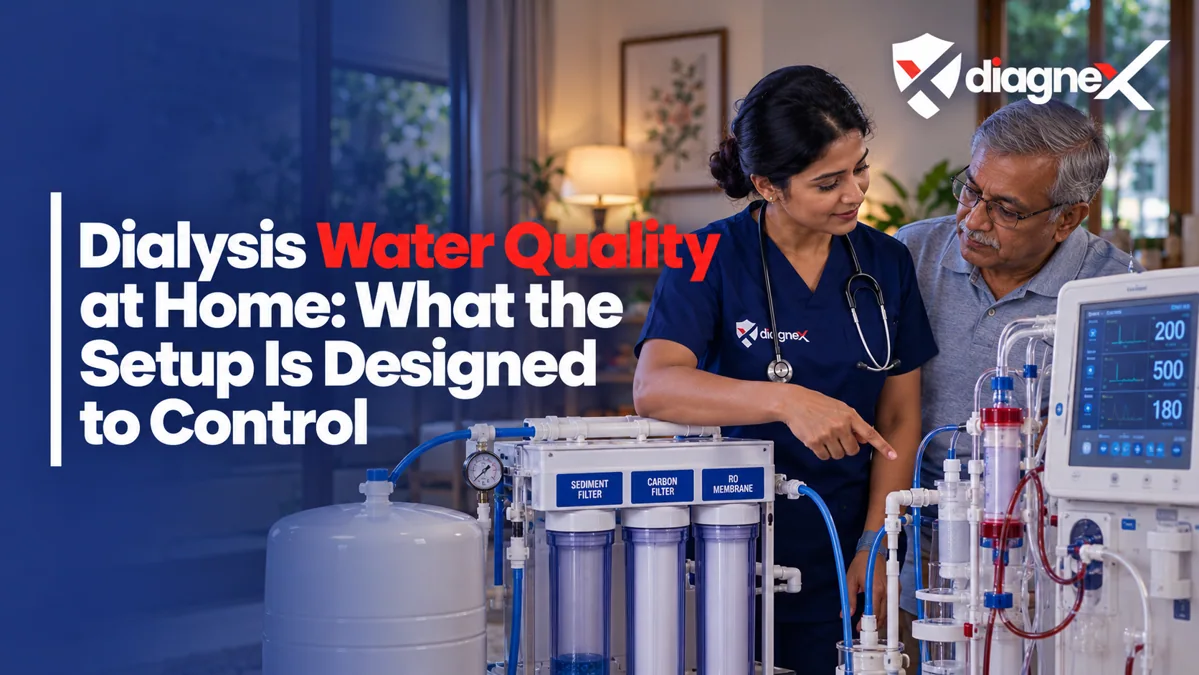
Pretreatment prepares the source water before it reaches the main reverse-osmosis stage. The exact sequence varies, but it may include sediment filtration, water softening and activated-carbon treatment.
Each stage has a different purpose. Sediment filters protect the system from particles. Softening can reduce hardness. Carbon can remove chlorine and chloramine. By controlling these upstream problems, pretreatment helps the RO membrane operate more reliably.
This layered approach is one reason the phrase “RO system” can sometimes be misleading. In dialysis, the complete water-treatment pathway may involve several components before and after the RO membrane.
What Happens After RO
After reverse osmosis, the treated water may pass directly to the dialysis machine or through additional treatment components, depending on the system. Some setups use further filtration to improve microbiological control before the water is used to prepare dialysate.
The final arrangement is machine-specific. Families should not add, remove or rearrange components simply because they have seen a different setup elsewhere.
Why Water Quality Needs Ongoing Monitoring
A water system that worked correctly on installation day still needs ongoing surveillance. Filters become exhausted, carbon performance changes, membranes age and source-water quality can vary.
This is why dialysis-water safety depends on both equipment and monitoring. Home programmes may use a combination of built-in machine checks, specified chlorine or chloramine testing, scheduled service checks and periodic chemical or microbiological testing.
The patient or caregiver is normally trained only in the checks that belong to their home programme. More specialised testing is handled by the provider or technical team. If the family is considering support at home, the Diagnex guide to home nursing explains the service pathway and its limits.
What a Water-Treatment Alarm Means
A water-treatment alarm should be treated as a safety signal, not as an inconvenience. It can indicate that pressure, conductivity, filter performance or another monitored parameter is outside the expected range.
The correct response depends on the machine. The patient or caregiver should follow the trained alarm procedure and contact the home dialysis support team when required. An alarm should not be bypassed simply because the water appears normal or because the patient wants to avoid postponing a session.
Why Source-Water Changes Matter
The water entering a home can change. Municipal authorities may alter disinfection methods, a building may switch between municipal and tanker water, storage tanks may be cleaned, or pressure and supply patterns may vary.
These changes can matter because the home dialysis water system was assessed for a particular source-water condition. A significant change may alter hardness, chlorine or chloramine exposure, chemical composition or microbiological risk.
Families should inform the home dialysis provider if the water source changes or if there is a municipal water-quality notice. They should not assume the RO system automatically makes every change irrelevant.
Stored Water and Building Tanks
Many homes receive municipal water into an underground or overhead tank before it reaches the tap. The presence of a storage tank does not automatically make a home unsuitable for dialysis, but it becomes part of the source-water pathway that needs to be understood.
Tank condition, cleaning practices and the stability of the water supply can influence source-water quality. The installer should assess the actual water reaching the dialysis equipment rather than assuming it is identical to the municipal supply at the street.
Tanker Water or an Alternative Water Source
Families should not switch to tanker water, bottled water or another alternative source without approval from the home dialysis team. An alternative source can have a different chemical and microbiological profile, even when it is marketed as safe for drinking. If the regular water supply fails, the safer approach is to follow the programme's interruption plan rather than improvising a new source for the dialysis machine.
Disinfection Is Part of Water Quality
Water-treatment components and dialysis machines can develop microbial contamination if they are not disinfected on schedule. Disinfection is therefore part of maintaining dialysis water quality, not merely routine cleaning.
The procedure may be chemical, thermal or machine-specific. Families should use only the method and products approved for their equipment. Household bleach, cleaning liquids or other products should never be substituted unless the manufacturer and home dialysis programme specifically instruct their use in a validated procedure.
Filter and Cartridge Replacement
Filters and cartridges do not last indefinitely. Sediment filters collect particles, carbon becomes exhausted, and other treatment components have defined service lives.
Replacement may be based on time, treatment volume, test results or equipment performance. The provider should give the family a clear maintenance schedule and explain which tasks are handled at home and which require a technician. Ignoring a replacement schedule can gradually reduce water-treatment performance even when the dialysis machine itself appears to be working normally.
Water Quality and the Dialysis Machine
The water-treatment system and dialysis machine should be viewed as one connected treatment pathway. Poor source-water control can affect not only the patient but also the reliability of the machine.
Scale, chemical breakthrough or microbial contamination can damage components, trigger alarms or lead to treatment interruption. Good water quality therefore supports both clinical safety and equipment reliability.
What the Family Is Usually Responsible For
The exact responsibilities differ by home dialysis programme. A patient or care partner may be trained to perform certain pre-treatment checks, recognise alarms, complete disinfection steps and report changes in the household water supply.
Technical servicing, scheduled water testing and replacement of certain components may remain the responsibility of the provider or equipment team. The safest arrangement is one where responsibilities are written down clearly. Families should not be expected to troubleshoot technical water-quality problems beyond their training.
Questions to Ask Before the Water System Is Installed
Before installation, families should understand the complete water-treatment pathway rather than hearing only that an “RO machine” will be provided. Useful questions include:
- What source water has the system been designed to use?
- Is pretreatment required before the RO unit?
- How are chlorine and chloramine controlled?
- What routine water checks will we perform at home?
- Who performs chemical and microbiological testing?
- How often are filters and cartridges replaced?
- What happens if the water system alarms?
- What should we do if the household water source changes?
Signs the Water System Needs Review
The family should contact the home dialysis support team when there is a water-treatment alarm, a failed required water test, a visible leak, repeated loss of water pressure, an unexplained change in source-water appearance or a municipal water-quality warning. A change does not necessarily mean the water is unsafe, but it should be assessed before the family assumes treatment can continue as usual.
When Treatment Should Not Proceed
Home dialysis should not proceed when the required water-safety checks have failed, a water-treatment alarm remains unresolved or the approved water source is unavailable. The patient should follow the machine-specific interruption procedure and contact the home dialysis team for guidance. If a dialysis session must be delayed or moved to another setting, that decision should follow the clinical and operational plan rather than improvisation at home.
Water Quality Is Only One Part of Home Dialysis Safety
Good dialysis water quality does not replace the other safety requirements of home hemodialysis. The treatment still depends on correct vascular-access care, hand hygiene, safe machine operation, appropriate electricity, drainage, supply storage and a clear emergency plan. Water treatment should therefore be integrated into the overall home dialysis setup rather than treated as a separate technical add-on.
How This Article Differs From General Home Dialysis Water Requirements
Home dialysis water requirements answer questions such as whether the home has enough water pressure, adequate flow, an appropriate inlet connection and drainage. Dialysis water quality focuses on what the treatment system is designed to remove or control after that source water enters the dialysis pathway.
Both questions matter. A home can have plenty of water and still need an appropriate treatment system. Conversely, an excellent water-treatment system cannot compensate for a household supply that fails to meet the machine's basic pressure, flow or source-water requirements. For care planning beyond this article, compare kidney care with the instructions already given by the treating professional.
Dialysis Water Quality at Home: Practical Checklist
Families do not need to become water-treatment engineers, but they should know whether the essential safety processes are in place. A practical review includes:
- The approved water-treatment system is installed for the selected dialysis machine
- The source-water type has been assessed
- Required home water checks are understood
- Filter and disinfection schedules are clear
- Water-treatment alarms are understood
- Source-water changes are reported
- The emergency plan for water failure is available
This checklist supports the home programme; it does not replace the machine's operating instructions or provider protocol. For dialysis water quality at home, the safest approach is to follow the programme's training and the selected equipment instructions rather than improvise at home.
The Bottom Line
Dialysis water quality at home is about controlling risks that cannot be judged by taste, smell or appearance. The home setup is designed to manage disinfectants such as chlorine and chloramine, water hardness, sediment, dissolved chemicals, microorganisms and bacterial by-products before the water is used to prepare dialysate.
Reverse osmosis is an important part of many home hemodialysis systems, but safe dialysis water usually depends on the entire treatment pathway, pretreatment, RO, additional filtration where required, monitoring, disinfection and timely maintenance. The family does not need to choose these components independently. The home dialysis provider and equipment manufacturer should define the correct system for the machine and the actual household water source, while the patient or caregiver follows the checks and maintenance responsibilities included in their training.
Frequently Asked Questions
What does dialysis water quality at home mean?
It refers to the chemical and microbiological quality of water used to prepare dialysis fluid. The water must meet the requirements of the selected dialysis system rather than simply normal drinking-water standards.
Why is drinking water not good enough for dialysis?
Drinking water can contain disinfectants, minerals, chemicals and microorganisms at levels considered acceptable for ordinary consumption. Hemodialysis creates much greater exposure through the dialysate pathway, so stricter control is required.
What does an RO system control in home dialysis?
Reverse osmosis reduces many dissolved salts, chemicals, metals and other contaminants. It usually works together with pretreatment such as sediment filtration, softening and carbon treatment.
Why is carbon treatment used in dialysis water systems?
Activated carbon is commonly used to remove chlorine and chloramine from source water before it reaches the dialysis pathway and, in many systems, before it reaches the RO membrane. This is also part of routine home dialysis safety, so any uncertainty should be clarified with the treating or home dialysis team before the next treatment.
Can I use a normal household RO purifier for home dialysis?
It should not be assumed suitable. A dialysis water system has specific flow, monitoring, chemical, microbiological, disinfection and maintenance requirements that a household drinking-water purifier may not meet.
How do I know whether home dialysis water is safe?
Safety is confirmed through the approved treatment system, required home checks, equipment monitoring and the provider's scheduled testing and maintenance programme, not by looking at, smelling or tasting the water. This detail should be confirmed with the home dialysis team because the exact process depends on the patient's machine, vascular access and prescription.
What should I do if the RO or water-treatment system alarms?
Follow the machine-specific instructions and contact the home dialysis support team when required. Do not bypass the alarm or continue treatment simply because the water appears normal.
What if my building changes to tanker water?
Tell the home dialysis provider before using the changed source. Tanker or alternative water can have a different chemical and microbiological profile and should not be connected to the dialysis setup without assessment.
This point should be confirmed with the home dialysis team because the exact process can vary by patient, machine and programme..
Related Diagnex guides
Explore Home Dialysis services, other Home Dialysis guides and Installing a Dialysis Machine at Home: What the Process Involves.
Diagnex publishes general healthcare information to support care planning. Individual decisions about diagnosis, prescriptions and treatment remain with the treating professional. Read our medical content policy and editorial standards.