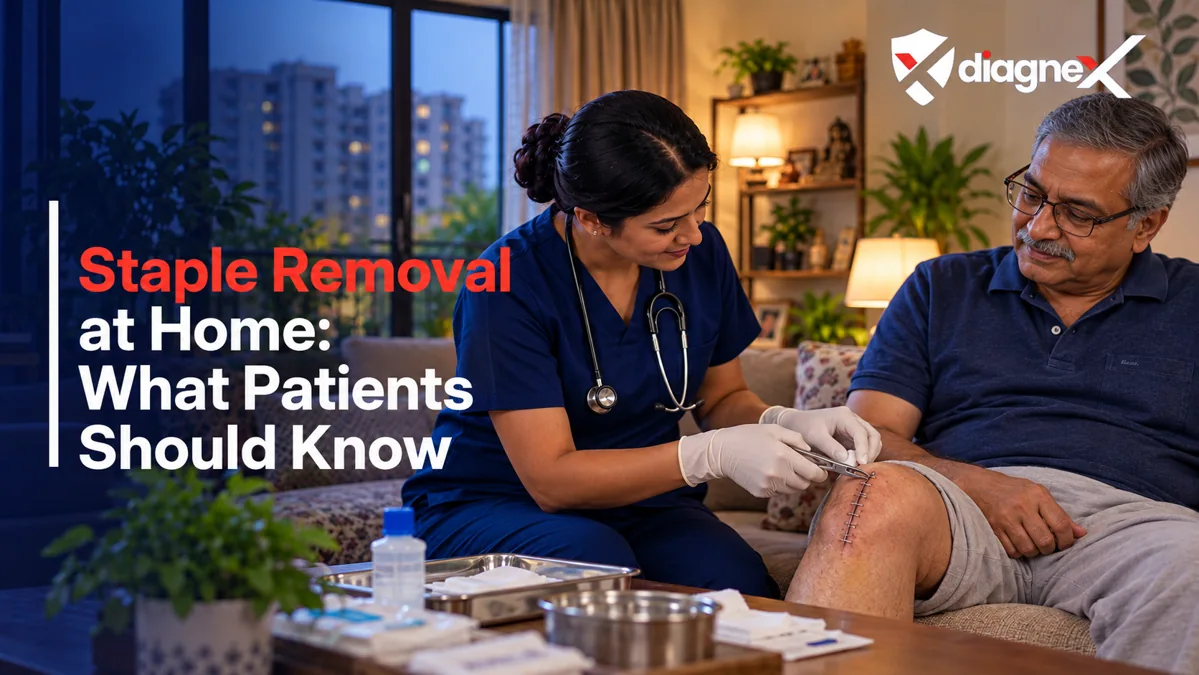
Staple removal at home can be appropriate when the wound is healing well, the treating surgeon or doctor has advised that the staples are ready to come out, and a qualified healthcare professional can assess the wound before removal.
For related context, read Injection at Home: What Patients Should Know Before Booking and Suture Removal at Home Cost: What Affects the Price?.
For related context, read Injection at Home: What Patients Should Know Before Booking and Suture Removal at Home Cost: What Affects the Price?.
Surgical staples are commonly used to close selected incisions because they can provide secure wound edge approximation. They are not the same as ordinary office staples, and they should not be removed with household tools.
A home nurse visit for clip removal should include more than the mechanical act of taking the staples out. The nurse should first check whether the wound edges are closed, whether there is redness, swelling, drainage, bleeding, or separation, and whether the planned removal timing matches the treating team's instructions.
When Is Staple Removal at Home Appropriate?
Staple removal at home may be suitable when: • the patient is clinically stable; • the treating professional has advised removal; • the wound is accessible and can be assessed properly; • the incision appears to be healing without obvious complications; • the patient has difficulty travelling after surgery; • the correct staple-removal instrument is available; • there is a clear plan for what to do if the wound does not appear ready.
Diagnex's Suture and Staple Removal service is the most directly relevant pathway when a patient has been advised to have surgical staples or non-dissolvable sutures removed at home.
What Is the Difference Between Staples, Sutures, and Clips?
Sutures use thread-like material to bring wound edges together. Staples use metal clips applied with a surgical stapling device. The term clip removal is sometimes used informally for staple removal, although surgical clips can also refer to other devices used inside the body.
For a skin wound, the important distinction is whether the closure material is external and intended to be removed. The discharge instructions should state whether the patient has staples, removable sutures, dissolvable sutures, adhesive strips, or skin glue.
If the closure type is uncertain, the patient should not attempt removal until the treating team confirms what is present.
How Long Do Surgical Staples Usually Stay In?
There is no single removal day that applies to every patient. Timing depends on the body area, operation, wound tension, blood supply, healing progress, and the surgeon's plan. For more on the practical service arrangements, review home nursing before deciding what information the care team needs.
MedlinePlus advises that the healthcare provider should tell the patient when staples need to be removed and recommends follow-up to confirm that the wound is healing properly. Some non-dissolvable closures may stay in place for several days to a few weeks depending on the wound.
The safest approach is to follow the removal date given by the surgeon or treating clinician rather than using a generic online timetable.
What Happens at the Start of the Nurse Visit?
The nurse should review the available clinical instructions before removing any staple.
Useful information includes: • date and type of surgery; • location of the incision; • planned staple-removal date; • current dressing instructions; • recent fever, redness, swelling, drainage, pain, or bleeding; • relevant medical conditions such as diabetes or poor circulation; • medicines that may affect healing or bleeding.
Patients who need broader recovery support after surgery may also benefit from Post-Operative Care at Home if wound care, mobility support, medicines, or ongoing monitoring are required.
The Wound Is Assessed Before Removal
The nurse may check: • whether the wound edges are closed; • whether there is increasing redness or warmth; • swelling; • wound drainage; • tenderness; • bleeding; • wound separation; • whether any staple appears embedded; • whether the surrounding skin is irritated.
If the wound does not appear ready, staple removal may need to be delayed or only partly completed.
How Is Staple Removal Performed?
Surgical staples are removed using a specific staple-removal device. The instrument bends the staple in a controlled way so that the ends lift out of the skin with less tissue trauma.
A typical visit may involve: • hand hygiene and preparation of a clean work area; • wound inspection; • cleaning the site if required; • placing the staple remover correctly under each staple; • removing staples one at a time; • checking the wound edges as removal progresses; • stopping if the wound starts to separate; • applying adhesive strips or a light dressing if advised; • documenting the wound after removal.
Families preparing for the visit can use the Home Clinical Procedure Safety Checklist for Families to organise the room, supplies, lighting, and access before the nurse arrives.
Does Staple Removal Hurt?
Most patients feel brief pulling, pressure, or pinching. The level of discomfort depends on the number of staples, wound location, skin sensitivity, swelling, and whether any staple has become tight or embedded.
The procedure should not be forced. If a staple is difficult to remove or causes severe pain, the nurse should reassess the area rather than continue mechanically.
What Happens if the Wound Starts to Open?
If the wound edges begin to separate during removal, the nurse may stop and leave the remaining staples in place until the treating clinician gives further instructions.
The wound may need adhesive strips, a dressing, delayed removal, or medical review depending on how much separation has occurred.
For patients who need ongoing dressing support, Diagnex's Wound Care and Dressing service may be relevant after the staple-removal visit.
Should All Staples Always Be Removed at the Same Time?
Not necessarily. In some wounds, the treating professional may advise staged removal, where selected staples are removed first and the remaining staples are left temporarily for additional support.
The decision depends on wound closure, tension, location, healing progress, and the treating plan.
Patients should not be concerned if a nurse decides not to remove every staple in one visit when the wound appears to need more support. If the family is considering support at home, the Diagnex guide to wound care at home explains the service pathway and its limits.
What Happens After Staple Removal?
After removal, the nurse should inspect the incision again.
Depending on the wound, the next step may include: • leaving the wound uncovered; • placing adhesive strips across the incision; • applying a light dressing; • continuing wound care; • arranging another review.
Even when the incision looks closed, the deeper tissues are still healing. Patients should avoid unnecessary stretching, friction, or activity that places tension across the wound until the treating team says it is safe.
How Should the Wound Be Cared for Before Removal?
Before the planned removal date, follow the surgeon's wound-care instructions.
MedlinePlus advises keeping stapled wounds clean and dry initially, gently washing around the area when permitted, and replacing dressings as directed. Patients should not rub the staples directly or pull at them.
If the patient is still receiving dressing changes, Surgical Wound Dressing at Home After an Operation provides additional guidance on post-surgical wound care.
How Should the Wound Be Cared for After Removal?
After staple removal: • keep the area clean; • avoid unnecessary rubbing or scratching; • use adhesive strips if advised; • follow bathing instructions; • avoid strenuous activity that pulls on the incision; • monitor for redness, swelling, drainage, bleeding, or reopening.
The treating surgeon's instructions should take priority because different operations and body areas have different recovery timelines.
Which Warning Signs Need Medical Review?
Contact the treating professional if there is: • increasing redness; • increasing pain; • swelling; • pus-like or foul-smelling drainage; • persistent bleeding; • fever; • new numbness or tingling; • wound separation; • staples coming out too early; • a wound that appears larger or deeper.
MedlinePlus specifically recommends medical review for redness, pain, pus, fever, persistent bleeding, numbness, wound opening, or staples that come out prematurely.
Can a Family Member Remove Surgical Staples?
It is safer for staple removal to be performed by an appropriately trained healthcare professional unless the treating clinician has explicitly advised otherwise.
Family members may not be able to judge whether the wound is ready, whether every staple has been removed completely, or whether wound separation is beginning.
Household pliers, scissors, tweezers, or other improvised tools should never be used for clip removal.
When Is Home Nursing More Appropriate Than a Single Visit?
A single staple-removal visit may be enough for a patient whose only remaining need is closure removal. Ongoing nursing may be more suitable when the patient also needs repeated wound dressing, medicines, monitoring, catheter care, mobility support, or post-surgical assistance.
In these situations, Home Nursing Services may be more practical than arranging each procedure separately.
How to Prepare for the Staple Removal Visit
Before the nurse arrives: • keep the discharge summary and removal instructions ready; • choose a clean and well-lit area; • ensure the wound can be accessed comfortably; • keep pets and unnecessary visitors away; • do not remove the staples yourself; • do not apply creams or antiseptics unless advised; • tell the nurse about any fever, drainage, swelling, bleeding, or increasing pain.
If the procedure forms part of a wider home-treatment plan, Clinical Procedures at Home may be the relevant service category. For care planning beyond this article, compare surgery dressing at home with the instructions already given by the treating professional.
How to Arrange Staple Removal at Home With Diagnex
To arrange staple removal at home, share the surgery details, incision location, removal date advised by the treating team, current wound condition, locality, and whether dressing support is also required.
Diagnex can review the requirement and route the enquiry to the appropriate professional and service pathway based on the procedure, locality, wound condition, and available clinical information.
For booking and service coordination, use the Diagnex Contact page.
Frequently asked questions
Can surgical staples be removed at home?
Yes, selected surgical staples can be removed at home when the treating team has advised removal, the wound is healing appropriately, and a qualified professional is available.
Does staple removal require a special tool?
Yes. Surgical staples are removed using a dedicated staple-removal device designed to bend and lift the staple safely from the skin.
Can a nurse leave some staples in place?
Yes. If the wound needs additional support, some staples may be left temporarily and removed later according to the clinical plan.
What if the wound is red or draining before removal?
The wound should be reviewed before routine removal. Increasing redness, pus-like drainage, swelling, pain, or fever may indicate infection or poor healing.
Can the wound reopen after the staples are removed?
Yes, especially if healing is incomplete or the incision is under tension. Wound assessment before and during removal helps reduce this risk.
Can I remove a loose staple myself?
No. A loose or displaced staple should be assessed by a healthcare professional rather than pulled out at home.
References and further reading
This article provides general education and does not replace the removal instructions provided by the treating surgeon or clinician. Clinical points were cross-checked against current MedlinePlus guidance on sutures, staples, and closed surgical wound care.
Related Diagnex services and guides
Explore the Clinical Procedures service pathway and the Clinical Procedures article library for more information.
Diagnex publishes general healthcare information to support care planning. Individual decisions about diagnosis, prescriptions and treatment remain with the treating professional. Read our medical content policy and editorial standards.