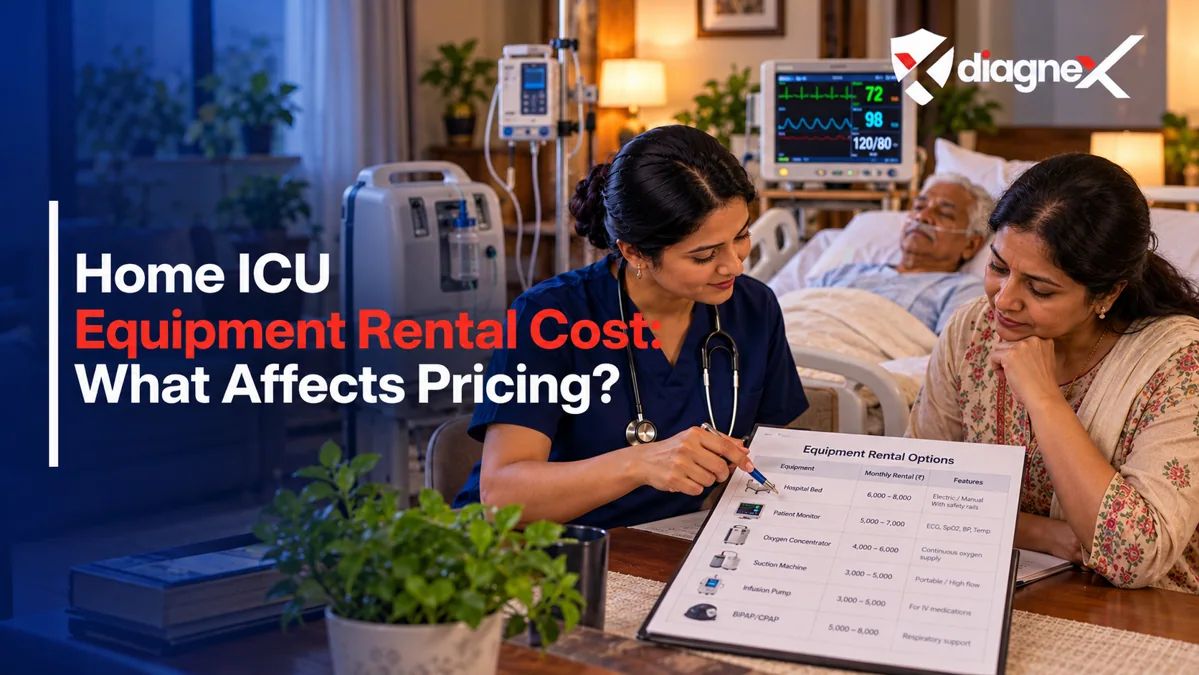
Home ICU equipment rental cost depends on much more than the name of the machine. The same type of equipment can cost differently depending on rental duration, city, model, clinical specification, availability, delivery, installation, deposits, service support, consumables and whether backup equipment is required.
For related context, read Home ICU vs Hospital ICU Cost: What Should Families Compare? and Home ICU Cost in India: What Determines the Price?.
For related context, read Home ICU vs Hospital ICU Cost: What Should Families Compare? and Home ICU Cost in India: What Determines the Price?.
For families, this means a quoted monthly rental is only one part of the real cost of using medical equipment at home.
Diagnex's current public Home ICU estimator lists separate 15-day and 30-day rental rates for several commonly used devices and confirms that exact availability, delivery, setup, deposits, GST and purchase-item pricing are finalised in the quotation. The examples in this article use the Kolkata selection only to explain how rental pricing works. They are not universal India-wide tariffs and not patient-specific quotations.
Why Home ICU Equipment Rental Prices Vary
Medical equipment rental is affected by several practical and clinical variables at the same time.
A manual hospital bed is simpler to supply and maintain than an invasive ventilator. A device used for 30 days may have a lower effective daily cost than the same device rented for 15 days. A ventilator-dependent patient may need technical backup and spare supplies that a bed-rental patient does not.
The correct way to compare prices is therefore device by device, with the rental period and included support clearly stated.
Rental Duration Is One of the Biggest Pricing Factors
Diagnex currently displays 15-day and 30-day rates rather than a universal one-day rate.
Longer rental periods can have a lower effective daily cost because delivery, allocation and service costs are spread over more days.
For example, the current Kolkata estimator lists a manual hospital bed at ₹2,000 for 15 days and ₹3,000 for 30 days. The 15-day plan works out to about ₹133 per day, while the 30-day plan works out to ₹100 per day.
That does not mean a one-day rental would necessarily cost ₹100. Shorter plans require a separate quotation.
The Same Pattern Applies to Higher-Cost Equipment
A ventilator in the current Kolkata estimator is listed at ₹25,000 for 15 days and ₹40,000 for 30 days.
Those amounts work out to effective daily equivalents of about ₹1,667 and ₹1,333 respectively.
This illustrates why families should compare the total rental period rather than simply multiplying a monthly rate backward into a short stay.
City and Locality Can Change the Rental Quote
Medical equipment rental is operationally local.
The Home ICU estimator currently asks families to select Mumbai, Navi Mumbai, Kolkata or Howrah before viewing rates. Local pricing can reflect stock availability, delivery distance, service coverage and the practical difficulty of installation.
A quote from one city should not automatically be treated as the rate for another city or even every locality within the same city.
Equipment Model and Specification Can Affect Price
Two devices in the same broad category may not be equivalent.
Hospital beds can be manual or automatic. Monitors can differ in parameters, screen size and alarm capability. Oxygen concentrators can differ in flow capacity. Ventilators and BiPAP devices can differ in features, modes, battery capability and intended use.
If a provider quotation changes after the exact model is selected, that does not necessarily mean the pricing is inconsistent. The clinical specification may have changed.
The Prescription Requirement Can Affect What Can Be Rented
Some equipment cannot be selected purely as a consumer preference.
Diagnex marks oxygen concentrators, oxygen cylinders, BiPAP, CPAP and suction as prescription-based items, and states that ventilators and infusion pumps are arranged after clinical assessment.
This protects the patient from receiving the wrong device simply because it appears cheaper.
Medical Equipment on Rent explains why the device, model and setup need to match the treating professional's instructions and the home environment.
Hospital Bed Rental Cost Depends on Manual vs Automatic
The current Kolkata 30-day estimator lists: • manual hospital bed: ₹3,000 for 30 days; • automatic hospital bed: ₹12,000 for 30 days.
For 15 days, the displayed rates are ₹2,000 and ₹8,000 respectively.
The difference reflects the type of bed and functionality. Families should choose based on positioning and transfer needs rather than assuming that the higher-priced option is automatically necessary.
Multiparameter Monitor Rental Adds a Separate Equipment Cost
The current Kolkata estimator lists a cardiac or multiparameter monitor at ₹9,000 for 30 days and ₹6,000 for 15 days. For more on the practical service arrangements, review medical equipment on rent before deciding what information the care team needs.
Continuous monitoring can be useful for selected high-dependency patients, but it should not be rented automatically for every post-discharge patient.
If the treating team only requires scheduled observations, simpler monitoring may be sufficient and less expensive.
Oxygen Concentrator Rental Is Only Part of the Oxygen Budget
The current Kolkata estimator lists an oxygen concentrator at ₹3,000 for 30 days and ₹2,000 for 15 days.
The full cost of oxygen therapy can also include electricity, masks or nasal cannulas, backup cylinders and cylinder refills.
A low concentrator rental does not therefore represent the total cost of long-term oxygen support.
Oxygen Cylinders Have Rental and Refill Components
A 10 kg oxygen cylinder is currently listed at ₹1,800 for 30 days and ₹1,000 for 15 days in the Kolkata estimator.
A cylinder stand or trolley is listed separately at ₹700 for 30 days and ₹500 for 15 days.
Refill pricing is not displayed as a fixed public amount and is confirmed in the quotation. Families with high oxygen use should ask specifically about refill frequency and expected refill cost.
BiPAP Rental Cost Is Different From Ventilator Rental Cost
The current Kolkata estimator lists BiPAP at ₹4,000 for 30 days and ₹2,500 for 15 days.
A ventilator is listed at ₹40,000 for 30 days and ₹25,000 for 15 days.
The large price difference reflects very different equipment and care requirements. BiPAP and invasive ventilation are not substitutes chosen by price. The treating respiratory team decides which form of support is clinically appropriate.
CPAP Has a Separate Rental Rate
CPAP is currently listed at ₹3,500 for 30 days and ₹2,000 for 15 days in the Kolkata estimator.
CPAP is not interchangeable with BiPAP or a ventilator.
Families should avoid selecting a device based on the cheapest rate when the prescribed therapy is different.
Ventilator Rental Has Additional Costs Around the Machine
A ventilator is usually the largest single rental item in a Home ICU equipment list.
The current Kolkata rate of ₹40,000 for 30 days covers the displayed equipment rental, not the full ventilator-care pathway.
A ventilator-dependent patient may also need suction, respiratory circuits, filters, oxygen backup, battery or power backup, trained nursing and rapid technical support.
The British Thoracic Society's current model for complex home mechanical ventilation emphasises the service infrastructure, staffing and patient pathway needed around long-term home ventilation.
Suction Machine Rental Is Usually a Smaller Line Item
The current Kolkata estimator lists a suction machine at ₹3,000 for 30 days and ₹2,000 for 15 days.
Suction catheters and other disposable supplies may be charged separately.
The machine should only be added when the patient's airway or secretion-management plan requires it.
Infusion Pump Rental Is Another Distinct Cost
A syringe or infusion pump is currently listed at ₹4,500 for 30 days and ₹3,000 for 15 days.
The device can also require syringes, tubing and prescribed medicines.
Diagnex states that infusion pumps are arranged after clinical assessment, which means the rental should follow the treatment plan rather than be added as a generic Home ICU item.
Small Equipment Can Still Add Up
The current Kolkata estimator lists an IV stand at ₹800 for 30 days and ₹500 for 15 days.
An oxygen cylinder stand or trolley is another smaller line item.
Individually, these costs are modest. Together with several larger devices, however, they contribute to the total equipment rental bill.
Equipment-Only Rental Can Be Much Lower Than the Full Home ICU Cost
Using the current Kolkata 30-day rates as an illustration, a manual bed, monitor, oxygen concentrator, suction machine and IV stand total ₹18,800 for the rental period.
That figure is equipment only.
It does not include nursing, doctor visits, physiotherapy, consumables, medicines, delivery, setup, deposits or GST.
ICU Setup at Home Cost: Equipment, Nursing and Support explains how those non-equipment costs can change the full Home ICU budget.
A Ventilator-Based Equipment Stack Can Be Much Higher
Using the same public rates, an automatic bed, monitor, ventilator, oxygen concentrator, suction machine, infusion pump and IV stand total ₹72,300 for 30 days.
This is still an equipment-only subtotal.
Once 24-hour critical-care nursing, respiratory consumables, backup power and clinical support are added, the complete care cost can be much higher.
Delivery and Installation Can Affect the Final Rental Cost
Equipment rental does not always end with the displayed device rate.
Diagnex's public estimator states that delivery and setup are confirmed in the quotation.
The cost can be influenced by access to the home, distance, equipment size, stairs, lift access and how much on-site assembly is required.
Families should ask for the complete delivered and installed amount rather than comparing equipment rates alone.
Security Deposits Affect Upfront Cash Flow
Some rented medical equipment may require a refundable deposit.
Diagnex confirms any deposit in the final quotation rather than displaying one fixed deposit amount online.
A deposit is not the same as rental expense if it is fully refundable, but it still changes how much money the family needs when the setup starts.
GST Can Change the Final Payable Amount
The current public Home ICU estimator states that the displayed estimate excludes GST.
Families should therefore compare post-tax totals rather than only the listed equipment rate.
The quotation should show which items are taxable and the final payable amount.
Purchase Price and Rental Price Should Not Be Confused
The estimator allows families to request purchase pricing for selected items but does not publish one fixed purchase rate.
Diagnex states that purchase prices depend on model and availability and are confirmed in the quotation.
That makes sense because buying and renting solve different problems. Rental suits temporary or changing needs, while purchase may be considered for stable long-term requirements.
Renting Often Makes Sense When Recovery Duration Is Uncertain
After hospital discharge, families may not know whether a device will be needed for two weeks, one month or several months.
Rental avoids a large upfront purchase and makes it easier to return or change equipment when the treating team updates the care plan.
It can be especially practical for beds, monitors, oxygen concentrators and short-term respiratory support. If the family is considering support at home, the Diagnex guide to home nursing explains the service pathway and its limits.
Buying May Become More Attractive for Long-Term Stable Needs
If a device is likely to be used continuously for many months, purchase can become worth comparing with rental.
The comparison should include maintenance, servicing, breakdown support, replacement and the risk that the patient's clinical need changes.
A low purchase price does not automatically make ownership cheaper over the full period.
Maintenance Support Can Affect the Value of a Rental
Two rental quotes can have different value even when the device rate is similar.
Families should ask who maintains the equipment, how faults are reported, what happens if a device stops working and how quickly a replacement can be arranged.
For respiratory equipment, maintenance and support are part of safe long-term use. NICE's public guidance on home non-invasive ventilation specifically includes equipment and maintenance arrangements as part of the care plan.
Replacement Support Matters More for Life-Support Equipment
The consequence of a hospital bed motor failing is very different from the consequence of a ventilator failing.
The more essential the device is to breathing or medication delivery, the more important backup and replacement arrangements become.
A higher rental quote may sometimes include service capability that is not visible in the headline price. Families should ask for this in writing rather than assuming every provider offers the same support.
Backup Equipment Can Add Cost
A ventilator-dependent or oxygen-dependent patient may need backup oxygen, spare circuits, battery support or another contingency arrangement.
These items can increase the rental or purchase bill.
The need should be determined by the patient's dependency and the likely consequence of equipment failure.
Power Backup Is a Separate Cost for Some Homes
An oxygen concentrator, ventilator, suction machine and infusion pump all rely on electricity.
The family may need an inverter, battery or generator arrangement that is not part of the medical-equipment rental quote.
Home readiness can therefore affect the true cost of using rented equipment safely.
Home Access Can Affect Delivery Cost
Large equipment such as an automatic bed may be harder to deliver into buildings with narrow stairs, small lifts or restricted access.
The provider may need extra labour or special handling.
Families should share access details before delivery so the quotation and setup plan are realistic.
Availability Can Affect Which Model Is Quoted
Medical equipment stock changes over time.
A provider may have one model available in one city and another model in a different locality or week.
Diagnex's public pages state that exact service availability is confirmed for the locality and care requirement, so families should treat the displayed estimator as a planning tool rather than a guaranteed inventory list.
Short Extensions Should Be Clarified Before the Rental Starts
A patient may need the equipment longer than expected.
Families should ask how extensions are priced, whether the existing 15-day or 30-day rate rolls forward, and whether another minimum rental period applies.
This is especially important for expensive equipment such as ventilators and automatic beds.
Early Return Terms Can Affect the Effective Cost
The opposite situation also happens: the patient improves faster than expected.
Before accepting a rental, families should ask whether unused days are refundable or whether the full plan amount remains payable.
A lower 30-day daily equivalent may not save money if the device is only required for ten days and the provider does not refund the unused period.
Consumables Are Usually Separate From Equipment Rental
Masks, nasal cannulas, suction catheters, ventilator circuits, HME or bacterial filters, syringes, gloves and dressing kits are supplies rather than durable equipment.
Diagnex lists these separately under supplies and consumables, with pricing confirmed in the quotation.
A respiratory patient can therefore have a modest device rental but a higher monthly supply cost.
Cleaning and Infection-Control Requirements Can Affect Service Costs
Reusable medical equipment needs appropriate cleaning and preparation before it is supplied to another patient.
Families should ask whether the rental rate includes standard servicing and preparation and what cleaning responsibilities remain with the household during use.
The answer can differ by device, especially when masks, circuits, humidification systems or suction accessories are involved.
Brand-New and Refurbished Equipment Should Be Clarified
Rental equipment does not necessarily mean brand-new equipment.
A professionally serviced rental device may be reused between patients, while some supplies must be new and single-patient use.
Families should ask about device condition, service history, calibration where relevant and which accessories are new.
The Age of Equipment Is Less Important Than Suitability and Support
A newer machine is not automatically safer if it is the wrong model, poorly maintained or unsupported.
A slightly older device that is correctly specified, serviced, tested and supported can be more appropriate.
The most useful questions are whether the device matches the prescription, is functioning correctly and can be supported if something goes wrong.
Rental Pricing Should Not Override Clinical Suitability
Families should never choose a cheaper oxygen device, BiPAP, ventilator or monitor if it does not meet the treating team's requirement.
What Is Included in a Home ICU Package? explains how equipment is only one part of the broader care plan. For care planning beyond this article, compare bedridden patient care at home with the instructions already given by the treating professional.
The correct device is the one that safely fits the patient's prescribed support needs.
Equipment Rental and Home ICU Monthly Cost Are Different Questions
Monthly Cost of a Home ICU: A Practical Budget Guide looks at nursing, professional visits, rehabilitation, consumables, medicines and other monthly expenses in addition to equipment.
Equipment rental cost is narrower.
A family can have relatively low equipment rental but a high total Home ICU bill if 24-hour critical-care nursing is required.
Per-Day Cost and Rental Cost Are Also Different
ICU at Home Cost per Day: What Is Usually Included? explains how 15-day and 30-day package rates can be converted into effective daily equivalents for budgeting.
Those daily equivalents are not necessarily one-day rental tariffs.
For equipment comparisons, always use the actual quoted plan length.
The Broader India Cost Guide Helps Explain Non-Equipment Costs
Home ICU Cost in India: What Determines the Price? looks beyond equipment to staffing, clinical support, city, duration and insurance.
Families should use that broader view when trying to understand the final household budget.
Equipment rental is important, but it is only one component of critical care at home.
How to Compare Two Equipment Rental Quotations
Compare: • exact device and model; • clinical specification; • rental period; • city and delivery location; • delivery and installation; • GST; • deposit; • maintenance; • fault support; • replacement policy; • backup equipment; • included accessories; • consumables; • extension terms; • early-return terms.
A lower device price can be misleading when several of these items are excluded.
A Practical Medical Equipment Rental Checklist
Before renting, confirm: • What exact equipment has the treating team advised? • Is a prescription or clinical assessment required? • What model will be supplied? • Is the rate for 15 days, 30 days or another period? • Is delivery included? • Is installation included? • Is GST included? • Is there a refundable deposit? • Who maintains the equipment? • What happens if it fails? • How quickly can a replacement be arranged? • Is backup equipment required? • Which accessories are included? • Which consumables are separate? • What happens if the rental is extended? • What happens if the equipment is returned early?
How to Get a Home ICU Equipment Rental Quote From Diagnex
Share the equipment requested, treating-professional advice where relevant, expected rental duration, city or locality, delivery access and any practical details such as space and power.
Diagnex can review the requested equipment against the care need, confirm prescription or assessment requirements, check availability and provide the quotation with delivery, setup, deposits, GST and purchase options where relevant.
For a patient-specific equipment quotation, use the Diagnex Contact page.
Frequently asked questions
How much does Home ICU equipment rental cost?
There is no single equipment-rental price. Cost depends on the device, model, rental period, city, delivery, deposits and support requirements. Current Diagnex Kolkata examples range from ₹700 for a 30-day oxygen-cylinder trolley to ₹40,000 for a 30-day ventilator rental.
Is a 30-day equipment rental cheaper per day than a 15-day rental?
Often it can be. For example, the current Kolkata ventilator rates are ₹25,000 for 15 days and ₹40,000 for 30 days, giving a lower effective daily cost on the longer plan. The actual rate for any other duration should still be quoted directly.
Are delivery and setup included in the displayed rental price?
Not necessarily. Diagnex's public estimator states that delivery and setup are confirmed in the final quotation.
Is GST included in Home ICU equipment rental prices?
Diagnex's current estimator states that the displayed estimate excludes GST. The final quotation confirms the payable amount.
Do rented ventilators include nursing?
No automatic assumption should be made. Equipment rental and nursing are separate components unless a quotation specifically bundles them. Ventilator-dependent patients may require critical-care-experienced nursing in addition to the machine.
Are masks, circuits and suction catheters included in equipment rental?
They may be separate consumables. Diagnex lists masks, suction catheters, ventilator circuits and filters under supplies rather than durable rental equipment, with pricing confirmed in the quotation.
Is renting better than buying medical equipment?
Rental is often practical for temporary or uncertain care needs. Buying may be worth considering for stable long-term use, but maintenance, service support and the possibility that the patient's needs change should be included in the comparison.
Pricing and Clinical Note
All Diagnex rental figures in this article are based on the publicly displayed Kolkata 15-day and 30-day Home ICU estimator rates available when this article was prepared. They are planning examples, not fixed India-wide tariffs or patient-specific quotations.
Diagnex's public information states that exact availability is confirmed for the locality and care requirement, and that GST, delivery, setup, any deposit and prices for purchase items are confirmed in the quotation.
Clinical safety points around complex home ventilation were cross-checked against the current British Thoracic Society Model of Care for Complex Home Mechanical Ventilation. The importance of equipment and maintenance arrangements within a home non-invasive ventilation care plan was also cross-checked against current NICE public guidance.
Related Diagnex services and guides
Explore the Home ICU service pathway and the Home ICU article library for more information.
Diagnex publishes general healthcare information to support care planning. Individual decisions about diagnosis, prescriptions and treatment remain with the treating professional. Read our medical content policy and editorial standards.