Comparing home ICU cost vs hospital ICU cost is not as simple as comparing one daily room charge with one monthly equipment package.
For related context, read Home ICU vs Hospital ICU: What Families Should Compare and Home ICU After Brain Injury: What Families Need to Plan.
For related context, read Home ICU vs Hospital ICU: What Families Should Compare and Home ICU After Brain Injury: What Families Need to Plan.
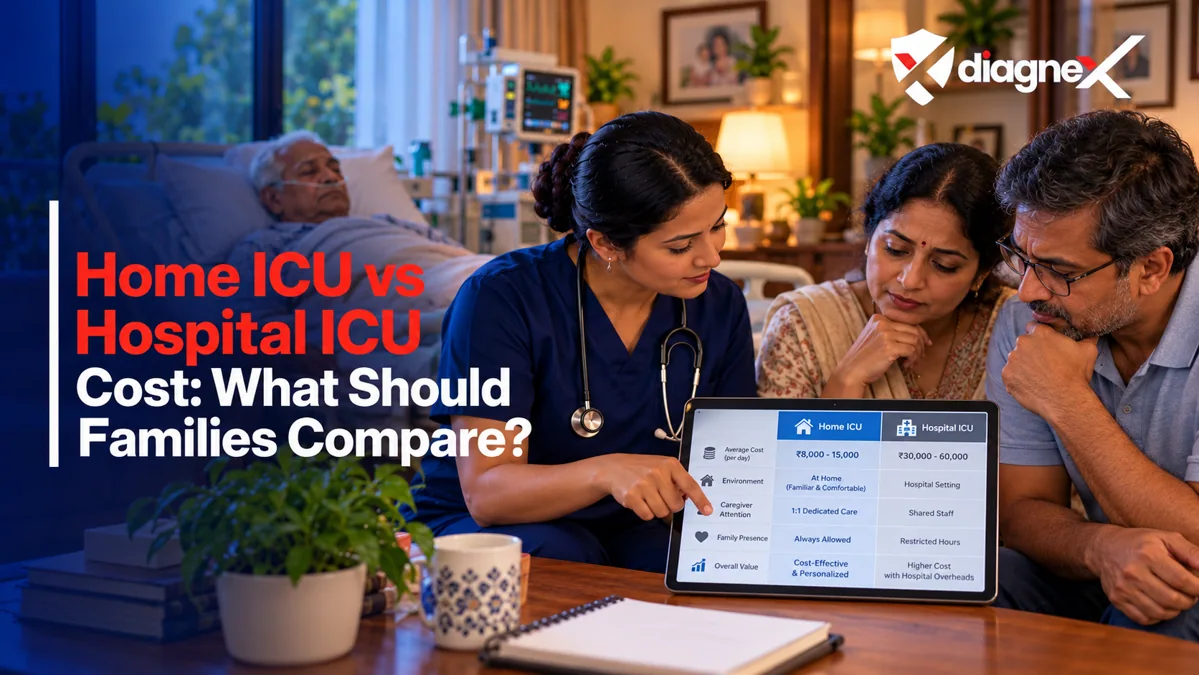
A hospital ICU bill can include the critical-care bed, nursing, intensivist and specialist fees, oxygen or ventilation, medicines, diagnostics, procedures, blood products, consumables and other hospital services. A Home ICU bill is usually assembled differently, with separate charges for nursing, rented equipment, doctor visits, physiotherapy, oxygen, consumables, delivery, setup, backup systems and sometimes emergency transport.
That difference in billing structure is why the question "Is Home ICU cheaper than hospital ICU?" does not have one universal answer.
For selected medically stable patients who need predictable long-term high-dependency care, Home ICU can have a lower or more controllable cost structure. For an unstable patient who still needs rapid diagnostics, multiple specialists, emergency procedures or escalating organ support, hospital ICU is not only clinically safer but may also be the only realistic setting regardless of cost.
Start by Comparing the Same Level of Care
The first mistake families make is comparing two unlike services.
A Home ICU with a hospital bed, oxygen concentrator and 12-hour nurse should not be compared with the total bill for a hospital ICU patient receiving invasive ventilation, repeated imaging, several specialist consultations and emergency procedures.
The comparison only becomes meaningful when both sides are adjusted for what the patient actually needs.
The existing Home ICU vs Hospital ICU: What Families Should Compare guide explains the clinical differences between the two settings. This article focuses specifically on the money behind those differences.
Hospital ICU and Home ICU Are Different Care Systems
A hospital ICU is built for unstable patients who may deteriorate rapidly and need immediate intervention.
It provides continuous access to critical-care staff, emergency airway management, advanced monitoring, laboratory services, imaging, blood products, dialysis, procedures and multiple specialist teams.
Apollo's current critical-care information for its Mumbai hospital describes multidisciplinary ICUs with advanced monitoring systems and life-support technologies. Its Delhi patient guide also notes round-the-clock intensivist presence in ICU areas.
Home ICU can reproduce selected bedside capabilities for appropriate patients, but it cannot reproduce the full hospital infrastructure.
Why the Hospital ICU Bed Charge Is Not the Hospital ICU Bill
Families sometimes hear a hospital ICU bed or room rate and treat that number as the expected daily bill.
That can be misleading.
Published hospital tariff structures commonly separate critical-care bed or nursing charges from ICU consultation, oxygen or ventilation, investigations, procedures and other services. Manipal Hospitals' publicly available inpatient tariff is one example of a hospital price list that separates several of these components.
The total hospital ICU cost therefore depends on much more than the bed category.
Why a Home ICU Equipment Quote Is Not the Home ICU Bill
The same problem exists at home.
A quote for a bed, oxygen concentrator or ventilator does not include the full care system around the patient.
Home ICU may also require nursing, doctor visits, physiotherapy, oxygen refills, suction supplies, ventilator circuits, filters, infusion equipment, medicines, laboratory testing, delivery, setup, power backup and ambulance transfer if the patient deteriorates.
The Home ICU service page separates these categories so families can build a more realistic estimate.
The Best Comparison Is Total Cost of the Required Care
A useful comparison asks what it will cost to safely deliver the patient's actual care for the next one, two or four weeks.
That means comparing: • required nursing coverage; • respiratory support; • monitoring; • doctor and specialist review; • medicines; • consumables; • diagnostics; • procedures; • rehabilitation; • emergency support; • transport; • backup systems; • taxes and deposits where applicable.
A headline room rate or equipment rental rate cannot answer that question by itself.
Current Home ICU Pricing Can Be Built From Individual Components
Diagnex's current public Home ICU estimator uses city-specific 15-day and 30-day rates rather than one national package.
With Kolkata selected for 30 days, the estimator currently lists examples such as: • manual hospital bed: ₹3,000; • automatic hospital bed: ₹12,000; • multiparameter monitor: ₹9,000; • oxygen concentrator: ₹3,000; • BiPAP machine: ₹4,000; • suction machine: ₹3,000; • syringe or infusion pump: ₹4,500; • ventilator: ₹40,000.
These figures are useful for understanding Home ICU cost structure, but they are not universal India prices and they do not include every cost of care.
Nursing Can Be the Largest Home ICU Cost
Equipment is often not the biggest recurring cost.
The same current Kolkata estimator lists trained nursing at ₹45,000 for a 12-hour shift over 30 days and ₹75,000 for 24-hour cover. Critical-care-experienced nursing is listed at ₹60,000 for 12-hour cover and ₹90,000 for 24-hour cover.
Home Nursing may be relevant when families are comparing general skilled nursing with higher-acuity critical-care staffing.
A ventilator-dependent patient can therefore have a much higher Home ICU bill because the machine and the staffing both increase. For more on the practical service arrangements, review medical equipment on rent before deciding what information the care team needs.
Illustrative Home ICU Scenario 1: Lower-Acuity Step-Down Care
Using the current Kolkata 30-day estimator only as an illustration: • manual hospital bed: ₹3,000; • multiparameter monitor: ₹9,000; • oxygen concentrator: ₹3,000; • suction machine: ₹3,000; • trained 12-hour nursing: ₹45,000.
The subtotal is ₹63,000 for 30 days.
This is not a standard package and not a patient-specific quotation. It excludes GST, delivery, setup, deposits, consumables, medicines, doctor visits, physiotherapy and tests.
Illustrative Home ICU Scenario 2: Ventilator-Dependent Care
Using the same current estimator: • automatic hospital bed: ₹12,000; • multiparameter monitor: ₹9,000; • ventilator: ₹40,000; • oxygen concentrator: ₹3,000; • suction machine: ₹3,000; • syringe or infusion pump: ₹4,500; • critical-care-experienced 24-hour nursing: ₹90,000.
The subtotal is ₹1,61,500 for 30 days before GST and the other excluded costs.
This shows why Home ICU cannot be described as one low-cost service. High-acuity home care can still be expensive.
Why There Is No Responsible Single Hospital ICU Cost for India
Hospital ICU charges vary by city, hospital, specialty, room category, level of organ support, investigations, medicines and complications.
Even within one hospital, the bill can change sharply if a patient moves from oxygen to invasive ventilation, needs dialysis, develops sepsis, undergoes a procedure or requires repeated imaging.
For that reason, a national "hospital ICU cost per day" figure can be more misleading than useful.
The most reliable hospital number is a current written estimate from the hospital for the patient's actual level of care, followed by the itemised bill.
Hospital Costs Can Rise Quickly With New Diagnostics
One major financial difference is access to rapid diagnostics.
A hospital ICU can order repeated blood tests, arterial blood gases, cultures, X-rays, CT scans, ultrasound, echocardiography and other investigations as the patient's condition changes.
That capability is clinically important, but it also adds to the bill.
At home, routine blood collection may be possible, but urgent advanced imaging or hospital-only diagnostics usually require transfer.
Hospital Costs Can Rise With Procedures and Organ Support
Hospital ICU may include procedures that Home ICU cannot safely provide.
Examples can include emergency intubation, central venous access, dialysis, chest-drain insertion, bronchoscopy, surgery, blood transfusion and other invasive procedures.
If the patient is likely to need these interventions, comparing only the Home ICU price can create a false impression of savings because the patient may ultimately require repeated hospital transfer anyway.
Hospital Specialist Fees Can Add to the Total
Critically ill patients may be reviewed by intensivists, cardiologists, pulmonologists, neurologists, surgeons, nephrologists, infectious-disease specialists and other teams.
Hospital tariffs may separate ICU consultation and cross-consultation fees from room or bed charges.
At home, medical oversight may involve fewer scheduled doctor visits, teleconsultation or communication with the existing treating team, which changes the cost structure.
Medicines Can Be a Large Cost in Either Setting
Antibiotics, anticoagulants, insulin, sedation, nebulised medicines, pain medicines and other treatments can add substantially to both home and hospital costs.
The difference is often how they are billed.
Hospital medicines may appear within the inpatient account, while Home ICU quotations frequently exclude medicines unless specifically stated.
Families should compare treatment costs separately from room, equipment and staffing costs.
Consumables Can Be Significant in Both Settings
Suction catheters, syringes, dressings, ventilator circuits, masks, filters, gloves, feeding supplies and catheter supplies can accumulate over time.
A hospital bill may include these as inpatient consumables.
A Home ICU provider may bill them separately according to use.
A fair comparison should include the expected monthly or weekly consumable burden in both settings.
Ventilation Changes Both Home and Hospital Cost
Mechanical ventilation increases the complexity of care in either setting.
At home, it adds ventilator rental, critical-care nursing, suction, respiratory consumables, oxygen planning, backup power and emergency support.
In hospital, invasive ventilation can add ventilator charges, more intensive monitoring and potentially more investigations and procedures.
The machine itself is only one cost component.
BiPAP and Oxygen Also Need Like-for-Like Comparison
A patient receiving BiPAP and oxygen at home should be compared with the hospital cost of supporting the same respiratory need, not with a stable ward patient.
Similarly, a patient who only needs low-flow oxygen and one nursing shift at home should not be compared with the bill for an unstable ventilated ICU patient.
Cost comparison is most useful after the required respiratory support is defined.
Doctor Availability Is a Major Structural Difference
Hospital ICU has medical staff immediately available within the hospital system.
Home ICU usually relies on scheduled visits, the treating doctor, teleconsultation and escalation to emergency services or hospital when needed.
That difference can reduce routine professional costs at home, but it also limits what can be safely managed outside hospital.
The cost advantage of home care therefore depends on the patient being stable enough not to need continuous on-site medical intervention.
Emergency Capability Has Financial Value Even When It Is Not Used
Hospital ICU charges support more than the care delivered in a single hour.
The hospital maintains resuscitation teams, diagnostic departments, blood bank access, pharmacy, operating theatres, specialist coverage and emergency equipment that may never be needed by one particular patient.
Home ICU does not carry that same infrastructure overhead.
This is one reason hospital and home prices should not be judged as though they were identical products.
Home ICU Can Be More Cost-Efficient for Predictable Long-Term Care
Home ICU may become financially attractive when the acute crisis has passed and the patient needs stable, predictable support for several weeks or months.
Examples can include selected patients on stable oxygen or long-term ventilation, patients recovering after a prolonged ICU stay, or patients needing ongoing skilled nursing and rehabilitation without repeated emergency intervention.
The longer the care remains predictable, the easier it becomes to plan staffing and equipment costs.
Home ICU Can Become Expensive When the Patient Is Highly Dependent
Twenty-four-hour critical-care nursing, ventilation, multiple infusion pumps, high consumable use, frequent doctor visits and backup equipment can create a substantial monthly bill.
If the patient also requires repeated hospital transfers, imaging or procedures, the total cost of the home-plus-hospital pathway can rise further.
Home ICU is therefore not automatically the cheapest option.
Hospital ICU Can Be Financially Rational When the Patient Is Unstable
If the patient is likely to need immediate diagnostics, specialist intervention or escalating organ support, hospital ICU can be the more efficient setting because all of those services are already available within one system.
Trying to maintain a complex home setup while repeatedly transferring the patient back to hospital can create duplicate expenses.
Clinical appropriateness should therefore come before any assumption about savings.
Length of Stay Changes the Comparison
A short hospital ICU stay followed by step-down Home ICU is a very different financial pathway from four uninterrupted weeks in hospital ICU.
Home ICU may become more attractive after the acute phase ends because equipment and staffing can be rented for 15 or 30 days and scaled down as recovery progresses. If the family is considering support at home, the Diagnex guide to home nursing explains the service pathway and its limits.
Hospital ICU remains more appropriate while the patient needs the hospital's rapid-response capability.
Step-Down Timing Can Matter More Than the Daily Price
A family may save more by moving to the correct lower-acuity setting at the right time than by negotiating one equipment rate.
Hospital ICU to Home: How the Transition Is Planned explains why the discharge decision, equipment delivery, nursing start date and room preparation should be coordinated.
Moving too early can be unsafe. Moving too late can extend higher-cost inpatient care unnecessarily if the treating team already considers home appropriate.
The First Month at Home Can Cost More Than Later Months
Month one may include delivery, installation, deposits, purchased supplies and room preparation.
Later months may lose some of those one-time costs.
If the patient improves, nursing hours or equipment may also be reduced, lowering the recurring amount.
A Hospital Bill Can Also Change Day by Day
Hospital ICU cost is rarely static.
A stable day may involve fewer investigations and procedures than a day with sepsis, bleeding, arrhythmia, ventilator complications or renal failure.
Families should therefore be cautious about projecting the entire hospital stay from one day's bill.
Home ICU Has Costs That Hospital Families May Not Initially See
Possible home-only or home-specific expenses include: • delivery and installation; • equipment deposits; • power backup; • oxygen-cylinder refills; • equipment maintenance; • backup ventilator or respiratory equipment; • nursing overtime or additional shifts; • home modifications; • ambulance transfer; • caregiver relief or attendant support.
Monthly Cost of a Home ICU: A Practical Budget Guide explains how these recurring and one-time lines fit into a 30-day household budget.
Hospital ICU Has Costs That a Home Quote Does Not Show
Possible hospital charges can include: • critical-care bed or room; • nursing and support charges; • intensivist and specialist consultations; • ventilation or oxygen; • laboratory tests; • imaging; • procedures; • medicines and pharmacy; • blood products; • consumables; • dialysis; • operating-theatre or procedure-room charges; • ancillary hospital services.
The exact structure varies by hospital, so families should request the current tariff and a patient-specific estimate.
Room Charges and Total Hospital Cost Are Different Numbers
A hospital may publish or quote an ICU bed charge, but that amount can represent only one component.
The current Manipal public tariff page is a useful example because it separates critical-care bed and nursing charges from ICU consultation and oxygen or ventilation line items.
Families should therefore ask whether the quoted hospital "ICU rate" includes doctors, ventilation, investigations and medicines before comparing it with Home ICU.
Taxes Can Be Different Across the Two Settings
Diagnex's current public Home ICU estimator states that its displayed estimate excludes GST and that final GST is confirmed in the quotation.
Hospital healthcare has different GST treatment. CBIC's 2022 notification specifically applies 5% GST to certain non-ICU hospital rooms above ₹5,000 per day and excludes ICU, CCU, ICCU and NICU rooms from that room-rent provision.
Families should compare final payable totals rather than assuming the same tax treatment applies to every line item in both settings.
Insurance Can Change the Family's Out-of-Pocket Comparison
A hospital ICU bill may be partly cashless under an eligible network policy, while Home ICU reimbursement may depend on domiciliary or homecare provisions and policy conditions.
IRDAI's current health-insurance information recognises homecare and domiciliary hospitalisation as treatment situations that may be addressed by insurance products, but individual policies can have limits, exclusions, co-payments and pre-authorisation rules.
The cheaper gross price is not always the cheaper out-of-pocket price after insurance.
Compare Insurance Approval Before Discharge
Families considering Home ICU should ask the insurer or TPA what is eligible before assuming reimbursement.
Questions should cover nursing, equipment rental, doctor visits, medicines, consumables, diagnostics, ambulance transfer and any pre-authorisation requirements.
A written insurer response is more useful than a verbal assumption.
Family Time and Caregiver Burden Also Have Economic Value
Home care can reduce daily travel, parking, meals outside the home and time spent commuting to the hospital.
But it can also shift coordination work onto the family.
If relatives must reduce working hours, arrange overnight relief or manage supplies and emergency logistics, those indirect costs should be considered in the decision.
Rehabilitation May Be Easier to Integrate at Home
Some patients benefit from earlier integration of physiotherapy, mobility training and daily-life practice at home.
That can create an additional Home ICU cost line, but it may also make rehabilitation easier to coordinate around the patient's real environment.
The current Diagnex estimator lists physiotherapy separately rather than hiding it inside the equipment subtotal.
Hospital Rehabilitation and Home Rehabilitation Are Not Identical
Hospital rehabilitation may have faster access to multiple departments and diagnostic support.
Home rehabilitation can be more focused on transfers, walking, bed mobility and the physical layout the patient will actually use.
Cost should be compared alongside the rehabilitation goal, not only by the session rate.
Home ICU May Reduce Some Non-Medical Hospital Spending
Families may spend less on travel, parking, outside meals or accommodation when care moves home.
Those savings are real but should not be used to justify a clinically unsafe discharge.
They are secondary benefits after the treating team has agreed that home is appropriate.
Do Not Count the Family as Free Nursing
A Home ICU quotation can look artificially low if it assumes relatives will provide complex care without training.
Family caregivers can help with observation, meals, communication and personal support, but they should not be expected to replace a nurse for ventilator management, tracheostomy procedures, infusions or other skilled tasks.
A realistic cost comparison includes the professional cover actually required.
Compare What Happens if Equipment Fails
A hospital can usually replace malfunctioning equipment within its own system.
At home, the quotation should explain technical support, replacement time, backup oxygen and backup ventilation.
Backup capability can add cost, but it is part of the safe care system for equipment-dependent patients.
Compare What Happens if the Patient Deteriorates
Hospital ICU already has immediate escalation capability.
Home ICU requires a plan for urgent medical review, emergency services and transfer to a receiving hospital.
Ambulance cost and the possibility of readmission should therefore be part of the home-side budget discussion.
The Cheapest Option Is Not Always the Least Expensive Pathway
Choosing an under-resourced Home ICU can create preventable complications, emergency transfers and duplicate expenses. For care planning beyond this article, compare bedridden patient care at home with the instructions already given by the treating professional.
Keeping a clinically stable patient in hospital ICU longer than necessary can also create avoidable inpatient cost.
The most efficient pathway is usually the one that matches the patient's current level of medical need.
Clinical Suitability Comes Before Financial Comparison
A patient should not move home because the family has found a lower Home ICU quote.
Who Is Suitable for ICU Care at Home? explains the stability, nursing, equipment, monitoring and emergency-access factors that should be assessed first.
Cost comparison only becomes relevant after the treating team believes home care can be provided safely.
Who May Not Be Suitable Even if Home Is Cheaper?
A patient may still need hospital ICU if they have rapidly changing oxygen needs, unstable blood pressure, active shock, recurrent arrhythmia, uncontrolled bleeding, acute organ failure, need for emergency imaging or a high likelihood of urgent procedures.
Who May Not Be Suitable for Home ICU Care? explains why an apparently lower home price cannot compensate for missing hospital capabilities.
The correct setting is the setting that can safely manage the next likely problem.
A Practical Cost Comparison Worksheet
Families can create two columns, Home ICU and Hospital ICU, and compare: • bed or room; • nursing; • intensivist or doctor fees; • other specialist fees; • oxygen or ventilator; • monitoring; • suction and infusion equipment; • medicines; • consumables; • laboratory tests; • imaging; • procedures; • blood products or dialysis if relevant; • physiotherapy; • ambulance or transport; • equipment delivery and deposits; • backup power and oxygen; • taxes; • insurance reimbursement; • family travel and caregiver burden.
Use current written estimates wherever possible rather than generic internet averages.
Questions to Ask the Hospital Before Comparing
Ask: • What is the ICU bed or room charge? • Is nursing included? • Are intensivist fees separate? • Are cross-consultations separate? • Is oxygen or ventilation separate? • Which diagnostics are expected? • Are medicines and consumables separate? • What procedures are likely? • What is the current estimated daily total for this patient? • Which costs may change if the patient's condition worsens? • What does the insurer currently authorise?
Questions to Ask the Home ICU Provider
Ask: • Which nursing category is included? • Is coverage 12 hours or 24 hours? • Which equipment is included? • Are consumables included? • Are medicines included? • Are doctor visits and physiotherapy included? • Are oxygen refills included? • Is GST included? • Is delivery and setup included? • Is there a refundable deposit? • Is backup equipment included? • Who handles equipment failure? • What is the hospital-transfer plan? • What happens if the patient's needs increase or decrease?
How to Compare Diagnex Home ICU With a Hospital Estimate
First obtain the hospital's current patient-specific estimate or recent itemised bill.
Then share the treating team's discharge plan, nursing requirement, respiratory support, monitoring, equipment, expected duration and locality when requesting a Home ICU quotation.
Compare the final payable totals for the same expected period and the same clinical needs. Do not compare a Home ICU equipment subtotal with a hospital's full inpatient bill.
For a patient-specific Home ICU quotation, use the Diagnex Contact page.
Frequently asked questions
Is Home ICU cheaper than hospital ICU?
It can be for selected medically stable patients who need predictable long-term nursing and equipment, but not always. High-acuity home care with 24-hour critical-care nursing, ventilation, consumables and frequent medical review can still be expensive.
Why is it difficult to compare ICU prices directly?
Hospital ICU and Home ICU use different billing structures. Hospital bills can include bed, intensivists, specialists, diagnostics, medicines and procedures, while Home ICU often separates nursing, rented equipment, visits, consumables, delivery and backup systems.
Should families compare hospital ICU room charges with Home ICU equipment rental?
No. Those are only individual components. Compare the total cost of delivering the same level of care over the same period.
Can Home ICU be cheaper for a ventilator patient?
It can be for selected stable long-term ventilator patients, but the full home cost must include the ventilator, 24-hour skilled nursing where required, suction, consumables, oxygen backup, power backup, doctor review and emergency planning.
Does health insurance cover Home ICU the same way as hospital ICU?
Not necessarily. Hospital cashless coverage and homecare or domiciliary benefits can have different policy rules. Families should confirm eligible line items, limits and pre-authorisation requirements with the insurer or TPA.
What hospital costs are easy to miss?
Specialist consultations, ventilation, diagnostics, procedures, medicines, consumables, blood products, imaging and other ancillary services can substantially increase the total beyond the ICU bed charge.
What Home ICU costs are easy to miss?
Consumables, oxygen refills, delivery, setup, deposits, power backup, doctor visits, physiotherapy, equipment replacement, ambulance transfer and additional nursing shifts can all raise the final amount.
Pricing, Hospital and Insurance References
Diagnex Home ICU examples in this article are based on the publicly displayed Kolkata 30-day estimator rates available when this article was prepared. They are planning examples only, not fixed packages, universal India prices or patient-specific quotations.
Hospital cost structure was cross-checked against currently accessible hospital tariff and critical-care information from Manipal Hospitals and Apollo Hospitals. Published hospital tariffs illustrate how bed, nursing, ICU consultation and respiratory-support charges can be separated, but families should obtain the current tariff and patient-specific estimate directly from the hospital before making a financial decision.
GST treatment was cross-checked against the Central Board of Indirect Taxes and Customs notification that applies 5% GST to certain non-ICU hospital rooms above ₹5,000 per day while excluding ICU, CCU, ICCU and NICU room charges from that provision.
Insurance information was cross-checked against current Insurance Regulatory and Development Authority of India information. Actual reimbursement depends on the policy, insurer, limits, exclusions and pre-authorisation rules.
Related Diagnex services and guides
Explore the Home ICU service pathway and the Home ICU article library for more information.
Diagnex publishes general healthcare information to support care planning. Individual decisions about diagnosis, prescriptions and treatment remain with the treating professional. Read our medical content policy and editorial standards.