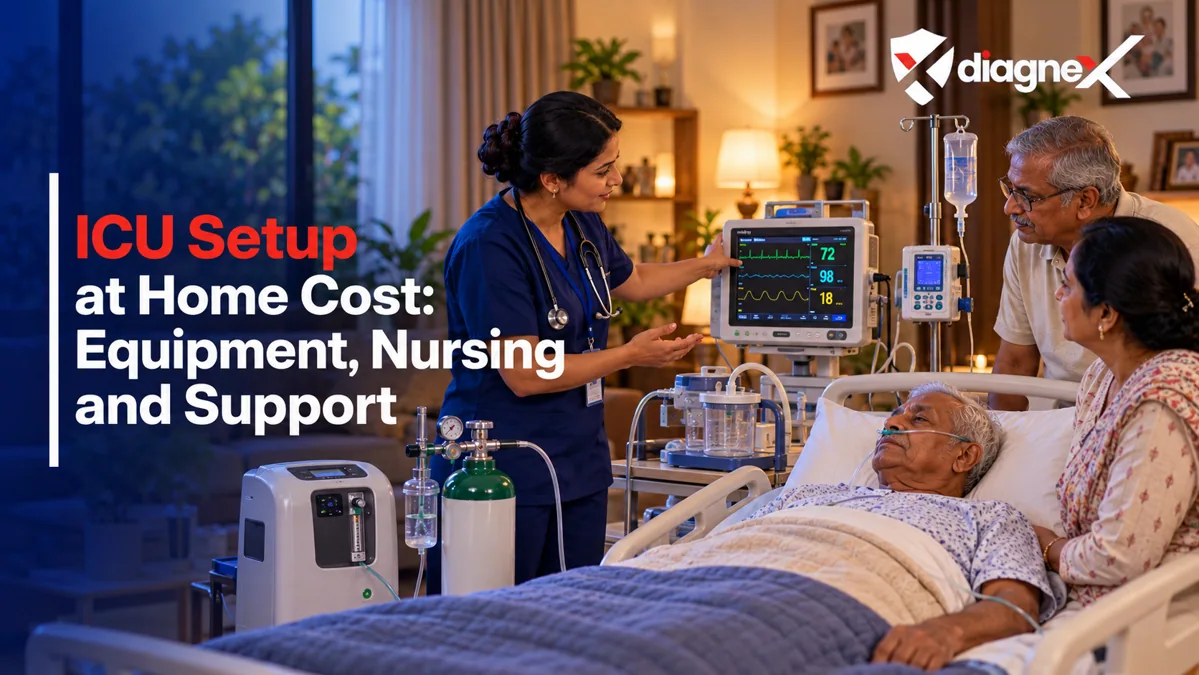
ICU setup at home cost is made up of more than equipment rental. The final amount usually combines the hospital bed, monitoring, oxygen or ventilatory support, suction, infusion equipment, nursing, doctor or physiotherapy visits, consumables, delivery, setup, taxes and any deposits.
For related context, read Home ICU Room Requirements: Space, Access and Utilities and Critical Care at Home for COPD Patients.
For related context, read Home ICU Room Requirements: Space, Access and Utilities and Critical Care at Home for COPD Patients.
The exact price depends on what the patient actually needs. A stable step-down patient may require a basic bed, oxygen, scheduled monitoring and one nursing shift. A ventilator-dependent or tracheostomy patient can require much more equipment, 24-hour critical-care-experienced nursing, backup power and a larger supply of respiratory consumables.
Diagnex's current public Home ICU estimator shows 15-day and 30-day city-specific planning rates. The rates in this article use the Kolkata 30-day selection only as illustrations. They are not universal India tariffs and not patient-specific quotations.
What Does ICU Setup at Home Cost Include?
A complete estimate usually has three layers: equipment, people and ongoing support.
Equipment can include a bed, monitor, oxygen concentrator, oxygen cylinder, BiPAP, ventilator, suction machine, infusion pump and IV stand. People can include nurses, attendants, doctors and physiotherapists. Ongoing support can include consumables, oxygen refills, maintenance, delivery, installation, taxes and clinical coordination.
The Home ICU service page makes this structure clear by separating equipment, nurses and attendants, home visits, tests, supplies and quotation-specific charges.
Why One Home ICU Setup Can Cost Much More Than Another
The difference usually comes from care intensity.
One patient may need an oxygen concentrator, monitor and 12-hour trained nursing. Another may need an automatic bed, ventilator, suction, infusion pump and 24-hour critical-care nursing.
Two families can therefore receive very different quotations even if both describe the service as Home ICU.
The Treating Doctor's Plan Should Come Before the Shopping List
Home ICU equipment should be chosen from the discharge plan, not from a generic package.
The treating team should decide which support is essential, which can be monitored intermittently and which equipment is no longer needed by the time the patient goes home.
How to Set Up an ICU at Home: Step-by-Step Overview explains why the clinical plan, room readiness and equipment list should be coordinated before discharge.
Hospital Bed Rental Is Usually the Starting Equipment Cost
Diagnex's current Kolkata 30-day estimator lists a manual hospital bed at ₹3,000 and an automatic hospital bed at ₹12,000.
The cheaper option is not automatically the right option. Patients who need frequent repositioning, head elevation or assisted transfers may benefit from an automatic bed.
The bed should be selected around function and caregiver safety.
A Multiparameter Monitor Adds Another Monthly Rental
The current Kolkata estimator lists a cardiac or multiparameter monitor at ₹9,000 for 30 days.
Some high-dependency patients need continuous monitoring. Others may only need scheduled blood pressure, pulse and oxygen checks.
The treating team should decide whether continuous monitoring is clinically useful before it is added to the quotation.
Oxygen Concentrator Rental Can Be Modest, but Oxygen Planning Is Broader
The public estimator currently lists an oxygen concentrator at ₹3,000 for 30 days in Kolkata.
The total oxygen budget can still be higher because the family may also need backup cylinders, refills, tubing, masks and reliable electricity.
Oxygen should be prescribed according to the patient's actual respiratory requirement rather than added automatically to every Home ICU setup.
Oxygen Cylinders Add Rental and Refill Costs
The estimator lists a 10 kg oxygen cylinder at ₹1,800 for 30 days and an oxygen cylinder stand or trolley at ₹700.
Cylinder refill pricing is provided separately in the final quotation.
Patients with continuous oxygen dependence may need more than one cylinder for backup, which can increase both the equipment and refill budget. For more on the practical service arrangements, review medical equipment on rent before deciding what information the care team needs.
BiPAP Has Its Own Rental Cost
The current Kolkata estimator lists a BiPAP machine at ₹4,000 for 30 days.
BiPAP is prescription-based respiratory support and should not be chosen merely because it costs less than a ventilator.
A patient using BiPAP may also need monitoring, oxygen integration, mask replacement, suction and trained nursing depending on the clinical plan.
CPAP Is Priced Separately From BiPAP
The estimator lists a CPAP machine at ₹3,500 for 30 days.
CPAP and BiPAP are not interchangeable. They provide different forms of pressure support and are prescribed for different conditions.
Families should budget for the device the respiratory team has actually prescribed.
A Ventilator Can Become the Largest Equipment Rental
The current Kolkata 30-day estimator lists a ventilator at ₹40,000.
That figure covers the machine rental, not the full cost of ventilator care. A ventilator-dependent patient may also need critical-care nursing, suction, respiratory circuits, filters, oxygen backup, infusion equipment and power backup.
This is why ventilator-dependent Home ICU costs are driven by the care system around the ventilator, not only the machine itself.
Suction Adds Equipment and Consumable Costs
The current estimator lists a suction machine at ₹3,000 for 30 days.
The machine can be only one part of the cost because suction catheters and other supplies may need regular replacement.
Patients who do not have secretion-clearance problems may not need suction equipment at all.
Infusion Pumps Add Rental Plus Supply Costs
A syringe or infusion pump is listed at ₹4,500 for 30 days.
The pump may also require syringes, tubing and prescribed medicines.
Infusion equipment is arranged after clinical assessment, so families should not add it to a setup unless the treating plan calls for controlled infusion therapy.
An IV Stand Is a Small but Separate Line Item
The public estimator lists an IV stand at ₹800 for 30 days.
This is a smaller cost than a ventilator or monitor, but it illustrates why a Home ICU quotation should itemise even basic equipment.
Small items can accumulate when several devices and supplies are required.
Equipment-Only Cost Can Be Much Lower Than the Full Setup
Using the current Kolkata 30-day estimator only as an illustration, a manual bed, monitor, oxygen concentrator, suction machine and IV stand total ₹18,800 for 30 days.
That is an equipment-only subtotal. It excludes nursing, consumables, medicines, doctor visits, physiotherapy, GST, delivery, setup and deposits.
Families should therefore avoid comparing an equipment-only figure with an all-inclusive hospital or home-care package.
A Higher-Acuity Equipment Stack Can Exceed ₹70,000 Before Nursing
Using the same estimator, an automatic bed, monitor, ventilator, oxygen concentrator, suction machine, infusion pump and IV stand total ₹72,300 for 30 days.
This still does not include nursing or consumables.
A ventilator-dependent home setup therefore becomes expensive before the staffing cost is added.
ICU Nurse Cost Is Often the Largest Recurring Part of the Setup
Diagnex's current Kolkata estimator lists trained nursing at ₹45,000 for a 12-hour shift and ₹75,000 for 24-hour cover over 30 days.
Critical-care-experienced nursing is listed at ₹60,000 for 12-hour cover and ₹90,000 for 24-hour cover.
Home Nursing may be relevant when families are comparing general skilled nursing with higher-dependency ICU staffing.
Nurse Skill Level Matters
A stable patient needing medicines and routine monitoring does not necessarily require the same nurse profile as a ventilated patient with a tracheostomy and infusion pumps.
Critical-care-experienced nursing may be needed for ventilator observation, suction, tracheostomy care, infusion therapy and rapid recognition of deterioration.
The quotation should state the nursing category clearly rather than using the word nurse as if all staffing were equivalent.
12-Hour and 24-Hour Nursing Can Change the Budget Dramatically
The difference between one daily shift and round-the-clock coverage can be tens of thousands of rupees per month.
A patient who is clinically stable overnight may not need 24-hour nursing. Another patient may not be safe without continuous professional supervision.
The staffing plan should be driven by risk and dependency, not by cost alone.
Attendant Care Is Different From Nursing
An attendant may help with bathing, feeding, toileting, turning and mobility.
The current Kolkata estimator lists attendant care at ₹36,000 for a 12-hour shift and ₹60,000 for 24-hour cover over 30 days.
An attendant should not replace a nurse when the patient needs clinical procedures, respiratory support or skilled monitoring.
Doctor Visits Are Usually Added Separately
The public estimator lists a doctor home visit at ₹4,000 per visit.
A patient needing four home medical reviews during the month would add ₹16,000 to the setup cost.
The number of visits should follow clinical need rather than a fixed package assumption.
Physiotherapy Can Add a Meaningful Monthly Amount
Diagnex's current estimator lists physiotherapy at ₹1,000 per session.
Eight sessions during a month add ₹8,000. Twelve sessions add ₹12,000.
Post-ICU rehabilitation may be important for weakness, transfers, breathing exercises or mobility, so this cost should be planned rather than treated as an unexpected add-on.
Small Tests Can Add Up Over a Month
The estimator lists a glucometer blood glucose check at ₹80 per check.
One test is inexpensive, but repeated daily checks can become a visible monthly expense.
Laboratory collection and other diagnostics may also be separate from the Home ICU quotation.
Consumables Are Often the Hidden Setup Cost
Masks, nasal cannulas, suction catheters, BiPAP masks, ventilator circuits, HME or bacterial filters, underpads, gloves, syringes and dressing kits may all be needed.
These items can be used repeatedly and may not be included in the headline equipment rental.
A quotation should state whether consumables are bundled, limited to a fixed allowance or billed as used. If the family is considering support at home, the Diagnex guide to home nursing explains the service pathway and its limits.
Medicines Usually Sit Outside the Equipment Package
The Home ICU setup price should not be assumed to include all prescribed medicines.
Antibiotics, anticoagulants, insulin, nebulised medicines, pain medicines and injections can vary significantly between patients.
Keeping medicines as a separate budget line makes provider comparisons more accurate.
Delivery and Setup Can Add to the First Invoice
Diagnex's current estimator states that delivery and setup are confirmed in the quotation rather than included in the displayed estimate.
These charges can matter more in a short-duration setup because they are one-time costs.
Families should confirm them before the equipment is dispatched.
Security Deposits Affect Upfront Cash Flow
Some rented equipment may require a deposit.
A refundable deposit is different from a permanent care expense, but it still increases how much money the family needs upfront.
The quotation should state the deposit amount and refund conditions.
GST Should Be Added Before Comparing Final Setup Prices
The current public estimator states that GST is excluded from the displayed estimate.
Families should therefore compare post-tax totals rather than only pre-tax subtotals.
A provider quotation should make clear which items attract GST and whether any line is tax-inclusive.
Room Readiness Can Create Costs Outside the Provider Quote
A home may need electrical work, more space around the bed, additional sockets, inverter or generator support, better access for equipment or changes to make transfers safer.
These are not always billed by the Home ICU provider.
They can still materially affect the family's total setup cost.
Power Backup Is Essential for Some High-Acuity Setups
Ventilators, oxygen concentrators, suction machines and infusion pumps depend on electricity.
A ventilator-dependent patient may need batteries, inverter or generator support and an emergency plan for prolonged power failure.
This can create both capital and ongoing household costs that are separate from the medical quotation.
Illustrative Setup 1: Basic Step-Down Equipment Plus 12-Hour Nursing
Using the current Kolkata 30-day public estimator only as an illustration: • manual hospital bed: ₹3,000; • multiparameter monitor: ₹9,000; • oxygen concentrator: ₹3,000; • suction machine: ₹3,000; • trained 12-hour nursing: ₹45,000.
The subtotal is ₹63,000 for 30 days.
This is not a recommended package and excludes GST, delivery, setup, deposits, consumables, medicines, doctor visits, physiotherapy and tests.
Illustrative Setup 2: BiPAP, Monitoring and 24-Hour Nursing
Using the same current Kolkata estimator: • automatic hospital bed: ₹12,000; • multiparameter monitor: ₹9,000; • BiPAP machine: ₹4,000; • oxygen concentrator: ₹3,000; • suction machine: ₹3,000; • trained 24-hour nursing: ₹75,000.
The subtotal is ₹1,06,000 for 30 days before GST and other excluded costs.
The treating respiratory team must decide whether BiPAP, oxygen and suction are clinically appropriate.
Illustrative Setup 3: Ventilator Equipment Plus 24-Hour Critical-Care Nursing
Using the same public estimator: • automatic hospital bed: ₹12,000; • multiparameter monitor: ₹9,000; • ventilator: ₹40,000; • oxygen concentrator: ₹3,000; • suction machine: ₹3,000; • syringe or infusion pump: ₹4,500; • critical-care-experienced 24-hour nursing: ₹90,000.
The subtotal is ₹1,61,500 for 30 days before GST, delivery, setup, deposits, consumables, medicines, backup equipment and professional visits.
Actual ventilator-dependent care may cost more or less depending on the final care plan.
Why These Examples Are Not Home ICU Packages
The examples show how separate cost components add together.
They are not fixed Diagnex packages, not clinical recommendations and not universal India prices.
A real quotation should be built from the patient's discharge plan, city, expected duration and local service availability.
Home ICU Cost per Day and Setup Cost Answer Different Questions
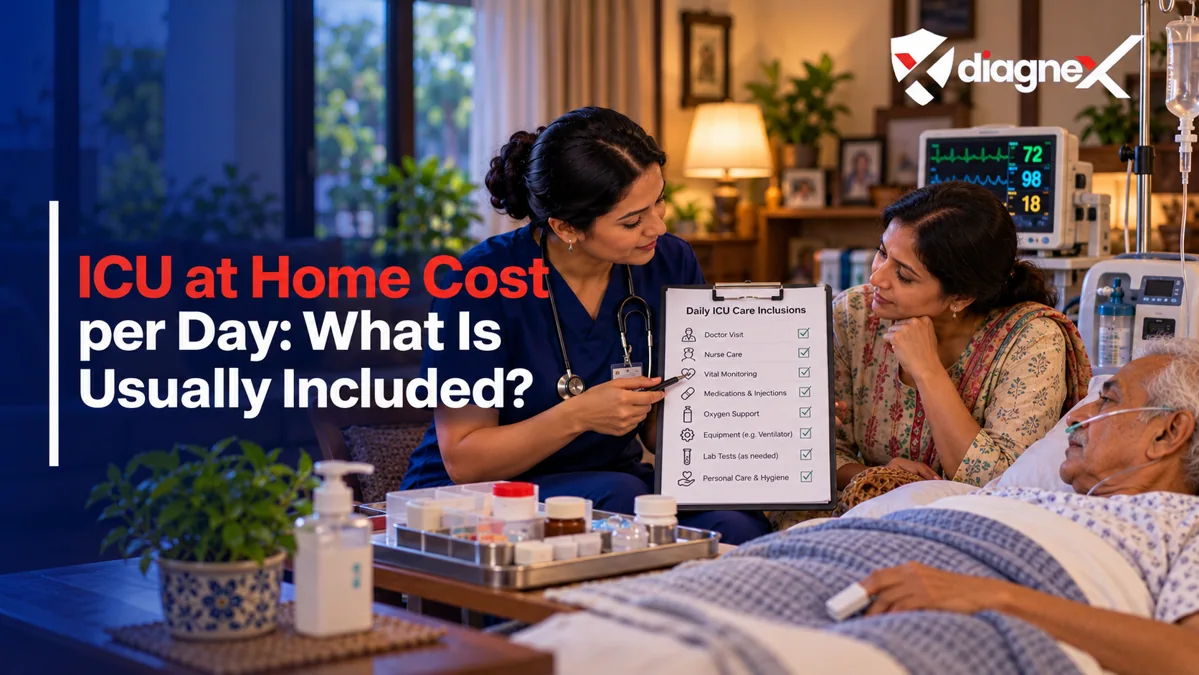
ICU at Home Cost per Day: What Is Usually Included? is useful when families want to convert a package into an effective daily budget.
This article focuses on the cost of building the actual setup from equipment, staffing and support.
The two numbers can look different because setup costs often include items that are rented for 15 or 30 days rather than priced as a one-day service.
Monthly Cost and Setup Cost Are Also Different
Monthly Cost of a Home ICU: A Practical Budget Guide looks at a full 30-day household budget, including recurring and one-time costs.
Setup cost focuses more narrowly on what has to be assembled around the patient to make home critical care possible.
Families planning several months of care should use both views.
The Broader India Cost Guide Helps Explain Why Quotes Vary
Home ICU Cost in India: What Determines the Price? explains how city, nursing intensity, duration, respiratory support, equipment and insurance affect the final amount.
That broader context is useful when two provider quotations are far apart.
The correct comparison is always line by line.
A Low Equipment Quote Can Hide a High Total Cost
Equipment rental may look inexpensive compared with nursing.
A provider could advertise a low bed or oxygen rate while the real monthly bill is dominated by 24-hour staffing and consumables.
Families should compare complete quotations rather than promotional equipment prices.
A High Equipment Quote May Include More Capability
The reverse can also be true.
One quotation may include a ventilator, monitor, backup equipment, suction, setup and maintenance while another quote only shows the basic device rental.
A higher headline amount can sometimes represent a more complete clinical setup.
Clinical Suitability Comes Before Price
The cheapest Home ICU setup is unsafe if it does not meet the patient's needs.
Is ICU at Home Safe? What Needs to Be in Place explains why stability, trained staff, equipment reliability, emergency planning and hospital access all matter.
Cost reduction should follow clinical de-escalation, not replace it.
Discharge Planning Can Prevent Duplicate Rentals
Families sometimes rent equipment too early or rent the wrong device before the hospital finalises the discharge requirements.
Hospital ICU to Home: How the Transition Is Planned explains why nursing, equipment, prescriptions, room readiness and the transfer date should be coordinated before discharge.
Good planning reduces both clinical risk and avoidable cost.
When Renting Is Usually Practical
Rental is often practical when recovery duration is uncertain or the care plan may change.
It reduces upfront capital cost and makes it easier to return equipment that is no longer needed. For care planning beyond this article, compare bedridden patient care at home with the instructions already given by the treating professional.
Families should still ask about minimum rental periods, early return, servicing, breakdown support and deposits.
When Buying May Be Worth Considering
Purchase can make sense for stable long-term needs.
The comparison should include maintenance, servicing, replacement and whether the equipment could become unnecessary if the patient's clinical condition changes.
Purchase price alone does not show the full cost of ownership.
What Should a Complete ICU Setup Quote Show?
A useful quotation should identify: • every rented device and rental period; • every purchased item; • nursing category and shift hours; • attendant care if required; • doctor and physiotherapy fees; • consumables included or excluded; • oxygen refill policy; • medicines included or excluded; • laboratory services; • delivery and installation; • refundable deposits; • GST; • maintenance and replacement; • extension and early-return terms.
What Information Does a Provider Need to Price the Setup Properly?
The provider usually needs the diagnosis, discharge plan, oxygen or ventilator requirement, tracheostomy status, monitoring needs, infusion needs, mobility, pressure-care risk, nursing procedures, expected duration and locality.
A price given without these details may be only a rough equipment quote.
The final setup should be confirmed against the treating doctor's advice.
A Practical ICU Setup Cost Checklist
Before approving the setup, confirm: • Which equipment is essential? • Which equipment is optional? • Which items are rented and which are purchased? • Is nursing 12-hour or 24-hour? • What nursing skill level is included? • Is attendant care separate? • Are doctor visits included? • Are physiotherapy sessions included? • Are consumables included? • Are medicines included? • Are oxygen refills separate? • Are delivery and setup included? • Is there a deposit? • Is GST included? • Is backup power required? • What happens if a device fails? • What happens if the patient's needs change?
How to Get an ICU Setup Cost From Diagnex
Share the treating doctor's discharge plan, nursing requirements, oxygen or ventilator needs, monitoring requirements, equipment list, expected duration and locality.
Diagnex can use its public estimator as a planning starting point and then confirm the patient-specific quotation according to clinical requirements, staff availability, delivery, setup, deposits, GST and purchase needs.
For a patient-specific estimate, use the Diagnex Contact page.
Frequently asked questions
How much does an ICU setup at home cost?
There is no single price. The total depends on equipment, nursing hours, nurse skill level, oxygen or ventilator needs, consumables, visits, taxes and logistics. The examples in this article range from ₹63,000 to ₹1,61,500 for selected 30-day Kolkata planning scenarios before excluded costs.
How much does Home ICU equipment rental cost?
Equipment is priced item by item. In Diagnex's current Kolkata 30-day estimator, examples include ₹3,000 for a manual bed, ₹9,000 for a monitor, ₹3,000 for an oxygen concentrator, ₹4,000 for BiPAP and ₹40,000 for a ventilator.
How much does an ICU nurse cost?
Using the current Kolkata 30-day estimator as an illustration, trained nursing is listed at ₹45,000 for 12-hour cover and ₹75,000 for 24-hour cover, while critical-care-experienced nursing is listed at ₹60,000 and ₹90,000 respectively.
Is equipment usually cheaper than nursing?
Often yes, especially for high-dependency patients. Nursing can become the largest recurring cost because professional coverage is needed every day and may require more than one shift.
Are consumables included in ICU equipment rental?
Not automatically. Masks, suction catheters, ventilator circuits, filters, gloves, syringes and dressing supplies may be billed separately unless the quotation explicitly includes them.
Are GST, delivery and deposits included in public estimator prices?
Diagnex's current public estimator states that GST is excluded and that delivery, setup, any deposit and prices for purchase items are confirmed in the quotation.
Why can two ICU setup quotations be very different?
They may include different nursing hours, nurse skill levels, equipment, consumables, backup systems, professional visits, taxes, delivery or deposits. Compare each line item rather than only the final number.
Pricing Note
All Diagnex pricing examples in this article are based on the publicly displayed Kolkata 30-day Home ICU estimator rates available when this article was prepared. They are planning examples only, not universal India tariffs, fixed packages or patient-specific quotations.
The public estimator states that exact service availability is confirmed for the locality and care requirement, and that GST, delivery, setup, any deposit and prices for items to buy are confirmed in the final quotation.
Related Diagnex services and guides
Explore the Home ICU service pathway and the Home ICU article library for more information.
Diagnex publishes general healthcare information to support care planning. Individual decisions about diagnosis, prescriptions and treatment remain with the treating professional. Read our medical content policy and editorial standards.