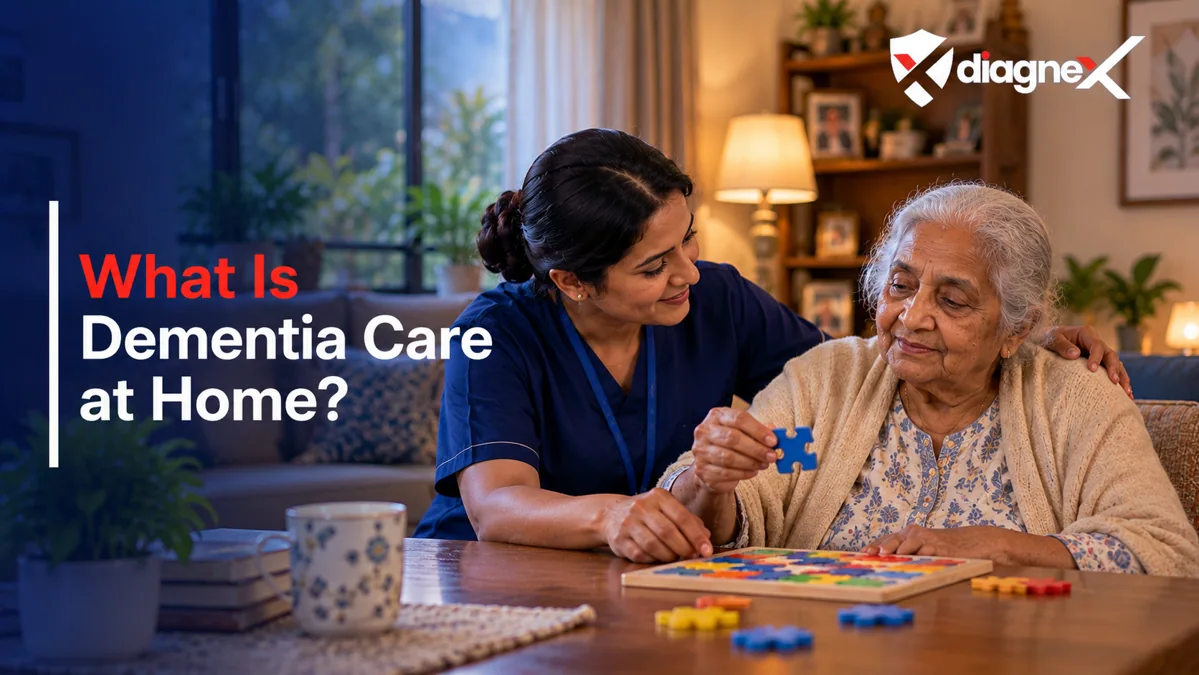
Alzheimer's care at home is structured support that helps a person with Alzheimer's disease remain as safe, comfortable and independent as possible in familiar surroundings. Depending on the stage of illness, it may include supervision, help with bathing and dressing, meal support, medicine routines, mobility assistance, behaviour support, home safety, nursing and coordination with the treating doctor.
For related context, read What Is Dementia Care at Home? and What Is Geriatric Care at Home?.
For related context, read What Is Dementia Care at Home? and What Is Geriatric Care at Home?.
Alzheimer's disease is the most common form of dementia. The National Institute on Aging describes it as a brain disorder that gradually affects memory, thinking, reasoning and, over time, the ability to manage everyday activities.
Because Alzheimer's is progressive, home care needs usually change. A person who initially needs reminders and companionship may later need help with personal care, wandering risk, night-time confusion, mobility, feeding or almost continuous supervision. The care plan should therefore evolve with the person's function rather than remain fixed.
How Is Alzheimer's Care Different From General Elder Care?
General elder care may focus on help with bathing, meals, mobility, toileting and companionship. Alzheimer's care adds the need to respond to changes in memory, orientation, judgement, communication and behaviour.
A caregiver may need to repeat information calmly, simplify choices, maintain a predictable routine and recognise when a behaviour is being driven by confusion rather than intention.
What Is Dementia Care at Home? explains the broader dementia-care framework that also applies to Alzheimer's disease.
What Does Alzheimer's Home Care Include?
Alzheimer's home care services can combine non-clinical caregiving with skilled clinical support.
The Alzheimer's Association notes that in-home services may include companion care, personal care, help with meals or housekeeping, and skilled care from professionals such as nurses or physical therapists.
The right combination depends on the person's stage, mobility, medical needs, behaviour, night-time safety and how much family support is available.
Early-Stage Alzheimer's Care at Home
In earlier stages, the person may still manage many activities independently but need reminders, help organising appointments, supervision with medicines or support with finances and transport.
Families should avoid taking over every task too quickly. Preserving independence can support confidence and dignity while still reducing clear risks.
This is also a useful time to establish routines, review the home and discuss future care preferences before needs become more complex.
Middle-Stage Alzheimer's Care at Home
In middle stages, the person may need more direct help with bathing, dressing, toileting, meals, medicines and supervision.
Behaviour changes, wandering, repeated questions, sleep disturbance or resistance to care may become more noticeable. Caregivers often need to simplify communication and provide more structure.
How to Care for a Person with Dementia at Home provides practical guidance for day-to-day routines and personal care.
Later-Stage Alzheimer's Care at Home
Later-stage Alzheimer's care can become physically and clinically demanding. The person may need help with nearly every activity, including eating, transfers, continence, repositioning and mobility.
The National Institute on Aging notes that later-stage care may require help from nurses, home health aides, physical therapists or other professionals, particularly when mobility and positioning become difficult. For more on the practical service arrangements, review home nursing before deciding what information the care team needs.
Families should review whether the home setting can safely meet these needs as dependence increases.
Why Routine Matters
A predictable routine can make the day easier to understand.
Meals, medicines, bathing, activity and bedtime at roughly familiar times may reduce confusion and unnecessary decisions. The routine should remain flexible enough to adapt to fatigue, illness or a difficult day.
Familiar routines are especially useful when the person can no longer remember why a task is happening.
How Caregivers Should Communicate
Alzheimer's disease can make long explanations and complex questions difficult to follow.
Use short sentences, one idea at a time and a calm tone. Give the person enough time to respond. Arguing over forgotten facts is often less helpful than acknowledging the person's emotion and gently redirecting.
The aim is respectful communication, not testing memory.
Helping With Bathing and Dressing
Bathing and dressing can become difficult because the person may feel rushed, exposed or confused about what the caregiver is doing.
Prepare clothes and supplies in advance, use one instruction at a time and preserve privacy. Offer limited choices rather than asking the person to choose from many options.
Patient Care at Home may be relevant when regular non-clinical help is needed with hygiene, dressing, feeding, toileting or supervision.
Supporting Meals and Hydration
People with Alzheimer's may forget meals, become distracted while eating or develop difficulty recognising food.
Simple meals, a calm eating environment and regular prompts may help. Families should watch for weight loss, dehydration, coughing while eating or repeated choking.
New swallowing difficulty requires clinical assessment because the safest food texture and level of supervision may need to change.
Medication Support
Memory problems can make medicine routines unsafe. A person may miss doses, take a medicine twice, hide tablets or become confused by several prescriptions.
Some people need reminders while others need direct supervision. If the person becomes unusually sleepy, dizzy, unsteady or confused after a medicine change, the treating clinician should be informed.
Families should not independently alter prescribed doses or use sedating medicines simply to make care easier.
Home Safety for Alzheimer's Disease
The National Institute on Aging recommends reviewing the home room by room because Alzheimer's can affect judgement, depth perception, memory and the ability to respond to emergencies.
Lighting, stairs, bathrooms, kitchens, medicines and dangerous household products may all need attention. Safety should be reviewed repeatedly because the person's abilities change over time.
Dementia Home Safety Checklist for Families provides a practical home-safety framework.
Managing Wandering Risk
Wandering may begin as pacing, door checking or repeated requests to go home.
A safe plan can include supervision, door alerts, identification, a recent photograph and a clear response plan if the person leaves unnoticed.
How to Manage Wandering in Dementia at Home explains how to reduce risk without relying only on stronger locks.
Managing Sundowning and Evening Confusion
Some people become more restless or confused later in the day.
Good lighting, a calm evening routine, appropriate daytime activity and attention to pain, hunger, toileting and fatigue may help.
What Is Sundowning in Dementia? explains the difference between a familiar late-day pattern and a sudden change that may need medical review.
Night Care and Sleep Problems
Sleep can become fragmented. The person may wake repeatedly, get lost on the way to the bathroom or try to leave the home.
A night-care plan may include clear walking routes, nightlights, toileting support, door alerts and caregiver coverage during high-risk periods.
Night Care for a Person with Dementia explains how families can structure night-time support more safely.
Handling Agitation
Agitation may be linked to pain, hunger, thirst, constipation, fatigue, infection, noise, fear or a change in routine.
Caregivers should reduce stimulation, speak calmly and check for a possible cause before assuming the person is simply being difficult. If the family is considering support at home, the Diagnex guide to Alzheimer care at home explains the service pathway and its limits.
How to Handle Agitation in Dementia at Home explains how to respond to agitation, aggression and sudden behaviour changes.
Meaningful Activities and Companionship
People with Alzheimer's still benefit from meaningful activity even when memory is significantly impaired.
The National Institute on Aging recommends adapting activities to what the person can still do. Familiar music, household tasks, photographs, gardening, simple sorting and supervised movement may all be useful.
Activities for People with Dementia at Home explains how to choose engagement that supports success rather than frustration.
Mobility and Fall Prevention
Alzheimer's can affect attention, judgement and depth perception, while age-related weakness or other medical conditions may add to fall risk.
Clear walkways, good lighting, safe footwear and correct use of walking aids are important. A physiotherapist may be useful when walking, balance or transfers decline.
Mobility problems should not automatically be treated as part of dementia without considering other medical causes.
What Is the Role of an Alzheimer's Caregiver?
An Alzheimer's caregiver at home may provide supervision, companionship, personal-care help, meals, toileting support, mobility assistance, reminders and observation of behaviour changes.
The caregiver should not diagnose Alzheimer's or independently change treatment. Their observations can still be valuable because they may notice changes in sleep, appetite, wandering, continence or mobility before a short clinic visit reveals them.
Good caregiving combines practical support with careful observation.
When Is Nursing Support Needed?
A caregiver and a nurse have different roles.
Home Nursing may be needed when Alzheimer's care is combined with medicine administration, wound care, injections, catheter or tube care, monitoring or other defined clinical tasks.
Diagnosis, prescribing and treatment changes remain with the treating doctor or appropriate specialist.
Why Caregiver Consistency Helps
Frequent changes in caregivers can increase confusion.
A familiar caregiver may learn the person's usual routines, communication style, behaviour triggers and preferred ways of accepting personal care.
Consistency should still be supported by backup coverage so the care plan does not collapse when the regular caregiver is unavailable.
How to Choose an Alzheimer's Caregiver
Families should look for dementia-specific experience, patience, communication skills, personal-care competence, reliability and the ability to stay calm during repetition or resistance.
The Alzheimer's Association recommends listing care needs and interviewing prospective providers to confirm that the service matches those needs.
A good caregiver should also understand the limits of their role and know when to involve the family or clinical team.
When Is 24-Hour Supervision Considered?
Continuous supervision may be considered when the person wanders, cannot manage medicines safely, leaves appliances on, falls repeatedly or cannot be left alone because of night-time confusion.
This does not always mean continuous skilled nursing. Some people need continuous non-clinical supervision with nursing added only for defined clinical needs.
The amount of support should be based on actual risk and function rather than diagnosis alone.
How Family Caregivers Can Avoid Burnout
Alzheimer's caregiving can become exhausting when one person is responsible for personal care, medicines, supervision and night-time needs.
The National Institute on Aging recommends building a support system and seeking help when needed. Family members may need to share responsibility, arrange respite or use professional caregiver support.
A plan that depends on one exhausted person is difficult to sustain safely.
When Home Care May No Longer Be Enough
Home care can become difficult when the person needs constant skilled monitoring, repeated emergency care, complex nursing, severe behaviour that cannot be managed safely or physical assistance beyond what the home can support.
The Alzheimer's Association notes that in-home care can be very helpful, but the level and type of service should be matched to changing needs.
Moving to a different care setting is sometimes the safest option and should not be viewed as a failure. For care planning beyond this article, compare medical caretaker support with the instructions already given by the treating professional.
When Should Families Seek Prompt Medical Review?
Families should seek prompt clinical review for: • sudden or rapidly worsening confusion; • new weakness, facial droop or speech difficulty; • fever or signs of infection; • repeated falls or a new inability to walk; • severe pain; • choking or new swallowing difficulty; • marked drowsiness or reduced responsiveness; • a major behaviour change that is very different from the person's usual pattern.
A sudden change should not automatically be assumed to be Alzheimer's progression.
How Alzheimer's Care Fits Into Elder Care at Home
Alzheimer's rarely exists in isolation. The person may also have arthritis, diabetes, heart disease, frailty, continence problems or mobility limitations.
A broader elder-care plan may therefore need to combine memory support with caregiver assistance, nursing, physiotherapy, doctor follow-up and home safety.
This is why the care plan should be built around the whole person rather than around one diagnosis.
How to Arrange Alzheimer's Care at Home With Diagnex
To arrange Alzheimer's care at home, share the diagnosis if known, current memory and behaviour concerns, level of independence, mobility, medicine needs, wandering or night-time risks, current caregiver arrangement and locality.
Diagnex can review whether the requirement fits Memory & Dementia Care, Patient Care at Home, Home Nursing or another elder-care pathway based on the person's actual needs.
For service coordination, use the Diagnex Contact page.
Frequently asked questions
What is Alzheimer's care at home?
It is organised support that helps a person with Alzheimer's manage daily routines, personal care, medicines, safety, mobility, behaviour and supervision while remaining at home when this is appropriate.
Is Alzheimer's the same as dementia?
Alzheimer's disease is a specific brain disease and the most common form of dementia. Dementia is the broader term for cognitive decline severe enough to interfere with daily life.
What does an Alzheimer's caregiver do?
A caregiver may provide supervision, companionship, help with bathing, dressing, meals, toileting, mobility and routine while observing meaningful changes in behaviour and function.
When does someone with Alzheimer's need a nurse?
Nursing may be needed when there are clinical requirements such as medicine administration, monitoring, wound care, injections, catheter or tube care, or post-hospital needs.
Can a person with Alzheimer's stay at home?
Many people can remain at home for a period with appropriate support, but safety, supervision, mobility, behaviour and medical needs should be reviewed as the disease progresses.
When is 24-hour care needed?
Continuous supervision may be needed when the person cannot be left safely alone because of wandering, falls, medication risk, night-time confusion or inability to manage basic needs.
When is home Alzheimer's care no longer enough?
Home care may no longer be sufficient when risks cannot be controlled safely, skilled needs become too complex or behaviour and mobility needs exceed what the home setting can support.
References and further reading
This article provides general education and does not replace an individual Alzheimer's assessment or care plan. Clinical points were cross-checked against current National Institute on Aging guidance on Alzheimer's disease, caregiving, home safety and late-stage care, and Alzheimer's Association guidance on in-home care and home safety.
Related Diagnex services and guides
Explore the Elder Care service pathway and the Elder Care article library for more information.
Diagnex publishes general healthcare information to support care planning. Individual decisions about diagnosis, prescriptions and treatment remain with the treating professional. Read our medical content policy and editorial standards.