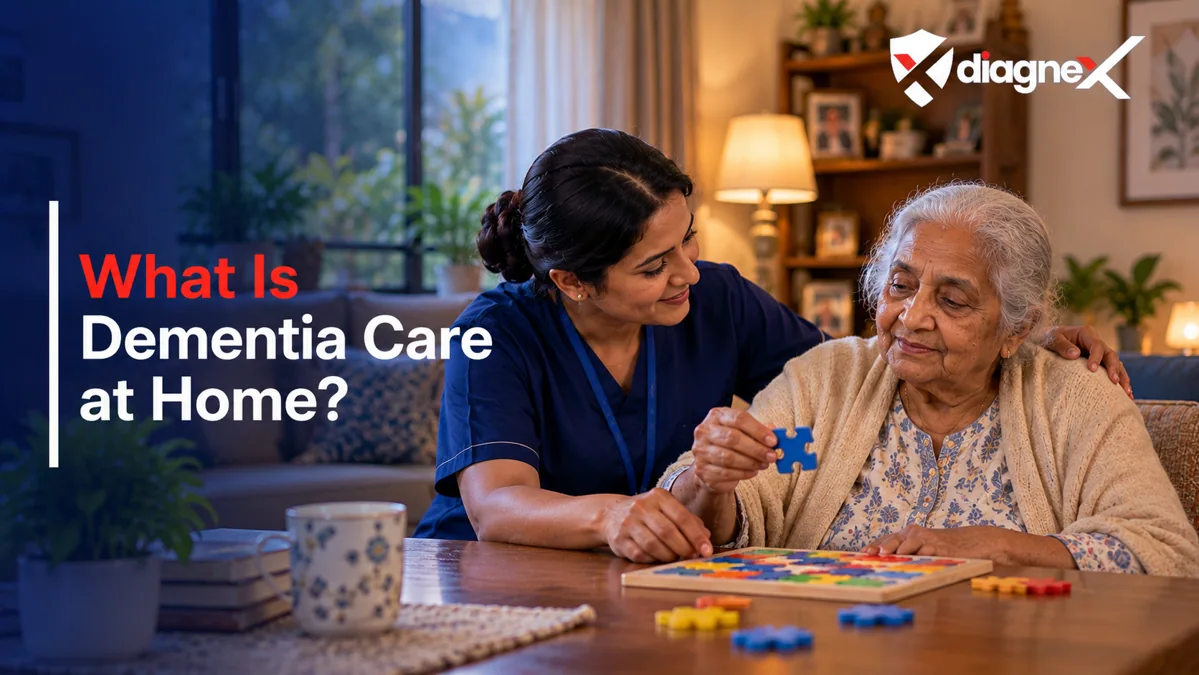
Dementia care at home is organised support that helps a person with dementia remain as safe, comfortable and independent as possible in familiar surroundings. It can include help with daily routines, supervision, medicines, meals, mobility, communication, behaviour changes, sleep, safety and coordination with doctors or nurses, depending on the person's needs.
For related context, read What Is Geriatric Care at Home? and What Is Alzheimer's Care at Home?.
For related context, read What Is Geriatric Care at Home? and What Is Alzheimer's Care at Home?.
Dementia home care services are not one fixed package. Someone in an early stage may mainly need reminders, routine, companionship and supervision with medicines. A person with more advanced dementia may need help with bathing, dressing, toileting, feeding, transfers, wandering risk, night-time confusion and almost continuous supervision.
The central principle is person-centred care. The goal is not to control the person or remove every risk. It is to preserve dignity, familiarity and meaningful independence while reducing avoidable harm and making sure the family has enough support.
What Does Dementia Care at Home Actually Include?
Dementia care at home can combine practical caregiving, clinical nursing and medical coordination. The exact mix should reflect the person's stage of dementia, mobility, behaviour, medical conditions and level of independence.
A dementia caregiver may help with dressing, hygiene, meals, toileting, companionship, supervision and daily routines. A nurse may be needed when there are clinical needs such as medicine administration, monitoring, wound care, catheter care or structured reporting to the treating doctor. Medical diagnosis and treatment changes remain the responsibility of the appropriate doctor or specialist.
Diagnex's Memory & Dementia Care pathway is specifically intended for families supporting someone with memory loss or diagnosed dementia at home.
Why Familiar Surroundings Can Be Helpful
Many people with mild-to-moderate dementia can continue living at home when the right support is in place. The NHS notes that familiar surroundings can help some people cope better with dementia.
Familiar rooms, routines, people and objects may reduce unnecessary confusion. Moving to a completely new environment can sometimes add disorientation, especially when memory and learning new information are already difficult.
Home care is not automatically the best option at every stage, but familiarity can be a meaningful advantage when safety and care needs can still be managed.
How Is Dementia Care Different From General Elder Care?
General elder care may focus on practical support such as bathing, meals, mobility, toileting and companionship. Dementia care adds another layer because memory, judgement, communication, orientation and behaviour can change over time.
The caregiver may need to repeat information calmly, simplify choices, reduce environmental confusion, observe patterns in behaviour, and anticipate risks the person may no longer recognise themselves.
What Is Geriatric Care at Home? explains how memory problems, mobility, medicines, nutrition and other age-related needs often need to be considered together rather than separately.
Why Routine Matters in Dementia Care
A predictable routine can make the day easier to understand. Meals, medicines, bathing, rest and bedtime at roughly consistent times may reduce confusion and make care feel more familiar.
Routine does not mean the day must be rigid. A person with dementia may have better and worse periods, and the caregiver should adapt to energy, mood and comfort.
The value of routine is that it reduces the number of new decisions and surprises the person has to manage.
How Should Caregivers Communicate?
Dementia can make it harder to find words, follow long conversations, understand complex instructions or filter background noise. The National Institute on Aging recommends adapting communication to these changes. For more on the practical service arrangements, review home nursing before deciding what information the care team needs.
Caregivers can help by speaking slowly, using short sentences, asking one question at a time and giving the person enough time to respond. Arguing about a forgotten fact is often less useful than acknowledging the person's emotion and redirecting gently.
Communication should remain respectful. The person should be spoken to as an adult, not discussed as though they are absent simply because memory or language has changed.
Helping With Bathing, Dressing and Toileting
Daily personal care can become difficult because the person may forget the sequence of a task, resist help, become embarrassed or misinterpret what the caregiver is doing.
A consistent routine, simple instructions and offering limited choices can make these tasks easier. For example, showing two shirts may be less confusing than asking the person to choose from an entire cupboard.
Patient Care at Home may be relevant when the person needs regular non-clinical help with bathing, dressing, toileting, feeding or mobility in addition to dementia-specific supervision.
Supporting Meals and Hydration
People with dementia may forget to eat, lose interest in meals, become distracted, have difficulty recognising food or develop swallowing problems as the condition progresses.
Simple meals, a quiet eating environment and regular prompts may help. Families should also watch for weight loss, dehydration, coughing while eating, recurrent chest infections or increasing difficulty swallowing.
Persistent swallowing problems require clinical assessment because the safest food texture, feeding strategy or route may need to change.
Medication Support in Dementia
Medication errors are a common concern when memory is impaired. A person may forget a dose, take it twice, hide tablets, refuse medicines or confuse one medicine with another.
The level of support should match the risk. Some people need reminders, while others need a caregiver or nurse to supervise administration. Medicines should also be reviewed if the person becomes unusually sleepy, dizzy, unsteady or confused.
Families should not change prescribed doses or stop medicines because of behaviour changes without discussing the situation with the treating clinician.
What Are Behavioural and Psychological Symptoms?
Dementia can affect mood and behaviour as well as memory. A person may become anxious, suspicious, restless, withdrawn, irritable, repetitive or agitated. Some people develop hallucinations, delusions or marked evening confusion.
These changes should be approached as communication rather than simply labelled as difficult behaviour. Pain, constipation, infection, hunger, thirst, poor sleep, overstimulation or an unfamiliar caregiver can sometimes worsen behaviour.
A sudden major change in behaviour or confusion should prompt medical review because an acute illness or delirium may be contributing.
What Is Sundowning?
Some people with dementia become more confused, restless or agitated in the late afternoon or evening. This pattern is often called sundowning.
The exact cause can vary. Fatigue, low lighting, disrupted sleep, pain, hunger, noise and changes in routine may all contribute.
A calm evening routine, good daytime activity, appropriate lighting and attention to physical discomfort may help, but severe or new agitation should be reviewed clinically.
What About Wandering?
Wandering can become a serious safety issue when a person leaves home and cannot find the way back. The National Institute on Aging recommends planning for this risk rather than waiting until someone gets lost.
Families may need to review door security, identification, supervision and the person's usual triggers for leaving. Some people wander because they are looking for a familiar place, trying to follow an old routine or responding to anxiety.
Safety measures should protect the person without creating unnecessary distress or unsafe confinement.
How Can the Home Be Made Safer?
Dementia can change memory, judgement, vision and depth perception, so ordinary household features may become confusing or unsafe.
The National Institute on Aging recommends reviewing the home room by room and correcting hazards such as poor lighting, unsafe stairs, dangerous household products and bathroom risks. Clear signs, good contrast, stable furniture and simple layouts can also help.
How to Make a Home Safer for an Elderly Parent provides a broader home-safety framework, including issues that become especially important when cognitive changes are present.
Fall Prevention for a Person With Dementia
People with dementia may be at increased risk of falls because judgement, depth perception, attention, balance, medicines and mobility can all be affected.
Fall prevention should therefore include more than removing rugs. Families may need to review lighting, bathroom safety, footwear, walking aids, medicines, vision and how the person moves through the home.
Fall Prevention at Home for Elderly Parents explains how mobility and environmental risks can be addressed together. If the family is considering support at home, the Diagnex guide to dementia care at home explains the service pathway and its limits.
Why Consistent Caregivers Can Help
Seeing familiar caregivers can reduce the number of new faces and routines the person has to process. This may make personal care, medicines and daily activities easier to accept.
Consistency is especially helpful when the person becomes suspicious of unfamiliar people or has difficulty remembering why someone has come into the home.
Families should still have a backup plan because illness, leave or emergencies can interrupt even a well-organised caregiving routine.
What Is the Role of a Dementia Caregiver?
A dementia caregiver helps the person manage everyday life safely. Depending on the care plan, this may include supervision, companionship, hygiene support, meals, toileting, mobility assistance, reminders and observing changes in behaviour.
The caregiver should not diagnose dementia or independently alter medicines. Their observations can still be clinically valuable because they may notice patterns in sleep, appetite, wandering, agitation, continence or mobility that are not obvious during a short doctor visit.
Good dementia caregiving therefore involves both practical support and careful observation.
When Is Nursing Support Needed?
A caregiver and a nurse have different roles. A nurse may be needed when the person has clinical requirements such as medicine administration, wound care, injections, catheter or tube care, monitoring or post-hospital needs.
Home Nursing can be relevant when dementia care must be combined with these clinical responsibilities.
For complex patients, caregiver support and nursing may work together, with the caregiver handling daily routines and the nurse handling defined clinical tasks.
When Is Physiotherapy Useful?
Dementia does not automatically prevent a person from benefiting from physiotherapy. Strength, walking and balance work may still help when the person has mobility decline, repeated falls or weakness after hospitalisation.
The programme may need to be simpler, more repetitive and closely supervised because learning new exercises can be difficult.
Physiotherapy at Home for Elderly Adults: When Can It Help? explains how mobility rehabilitation can be adapted for older adults with cognitive as well as physical limitations.
What if the Person Refuses Care?
Refusal may happen because the person does not understand why help is needed, does not recognise the caregiver, feels rushed, is embarrassed or is frightened.
It can help to slow down, reduce the number of instructions, try again later and use a familiar routine. Forcing non-urgent care can increase distress and make future cooperation harder.
If refusal affects essential medicines, nutrition, hygiene or safety, the treating team should be involved in planning the next step.
How Families Can Respond to Repeated Questions
Repeated questions are usually a result of memory impairment rather than deliberate behaviour. The person may genuinely not remember asking the same thing moments earlier.
A calm answer, visual reminder or gentle redirection is often more useful than pointing out how many times the question has already been asked.
Caregiver frustration is understandable, which is why family members also need breaks and realistic expectations.
Why Caregiver Burnout Matters
Dementia caregiving can be physically and emotionally demanding, especially when the person needs supervision at night, resists care or cannot be left alone safely.
The National Institute on Aging encourages caregivers to build support systems and ask for help rather than trying to manage every task alone.
Families may need to divide responsibilities, use paid caregiver support, arrange respite, or increase professional involvement as needs grow. A care plan that depends on one exhausted family member is difficult to sustain.
How Dementia Care Changes as the Condition Progresses
Dementia is progressive, so the level of support usually changes over time. Early care may focus on reminders and planning. Later care may involve more help with personal care, mobility, continence, eating, communication and supervision.
The care plan should be reviewed when there are repeated falls, wandering, weight loss, swallowing difficulty, increasing night-time problems, frequent infections or a major decline in independence.
What Does Elder Care at Home Include? explains how the mix of caregiver, nursing, rehabilitation and medical support can change as an older person's needs become more complex.
When Is 24-Hour Supervision Considered?
Continuous supervision may be considered when the person cannot be left safely alone because of wandering, unsafe cooking, falls, night-time confusion, medication risk or inability to manage basic needs.
Not every person with dementia requires 24-hour care. The decision should be based on actual risk and function rather than the diagnosis alone. For care planning beyond this article, compare medical caretaker support with the instructions already given by the treating professional.
Families should also distinguish between continuous non-clinical supervision and continuous skilled nursing, because these are different levels of care.
When Might Home Care No Longer Be Enough?
Home care may become difficult when risks cannot be managed safely despite increasing support, when the person needs constant skilled nursing, when severe behavioural symptoms place the person or others at risk, or when the home environment cannot meet mobility and care needs.
The NHS notes that some people eventually require residential or nursing-home care as dementia progresses.
Moving out of the home is not a failure. The right setting is the one that can safely meet the person's current needs while preserving dignity and comfort.
What Changes Need Prompt Medical Review?
Families should seek prompt clinical review when there is: • sudden or rapidly worsening confusion; • new weakness or speech difficulty; • fever or signs of infection; • repeated falls or new inability to walk; • severe agitation that is new or dangerous; • inability to eat or drink adequately; • choking or new swallowing difficulty; • marked drowsiness or reduced responsiveness.
A sudden change should not automatically be assumed to be progression of dementia.
How to Arrange Dementia Care at Home With Diagnex
To arrange dementia care at home, share the person's diagnosis if known, current memory and behaviour concerns, level of independence, mobility, medicine needs, wandering or night-time concerns, current caregiver arrangement and locality.
Diagnex can review whether the requirement is best routed to Memory & Dementia Care, Patient Care at Home, Home Nursing or another elder-care pathway depending on the person's actual needs.
For service coordination, use the Diagnex Contact page.
Frequently asked questions
What is dementia care at home?
Dementia care at home is organised support that helps a person with dementia manage daily life, safety, routines, medicines, meals, mobility and behaviour while remaining at home when this is appropriate.
What does a dementia caregiver do?
A dementia caregiver may provide supervision, companionship, help with personal care, meals, toileting, mobility, reminders and observation of changes in behaviour or function.
Can a person with dementia live alone?
Some people with early dementia may live independently for a period with appropriate support, but safety, medicines, cooking, falls, wandering and emergency response should be reviewed regularly.
How do you make a home safer for someone with dementia?
Good lighting, clear walking paths, safer bathrooms, secure medicines and hazardous products, simple signs, stable furniture and planning for wandering can all improve safety.
When does someone with dementia need a nurse?
A nurse may be needed when there are clinical requirements such as medicine administration, monitoring, wound care, injections, catheter or tube care, or post-hospital medical needs.
Is sudden confusion normal in dementia?
No. A sudden or marked change can indicate delirium, infection, medication effects or another acute problem and should be medically assessed.
When is home dementia care no longer enough?
Home care may no longer be sufficient when risks cannot be managed safely, the person requires constant skilled care, or behavioural, mobility or medical needs exceed what the home setting can support.
References and further reading
This article provides general education and does not replace dementia assessment or an individual care plan. Clinical points were cross-checked against current National Institute on Aging guidance on Alzheimer's caregiving, communication, wandering and home safety, and NHS guidance on dementia care and support.
Related Diagnex services and guides
Explore the Elder Care service pathway and the Elder Care article library for more information.
Diagnex publishes general healthcare information to support care planning. Individual decisions about diagnosis, prescriptions and treatment remain with the treating professional. Read our medical content policy and editorial standards.