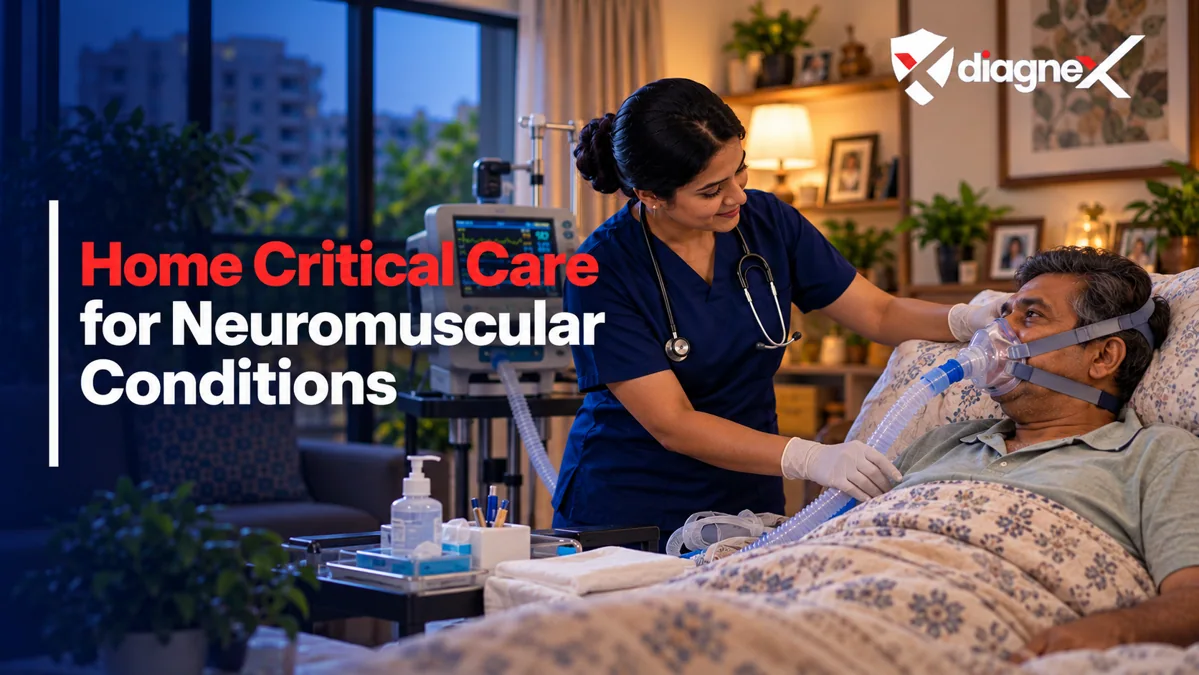
Home critical care for neuromuscular conditions can involve long-term respiratory support, skilled nursing, secretion management, feeding support, mobility assistance and emergency planning for people whose breathing muscles have become weak.
For related context, read Critical Care at Home for COPD Patients and Palliative Critical Care at Home: What It Means.
For related context, read Critical Care at Home for COPD Patients and Palliative Critical Care at Home: What It Means.
The conditions in this group are not identical. They can include amyotrophic lateral sclerosis, also called motor neurone disease in many countries, muscular dystrophies, spinal muscular atrophy and other disorders that weaken the muscles used for breathing and coughing. Some patients remain stable with nighttime non-invasive ventilation, while others gradually become dependent on ventilation for more hours of the day.
The central issue is that neuromuscular respiratory failure is often a problem of ventilation, not simply low oxygen. The MND Association specifically warns that oxygen should be used with extreme caution in MND because breathing symptoms are usually caused by reduced ventilation and oxygen alone may worsen carbon dioxide retention. Respiratory support therefore needs specialist assessment rather than a simple oxygen-first approach.
Why Neuromuscular Respiratory Care Is Different
In many neuromuscular diseases, the lungs themselves may initially be structurally normal while the diaphragm and other breathing muscles progressively weaken.
This can lead to shallow breathing during sleep, morning headaches, daytime sleepiness, fatigue, poor concentration, breathlessness when lying flat and eventually respiratory failure. Cough also becomes weaker, making it harder to clear mucus or material that enters the airway.
The care plan therefore has to address ventilation, cough strength, secretions, swallowing and airway protection together.
Which Neuromuscular Conditions May Need Home Ventilatory Support?
The British Thoracic Society's 2024 Model of Care for Complex Home Mechanical Ventilation identifies neuromuscular diseases as an important group requiring long-term ventilatory support in the community.
Examples include motor neurone disease, Duchenne muscular dystrophy and other progressive neuromuscular disorders. The exact support differs by diagnosis, progression, cough strength, swallowing function and the number of hours of ventilation required.
Respiratory Failure Care at Home: What Support May Be Needed explains the broader distinction between oxygen support, non-invasive ventilation and invasive home ventilation.
Home Critical Care Is for Stable or Predictable Support Needs
Home care works best when the patient's respiratory needs are known and the treating team has defined how they should be supported.
A person with rapidly worsening breathlessness, new severe drowsiness, cyanosis, inability to clear the airway, suspected aspiration, acute infection with respiratory deterioration or ventilator failure that cannot be corrected safely at home may need urgent hospital care.
The home setting should not delay emergency treatment when the patient's needs exceed the established plan.
Respiratory Symptoms Can Appear Before Daytime Oxygen Falls
Neuromuscular hypoventilation often appears first during sleep.
NICE recommends monitoring respiratory symptoms in MND, including breathlessness, orthopnoea, disturbed sleep, non-refreshing sleep, nightmares, daytime sleepiness, poor concentration, confusion, morning headaches, fatigue and poor appetite.
Families should report these changes even when the patient looks comfortable during the day.
Regular Respiratory Assessment Is Important
NICE recommends regular assessment of respiratory function in MND and involvement of a respiratory ventilation service when respiratory impairment develops.
Depending on the condition, testing may include vital capacity, inspiratory-pressure testing, overnight oximetry, sleep studies or blood-gas assessment.
The purpose is to identify respiratory muscle weakness early enough to discuss treatment before a crisis occurs.
Non-Invasive Ventilation Is Often the First Ventilatory Support
Non-invasive ventilation, or NIV, uses a mask or another external interface to support the movement of air into and out of the lungs.
In ALS and MND, NIV is commonly used when respiratory muscle weakness begins to cause symptoms or abnormal respiratory testing. NICE states that NIV can improve symptoms associated with respiratory impairment and may prolong life, although it does not stop progression of the underlying disease.
The MND Association similarly describes NIV as the most commonly used form of ventilation for people with MND. For more on the practical service arrangements, review home nursing before deciding what information the care team needs.
BiPAP Is One Form of Non-Invasive Ventilation
Families often use the term BiPAP when referring to home NIV.
A bilevel device provides different pressures during inhalation and exhalation to reduce the work of breathing. The prescribed pressures, backup rate, interface and hours of use should be set by the respiratory ventilation team.
Caregivers should not increase pressures or alter backup settings simply because the patient seems more tired.
NIV May Begin at Night and Increase Over Time
NICE recommends that people with MND generally become accustomed to NIV while awake and then begin regular use at night before and during sleep, with hours increased as necessary.
As neuromuscular weakness progresses, some people use NIV for longer periods during the day.
The care plan should be reviewed as dependence increases because daytime mobility, eating, communication and caregiver support may all need to adapt.
Ventilator Dependence Changes the Home-Care Requirements
A patient who can tolerate several hours without ventilation has different safety needs from someone who depends on a ventilator nearly continuously.
NICE recommends considering the consequences of ventilator failure, power requirements, battery backup, hospital access, secretion management and carer availability before starting NIV in MND.
The British Thoracic Society also describes complex home mechanical ventilation services for patients with progressive neurological disease, tracheostomy ventilation or prolonged daily ventilator dependence.
Oxygen Is Not a Substitute for Ventilation
In neuromuscular disease, breathlessness or low oxygen may result from inadequate ventilation.
The MND Association warns that oxygen alone can worsen carbon dioxide retention in MND and recommends specialist advice before oxygen is started. If oxygen is clinically required for another reason, it should be prescribed within the respiratory plan.
Families should not add oxygen to an NIV or ventilator circuit without explicit clinical instructions.
Pulse Oximetry Does Not Measure Carbon Dioxide
A pulse oximeter can estimate oxygen saturation but cannot show whether carbon dioxide is accumulating.
Morning headache, increasing sleepiness, confusion, poor concentration and reduced alertness can be signs of hypoventilation even when oxygen saturation is not dramatically low.
This is why respiratory assessment in neuromuscular disease may require blood gases, sleep studies or ventilation data rather than pulse oximetry alone.
A Weak Cough Is a Major Safety Issue
Weak respiratory muscles reduce the ability to take a deep breath and generate an effective cough.
Mucus, saliva or aspirated material may then be harder to clear, increasing the risk of chest infection and airway obstruction.
NICE recommends assessing cough effectiveness in MND and offering cough-augmentation techniques when the cough becomes ineffective.
Manual Assisted Cough and Breath Stacking May Help
NICE recommends unassisted breath stacking and manual assisted cough as first-line cough-augmentation approaches for selected people with MND who cannot cough effectively.
These techniques should be taught by the respiratory or physiotherapy team because timing, positioning and suitability matter.
Families should not perform aggressive chest compression or unfamiliar breathing techniques without training.
Mechanical Cough Assist May Be Needed
If simpler cough-augmentation methods are not effective, a mechanical insufflation-exsufflation device, commonly called a cough-assist machine, may be considered.
NICE recommends considering mechanical cough assist when assisted breath stacking is ineffective or during a respiratory infection. The ALS Association also describes mechanical cough assist as a tool that can strengthen airway clearance when coughing becomes weak.
Settings should be individualized by the respiratory team.
Suction Has a Different Role From Cough Assist
Cough assist helps move secretions upward from the lungs, while suction removes accessible secretions from the mouth, upper airway or tracheostomy when indicated.
A patient with excessive oral secretions or a tracheostomy may need portable suction equipment.
Deep airway suction should be performed only by people who have been trained for the patient's airway and clinical plan.
Saliva and Thick Secretions Can Increase the Work of Care
MND and other neuromuscular conditions can make saliva difficult to swallow or clear.
The multidisciplinary team may need to address drooling, thick secretions, hydration, humidification, positioning and medicines for secretion management.
The respiratory plan should consider how secretions interact with NIV mask tolerance and airway clearance.
Swallowing Problems and Breathing Problems Often Overlap
Bulbar muscle weakness can affect swallowing, speech and airway protection.
The MND Association notes that progressive respiratory weakness can make coordination of breathing and swallowing more difficult. Coughing during meals, repeated choking, a wet voice or recurrent chest infections should prompt swallowing review.
Food textures or feeding routes should not be changed casually without professional assessment.
Gastrostomy May Be Discussed as Swallowing Declines
Some people with progressive neuromuscular disease eventually need gastrostomy feeding to support nutrition, hydration or medication administration.
Timing should be discussed with the neurology, respiratory and nutrition teams because respiratory weakness can affect procedural planning.
Tube feeding does not remove all aspiration risk, so positioning, secretion management and oral care can still matter.
Tracheostomy Ventilation Is a Major Care Decision
Some patients progress from mask-based NIV to invasive ventilation through a tracheostomy, while others choose not to.
The MND Association describes tracheostomy ventilation as a more complex intervention with significant practical, clinical and personal considerations. It commonly requires ongoing clinical support and extensive caregiver planning.
This decision should be discussed before an emergency whenever possible so the person's preferences are known. If the family is considering support at home, the Diagnex guide to bedridden patient care at home explains the service pathway and its limits.
Home Tracheostomy Ventilation Requires Advanced Support
The home setup may need a ventilator, backup ventilator or backup ventilation method, suction, humidification, spare circuits, tracheostomy supplies, emergency equipment and trained staff.
The airway plan should cover secretion blockage, accidental tube displacement, equipment alarms and emergency replacement procedures where appropriate.
Respiratory Care at Home may be relevant when specialist respiratory equipment and trained clinical support need to be coordinated at home.
Power Backup Is Essential for Ventilator-Dependent Patients
Ventilator dependence turns electricity into a clinical safety issue.
NICE specifically includes battery backup and the consequences of ventilator failure in its pre-NIV risk assessment for MND. Families should know how long batteries last, what happens during a prolonged outage and whom to contact for technical support.
A ventilator-dependent person should not rely on a single power source without a written backup plan.
Caregivers Need Hands-On Training
NICE recommends training people with MND and their families or carers in NIV use, emergency procedures, interface replacement, equipment failure and secretion management.
Training should be specific to the actual ventilator, mask, wheelchair setup, cough-assist device, suction machine and emergency plan used at home.
Written instructions are useful, but they do not replace practical competency.
Night-Time Assistance May Become Necessary
A person with progressive weakness may eventually be unable to remove or reposition the NIV mask independently.
NICE specifically highlights night-time assistance when the patient cannot manage the interface without help.
Families should plan for who will respond to alarms, mask displacement, secretion problems or distress during sleep.
Communication Needs Can Affect Ventilator Safety
ALS and MND can weaken speech while leaving cognition intact.
If the person cannot call out, remove a mask or use their hands reliably, the home needs an accessible call system or communication device.
Emergency communication should still work when the patient is lying in bed, using NIV or unable to speak.
Mobility and Positioning Support Often Increase Over Time
Progressive weakness can affect transfers, sitting balance, head control and the ability to reposition.
A hospital bed, pressure-relieving mattress, wheelchair, hoist or other mobility equipment may become necessary. Positioning can also affect breathing comfort, secretion drainage and NIV tolerance.
Rehabilitation at Home may be relevant for positioning, mobility preservation and caregiver training even when the underlying neurological disease is progressive.
Bedridden Care May Become Part of the Plan
Some people eventually become dependent for most movement and personal care.
Bedridden Patient Care at Home may become relevant when the person needs extensive support with turning, hygiene, pressure-area prevention, toileting and safe transfers in addition to respiratory care.
Skin integrity, joint positioning and caregiver ergonomics should be reviewed as mobility declines.
Nutrition and Weight Need Ongoing Review
Weight loss can worsen weakness and is an important issue in ALS and MND.
NICE recommends regular multidisciplinary review of weight, diet, nutritional intake, fluid intake, feeding and swallowing.
A dietitian and speech-language professional may both be needed when eating becomes slow, tiring or unsafe.
Home Nursing May Be Needed for Skilled Respiratory Tasks
Skilled nursing may be needed for ventilator monitoring, tracheostomy care, suction, gastrostomy care, medicines, pressure-area prevention, catheter care or other clinical tasks.
Home Nursing may be relevant when the patient needs professional clinical support in addition to family caregiving.
The required nursing hours should reflect ventilator dependence, airway risk and the patient's ability to summon help.
Not Every Patient Needs 24-Hour Nursing at First
A person using NIV only at night may initially need family support and scheduled clinical review rather than continuous nursing.
As weakness progresses, daytime ventilation, secretion management, feeding, communication and mobility may increase the amount of assistance required.
Care needs should be reassessed rather than assumed to stay fixed.
ALS and MND Care Should Remain Multidisciplinary
NICE recommends coordinated multidisciplinary MND care that includes neurology, specialist nursing, dietetics, physiotherapy, occupational therapy, respiratory expertise, speech and language therapy and palliative care expertise.
Home ventilation should therefore remain connected to the specialist disease team rather than becoming an isolated equipment service.
Regular review is especially important because respiratory, nutritional and communication needs can change together.
Advance Care Planning Should Include Ventilation Decisions
Progressive neuromuscular disease can lead to increasing dependence on NIV or tracheostomy ventilation.
NICE recommends giving people opportunities to discuss their wishes about continuing or withdrawing NIV, and the MND Association emphasizes planning ahead before ventilation becomes an emergency.
These conversations should be patient-led, sensitive and supported by clinicians experienced in neuromuscular respiratory and palliative care. For care planning beyond this article, compare medical equipment on rent with the instructions already given by the treating professional.
The Emergency Plan Should Be Shared With Other Services
NICE recommends informing services that may see a person with MND in a crisis that the person uses NIV.
The family should keep a current list of ventilation settings, respiratory equipment, emergency contacts, medication and communication needs where it can be found quickly.
If hospital transfer is needed, the patient's usual ventilatory support and airway-clearance plan should travel with them whenever practical.
When Should a Neuromuscular Patient Go to Hospital?
Urgent hospital assessment is needed for: • severe or rapidly worsening breathlessness; • inability to maintain usual ventilation despite the prescribed device; • marked new drowsiness, confusion or inability to wake normally; • cyanosis or rapidly worsening oxygenation; • repeated ventilator alarms with clinical deterioration; • inability to clear secretions with the established airway-clearance plan; • choking or suspected aspiration with respiratory distress; • suspected tracheostomy displacement or airway obstruction; • fever or chest infection with rapidly worsening breathing; • sudden equipment failure when safe ventilation cannot be maintained; • any other major deterioration identified in the individual emergency plan.
The patient's specialist respiratory plan should always take priority.
When Home Critical Care May No Longer Be Safe
Home care may become unsafe if ventilation needs exceed the available equipment and staffing, the airway cannot be managed reliably, recurrent emergencies are occurring or the patient needs hospital diagnostics or interventions that cannot be delivered at home.
It may also become unsafe when backup power, technical support or appropriately trained caregivers cannot be maintained.
Who Is Suitable for ICU Care at Home? is relevant when families need to reassess whether the current home environment can still support the patient's level of dependency.
A Practical Home Ventilator Care Checklist
Families can review: • Is the neuromuscular diagnosis and respiratory plan clearly documented? • Are NIV or ventilator settings and hours of use prescribed? • Does everyone understand that oxygen is not a substitute for ventilation? • Is cough strength being reviewed and is cough augmentation available if needed? • Are suction and secretion-management instructions clear? • Are swallowing and nutrition needs being reviewed? • Is there a written plan for mask problems, ventilator alarms and equipment failure? • Are backup batteries and power arrangements adequate? • Is night-time assistance available if the patient cannot manage the interface independently? • Are communication and call systems accessible? • Are pressure-area, mobility and transfer needs addressed? • Are nurses or caregivers trained on the actual equipment in use? • Are specialist neurology and respiratory reviews scheduled? • Are the person's future ventilation preferences documented and reviewed? • Are hospital-transfer and emergency contacts written down?
How to Arrange Neuromuscular Critical Care at Home With Diagnex
To plan neuromuscular disease ventilator care at home, share the diagnosis, hospital or respiratory plan, current NIV or ventilator prescription, hours of dependence, tracheostomy status, cough-assist and suction needs, swallowing and feeding status, communication ability, mobility, nursing requirements, equipment list, backup-power plan and locality.
Diagnex can review whether the requirement fits Home ICU, Respiratory Care at Home, Home Nursing, Bedridden Patient Care at Home, Rehabilitation at Home or another appropriate pathway based on the treating team's plan and the patient's current stability. Exact staffing, equipment and service availability are confirmed for the specific locality and care requirement.
For service coordination, use the Diagnex Contact page.
Frequently asked questions
Can ALS or MND ventilator care be provided at home?
Yes, many people use prescribed non-invasive ventilation at home, and selected patients receive more advanced home ventilation. The setup should remain linked to a specialist neuromuscular and respiratory team.
Is BiPAP commonly used in ALS or MND?
Yes. NIV delivered through a mask is commonly used when respiratory muscle weakness causes symptoms or abnormal respiratory testing. Device settings should be prescribed by the respiratory ventilation service.
Should oxygen be used for breathlessness in MND?
Not routinely without specialist advice. MND breathlessness is often caused by inadequate ventilation, and oxygen alone may worsen carbon dioxide retention in some patients.
What is cough assist used for?
Cough-assist devices help people with weak respiratory muscles move air more forcefully and clear secretions when an ordinary cough is ineffective.
Can a ventilator-dependent neuromuscular patient live at home?
Selected patients can live at home with long-term ventilatory support when trained caregivers or nurses, reliable equipment, power backup, airway-clearance support and an emergency plan are in place.
When is 24-hour nursing needed?
It depends on ventilator dependence, airway and secretion risk, tracheostomy needs, communication ability, mobility and whether trained family caregivers can safely provide part of the support.
When should a person with neuromuscular respiratory weakness return to hospital?
Severe worsening breathlessness, new marked drowsiness, inability to maintain ventilation, airway obstruction, aspiration with respiratory distress, repeated ventilator alarms with deterioration or failure of essential equipment should trigger urgent hospital escalation.
References and further reading
This article provides general education and does not replace a neurologist, neuromuscular specialist, respiratory physician or hospital discharge plan. Clinical points were cross-checked against current NICE guidance on motor neurone disease, the British Thoracic Society 2024 Model of Care for Complex Home Mechanical Ventilation, current MND Association respiratory and ventilation guidance and current ALS Association respiratory-management resources.
Related Diagnex services and guides
Explore the Home ICU service pathway and the Home ICU article library for more information.
Diagnex publishes general healthcare information to support care planning. Individual decisions about diagnosis, prescriptions and treatment remain with the treating professional. Read our medical content policy and editorial standards.