Clinical Procedures at Home: A Complete Guide for Patients and Families
Clinical procedures at home are healthcare interventions carried out in a patient’s residence by an appropriately qualified professional when the patient, the procedure, the home setting and the clinical plan make home delivery suitable. Depending on the situation, home clinical procedures may include wound dressing, prescribed injections, IV-related care, catheter procedures, feeding-tube procedures, sample collection and selected monitoring. The important point is that “at home” describes the setting, not a lower standard of clinical responsibility. A procedure should not move out of a clinic or hospital simply because doing so is more convenient. The better question is: can this particular procedure be performed appropriately for this particular patient, by the right professional, with the right equipment and a clear escalation plan? If you are new to care outside hospital, it may help to first read Diagnex’s guide to understanding home healthcare, which explains how professional roles, coordination and clinical accountability continue to matter when care moves into the home.
What Are Clinical Procedures at Home?
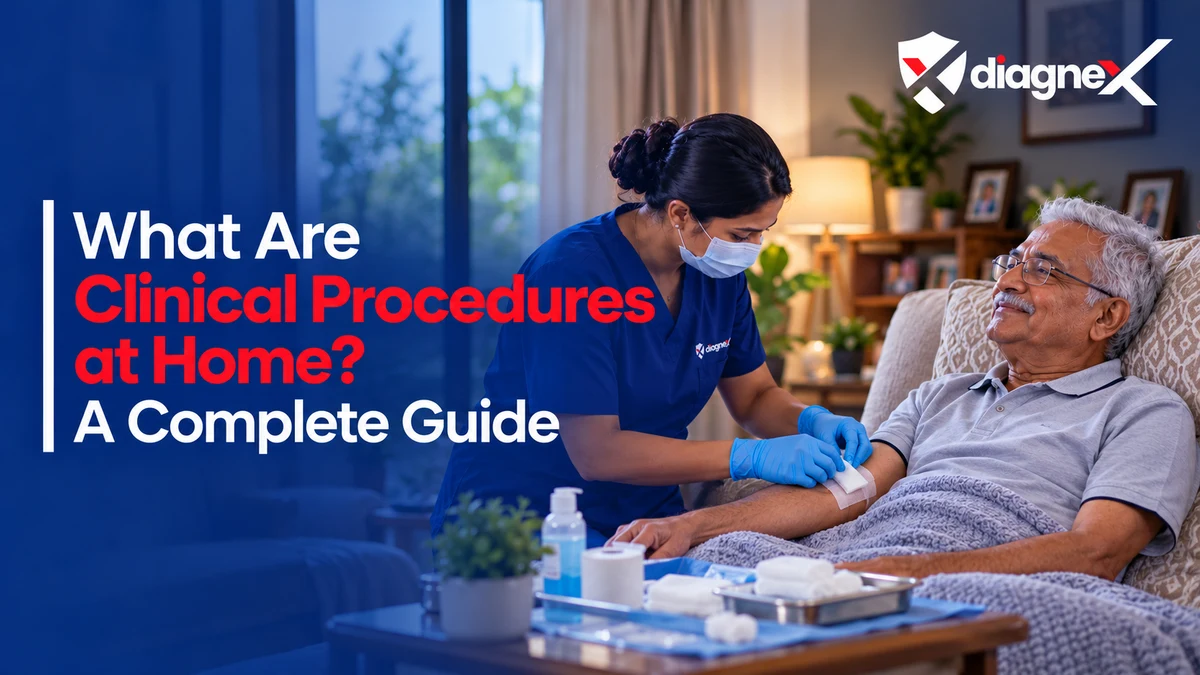
Clinical procedures at home are specific medical or nursing interventions delivered in a patient’s residence rather than requiring the patient to travel to a hospital, clinic or treatment centre for every episode of care. They are usually task-specific and may be one-time, repeated for a defined period, or part of a broader post-discharge or continuing-care plan. This category is broader than home nursing alone. Many nursing procedures at home are clinical procedures, but some home clinical procedures may involve doctors, phlebotomists, technicians, physiotherapists or other appropriately qualified professionals. The professional required depends on the procedure, the patient’s condition, local rules and the treating team’s instructions. It is equally important to separate clinical care from non-clinical support. An attendant or caregiver may help with personal care, mobility, meals or day-to-day assistance, but families should not assume that a non-clinical caregiver is qualified to perform invasive procedures, administer prescription medicines or make treatment decisions.
Which Medical Procedures Can Be Done at Home?
The range of medical procedures at home has expanded as healthcare systems have developed visit-based nursing, portable diagnostics and better post-discharge pathways. However, the fact that a procedure can sometimes be delivered at home does not mean it is appropriate for every patient. Suitability depends on clinical stability, the complexity of the procedure, the professional available, monitoring requirements and the home environment.
Wound Dressing and Wound Care
Wound dressing at home may be used for selected surgical wounds, chronic wounds, pressure injuries and other wounds that require planned dressing changes. The exact dressing method and frequency should follow the treating team’s instructions or an appropriate wound-care plan. A home visit may also create an opportunity to document changes and flag concerns that need clinical review. Wound care is not simply changing a bandage. Infection prevention, the type of wound, the condition of the surrounding skin, pain, drainage and the patient’s broader health can all affect what care is appropriate.
Injections and Prescribed Medication Administration
Some prescribed injections may be administered at home by an appropriately qualified professional when home administration is clinically suitable. The route of administration, medicine, dose, timing, allergy history, storage requirements and need for observation all matter. Families should be cautious about any service that treats an injection as a commodity without checking the prescription or other relevant clinical requirements. Medication administration remains part of the patient’s treatment plan and should stay connected to the treating professional’s direction.
IV Cannulation and Infusion Support
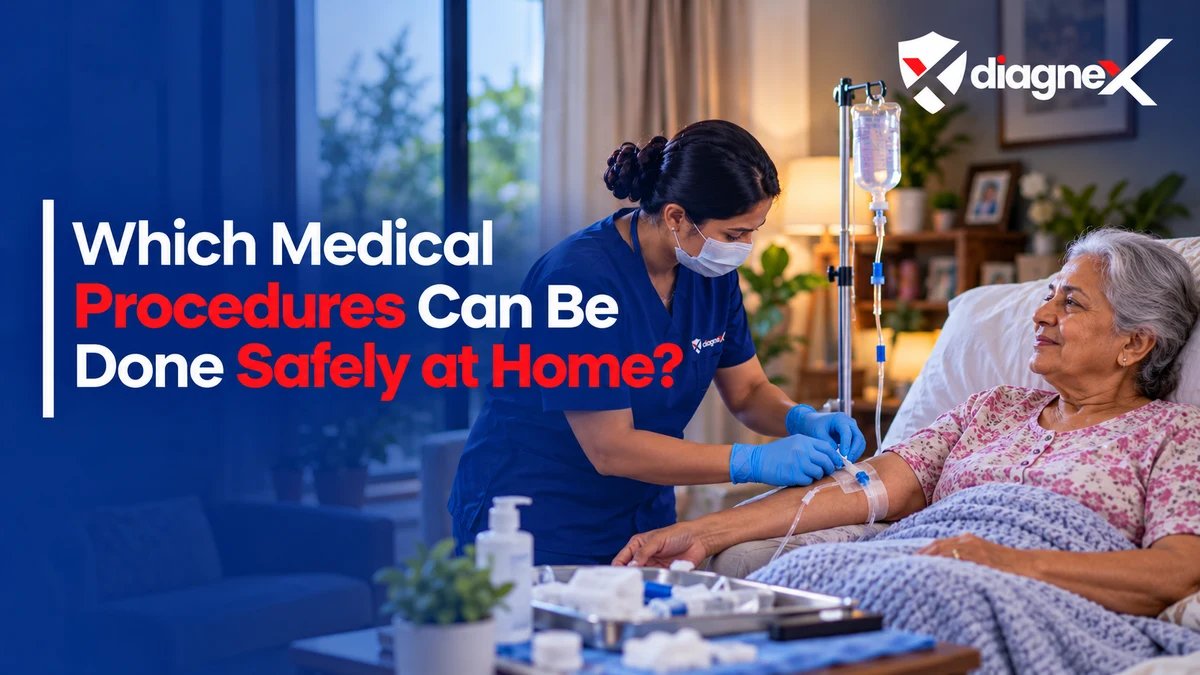
IV cannulation and selected infusions may be possible at home for suitable patients, but they require more than placing a cannula. The medicine or fluid being given, the patient’s condition, vein access, monitoring needs, previous reactions and the ability to escalate if a problem occurs all affect whether home delivery is appropriate. Not every infusion belongs in a home setting. Some medicines or patients require the monitoring and immediate backup available in a hospital or day-care unit.
Urinary Catheter Procedures and Catheter Care
Urinary catheter insertion, change or related catheter care may be delivered at home in selected situations by a professional with the appropriate competence. Because urinary catheters can introduce infection risk, the need for the catheter, aseptic practice, correct maintenance and timely removal when no longer needed are important clinical considerations. Families should also know what changes require review, such as new fever, pain, blockage, leakage, blood in the urine or a sudden change in the patient’s condition. These symptoms should be discussed promptly with the appropriate treating professional.
Ryle’s or Nasogastric Tube Procedures
Some patients require a Ryle’s tube or other nasogastric tube for feeding or medication. Insertion, replacement and related tube procedures require appropriate professional competence and should follow a defined clinical plan. The tube must not be treated as a routine household device simply because the patient is at home. Caregivers may be taught parts of ongoing tube care or feeding where appropriate, but training and responsibilities should be clearly defined by the treating team rather than assumed.
Blood Sample Collection and Selected Monitoring
Some home clinical procedures are diagnostic rather than treatment-focused. Home blood sample collection, ECG, blood pressure monitoring and other selected tests can reduce unnecessary travel when the service is suitable for home delivery. The person performing the test, equipment quality, sample handling, documentation and communication of results all influence the usefulness of the service. For broader testing needs, families can review Diagnex healthcare services and the appropriate diagnostic pathway before scheduling.
More Complex Procedures Need More Stringent Review
Some providers may list higher-complexity procedures for home delivery, including blood-product transfusion, albumin infusion, tracheostomy-related interventions or arterial blood sampling. These should never be treated as routine merely because they appear in a service catalogue. Higher-complexity procedures may require closer monitoring, specific equipment, stronger escalation arrangements and a narrower patient-selection threshold. In many situations, a hospital or monitored clinical facility is the safer setting. The appropriate treating professional should determine whether home care is reasonable for the individual patient.
Who May Benefit From Home Clinical Procedures?
Clinical procedures at home are most useful when they solve a genuine access or continuity problem without compromising the care required. Common situations may include: Home delivery is not automatically better. A patient who is unstable, needs continuous monitoring, may deteriorate rapidly or requires equipment and backup that cannot be safely provided at home may need hospital-based care instead.
- A patient who has been discharged from hospital with a defined nursing or procedure plan.
- An older adult or person with limited mobility for whom repeated travel is difficult.
- A patient receiving an ongoing course of treatment that includes suitable repeat procedures.
- A person recovering after surgery who needs planned wound care, monitoring or other clinical support.
- A patient whose condition is stable enough for a task-specific professional visit rather than facility-based care.
The 4P Test for Home Clinical Procedures
Patient
Is the patient clinically stable enough for the planned procedure outside a hospital? Are there important conditions, previous reactions, infection risks, bleeding risks or monitoring needs that change the setting required? Patient-specific suitability comes first.
Procedure
How invasive or complex is the procedure? Does it require a prescription, sterile equipment, continuous observation, specialised monitoring or access to immediate medical backup? The procedure itself may determine that a facility is more appropriate.
Professional
Who will perform the procedure, and is it within that person’s professional scope and competence? A qualified nurse, doctor, technician or other clinical professional should be matched to the actual task. Job titles should not be used as a substitute for competency.
Place
What Makes a Home Clinical Procedure Safe?
Before the Procedure
Clinical Direction and Prescription Requirements
Patient and Home Suitability
The Right Professional for the Task
During and After the Procedure
Infection Prevention and Equipment
Observation, Documentation and Escalation
Clinical Procedure Visit vs Home Nursing vs Attendant Care
Clinical Procedure Visit
Home Nursing
Attendant or Caregiver Support
Home ICU or Advanced Care at Home
A more complex care-at-home arrangement can involve equipment, trained nursing, monitoring and repeated professional input around a patient-specific plan. It should not be presented as automatically equivalent to a hospital ICU. Diagnex’s Home ICU Setup information explains the distinction and the need for treating-doctor direction.
What Happens During a Home Procedure Visit?
- The family or patient explains the procedure required and shares only the information needed through the appropriate secure channel.
- The provider checks whether a prescription, clinical instruction, assessment or other dependency is required.
- The scope, professional, timing, locality, consumables, equipment and fees are confirmed before the visit.
- At the home, the professional verifies the patient, the planned procedure and any relevant clinical instructions before beginning.
- The procedure is performed using the appropriate clinical and infection-prevention process, with observation as required.
- Relevant documentation, after-care instructions and escalation guidance are communicated, and follow-up is arranged when necessary.
Benefits of Appropriate Medical Procedures at Home
When clinically suitable, home procedures can make parts of the care journey easier to manage. Potential practical advantages include: These are operational benefits, not guarantees of better medical outcomes. The safest setting remains the one that matches the patient’s clinical needs.
- Less repeated travel for patients who are older, weak, recovering after discharge or living with limited mobility.
- A familiar setting for planned care that does not require a hospital environment.
- Better continuity between discharge instructions, scheduled procedures and the wider home-care plan.
- The ability to use task-specific visits when a patient does not need a full nursing shift.
- Simpler coordination for families when procedures, nursing, diagnostics and follow-up are organised within a connected care pathway.
Limitations of Home Clinical Procedures
- A home does not have the same immediate diagnostics, staff depth, resuscitation capability or specialist backup as a hospital.
- Some procedures require monitoring or equipment that may not be practical outside a clinical facility.
- Not every patient is stable enough for home care, even if the same procedure is offered at home for other patients.
- Professional scope, service availability and the ability to respond to complications can vary by provider and locality.
- Complex or rapidly changing conditions may need hospital assessment even when some routine elements of care were previously delivered at home.
When Hospital or Emergency Care Should Take Priority
Clinical procedures at home are intended for planned care, not as a substitute for emergency medical services. Seek urgent medical attention when a patient has severe or rapidly worsening symptoms such as major breathing difficulty, chest pain, loss of consciousness, a new stroke-like symptom, uncontrolled bleeding, a seizure, a severe allergic reaction or another sudden deterioration. In India, call 112 or go to the nearest appropriate emergency facility when urgent emergency care is required. Do not wait for a routine home visit if the patient may be seriously unwell.
How to Choose a Provider for Nursing Procedures at Home
- Who will perform the procedure, and what qualification or professional role do they hold?
- Does this procedure require a prescription, treatment plan or clinical assessment before it can be booked?
- How is patient suitability for the home setting assessed?
- What infection-prevention process and supplies are required?
- What monitoring is needed during or after the procedure?
- What documentation will be created, and how should important observations reach the treating team?
- What is the escalation plan if the patient deteriorates or the procedure cannot be completed safely?
- What exactly is included in the quoted fee, including professional visit, equipment, medicines and consumables?
- How is sensitive medical information collected and protected?
Clinical Procedures at Home With Diagnex
Diagnex’s current service directory includes clinical-procedure enquiries such as IV cannulation, Ryle’s tube insertion, catheterisation, wound dressing at home, nursing injections, blood sample collection and selected diagnostic or monitoring services. Suitability, prescription requirements, professional responsibility and local availability are confirmed for the specific requirement rather than assumed from the service list. If the family is not sure which service name fits the situation, the Find the Right Care pathway starts from the patient’s need instead of requiring the family to navigate a catalogue on its own.
Some patients need more than a single procedure. Depending on the care requirement, a wider pathway may involve home nursing, diagnostics, equipment, rehabilitation, Home ICU Setup or Home Hemodialysis. Treatment decisions and prescriptions remain with the appropriately qualified treating professionals. For more educational content about care outside hospital, visit the home healthcare knowledge hub.
Frequently Asked Questions About Clinical Procedures at Home
What are clinical procedures at home?
What medical procedures can be done at home?
The answer depends on the patient and the service model. Common examples may include wound care, prescribed injections, selected IV procedures, catheter care, blood collection and some monitoring. More complex interventions need stricter clinical review and may be safer in a hospital or monitored facility.
Are nursing procedures at home the same as home nursing?
Can an attendant or caregiver perform clinical procedures?
Families should not assume so. Attendant or caregiver roles are generally non-clinical. Invasive procedures, medication administration and other clinical tasks should be performed only by a professional whose role and competence are appropriate to the procedure.
Do I need a doctor’s prescription for a home procedure?
Are clinical procedures at home safe for elderly patients?
When should a patient go to hospital instead of having a procedure at home?
How can I arrange a clinical procedure through Diagnex?
The Bottom Line
Clinical procedures at home can be a practical part of modern healthcare when the setting genuinely matches the patient’s needs. The strongest home-care model is not the one that promises to move the most procedures out of hospital. It is the one that knows which procedures belong at home, which professional should perform them, what clinical direction is required and when the patient should be escalated back to facility-based care. For patients and families, start with the care need rather than the convenience of the location. When the patient, procedure, professional and place are aligned, home clinical care can become a useful part of a connected healthcare journey.