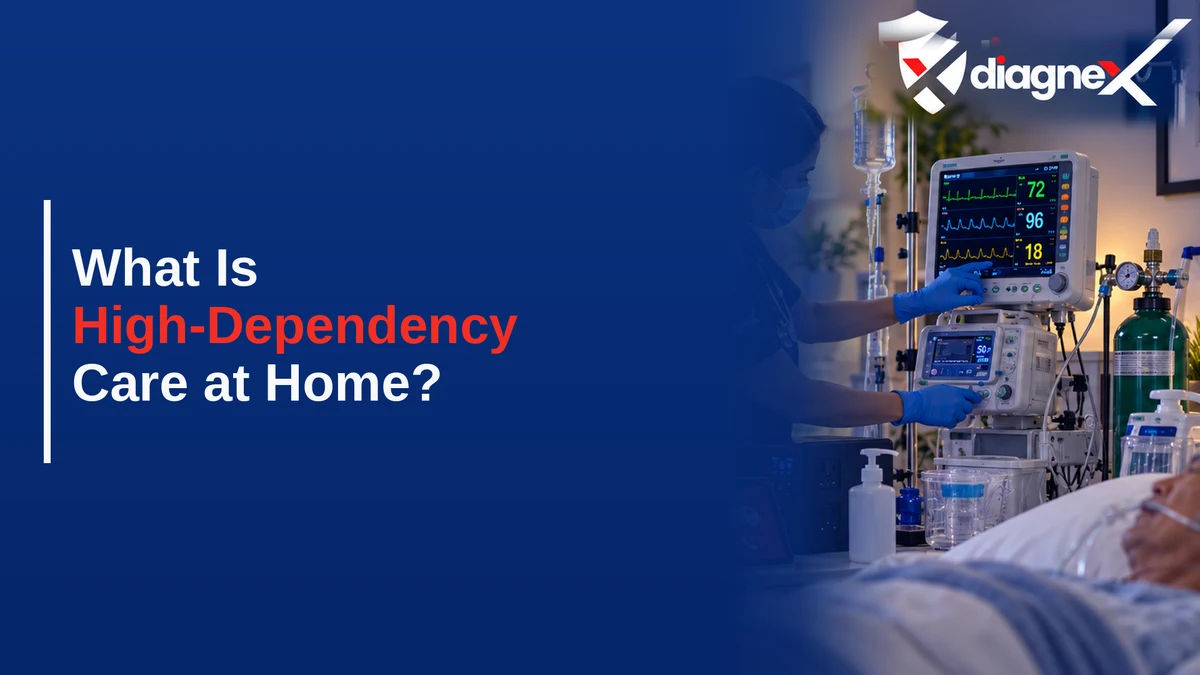
High-dependency care at home is a term that may be used for patients who need more clinical support than routine home care but do not necessarily require the full intensity of a hospital ICU. These patients may still need skilled nursing, closer monitoring, oxygen or respiratory support, complex medicines, feeding assistance, mobility support or management of medical devices after hospital discharge. However, the term high-dependency care is not used in exactly the same way by every hospital or home-care provider. Families should therefore focus on the patient's actual clinical needs rather than assuming that the label describes a fixed package of services.
What Does High-Dependency Care at Home Mean?
- Skilled nursing
- Regular or continuous monitoring of selected clinical parameters
- Prescribed oxygen therapy
- Respiratory support where clinically indicated
- Medication administration
- Infusion support where prescribed
- Feeding support
- Wound, catheter or tube care
- Mobility, positioning and pressure care
- Clear escalation and hospital-transfer planning
Is HDU Care at Home the Same as a Hospital HDU?
No. A hospital high-dependency unit is part of a hospital's clinical infrastructure, with facility-based staffing, equipment, medical oversight and access to escalation resources. A home environment cannot be assumed to reproduce all of those capabilities. When the term HDU care at home is used, it is better understood as a higher level of organised home-based support for a medically dependent patient rather than as a claim that the home has become a hospital HDU.
Who May Need High-Dependency Care at Home?
- Are recovering after an ICU or high-dependency hospital stay
- Need skilled nursing for multiple clinical tasks
- Require oxygen therapy
- Need closer monitoring than routine home-care patients
- Have feeding tubes, catheters, drains or wounds requiring professional care
- Have significant weakness or limited mobility
- Need rehabilitation after critical illness
- Require a structured step-down pathway before lower-intensity care
1. Patients Recovering After Critical Illness
- Weakness
- Reduced mobility
- Ongoing oxygen needs
- Feeding difficulties
- Need for regular monitoring
- Dependence on nursing care
2. Patients Who Need More Than Routine Nursing
- Clinical observations
- Medication administration
- Infusion support where prescribed
- Wound care
- Catheter or tube care
- Feeding support
- Airway or secretion care where required
- Documentation and escalation
3. Patients Requiring Closer Monitoring
A high-dependency patient may need more frequent clinical observation than a routine home-care patient. The treating team may prescribe monitoring of selected parameters such as: The frequency and type of monitoring should reflect the patient's condition. Continuous monitoring is not automatically required for every high-dependency patient.
- Heart rate
- Blood pressure
- Oxygen saturation
- Respiratory rate
- Temperature
- Fluid balance or urine output where relevant
- Other patient-specific observations
4. Patients on Oxygen or Respiratory Support
- The prescribed oxygen or respiratory support
- The primary equipment
- Monitoring requirements
- Power backup where electrically powered devices are essential
- Oxygen backup where clinically required
- Who is trained to manage the equipment
- What changes require urgent escalation
5. Patients With Multiple Tubes or Medical Devices
- Feeding tubes
- Urinary catheters
- Drains
- IV access
- Other prescribed devices
6. Patients With Significant Mobility Dependence
- Regular repositioning
- Pressure-area care
- Pressure-relieving mattress where indicated
- Wheelchair or commode
- Transfer aids
- Physiotherapy or rehabilitation
What Can High-Dependency Care at Home Include?
Clinical Assessment and Care Planning
Skilled Nursing
Monitoring
Oxygen and Respiratory Support
Medication and Infusion Support
Nutrition and Feeding Support
Wound and Device Care
Mobility and Rehabilitation
Emergency Escalation Planning
How Is High-Dependency Care Different From Step-Down Care at Home?
- the patient is moving from a higher-intensity setting toward lower-intensity care
- High-dependency care emphasises the current level of support the patient still needs
- A patient can therefore be receiving step-down care and still be highly dependent at the same time
How Is High-Dependency Care Different From Home ICU Care?
The distinction is generally based on clinical intensity. Home ICU care may involve more complex support such as advanced respiratory care, several infusion devices, more intensive monitoring or a higher level of continuous bedside clinical dependency. High-dependency care may involve substantial nursing and monitoring but with a lower level of critical-care intensity. There is no universal boundary between the two, so the treating team's assessment should guide the classification.
How Is High-Dependency Care Different From Routine Home Care?
- Greater clinical complexity
- More frequent observation
- More dependence on skilled nursing
- More medical equipment or devices
- More detailed escalation planning
- Closer connection to a recent hospital or ICU care plan
Is a Critical Care Unit at Home the Same as High-Dependency Care?
Not necessarily. The phrase critical care unit at home may be used informally, but it can imply a level of care closer to ICU support. High-dependency care may be a lower-intensity level depending on the patient's needs. Families should ask what nursing, monitoring, equipment, respiratory support and medical oversight are actually being provided rather than relying on the label alone.
What Equipment May Be Needed for High-Dependency Care at Home?
- Adjustable medical bed
- Pulse oximeter
- Multiparameter monitor where clinically required
- Oxygen concentrator or cylinders where prescribed
- Suction machine where indicated
- Nebuliser where prescribed
- Infusion or syringe pumps where required
- Feeding equipment
- Pressure-relieving mattress
- Wheelchair, commode or transfer aids
Does High-Dependency Care Need Continuous Nursing?
- Clinical stability
- Monitoring frequency
- Complexity of medicines and procedures
- Respiratory support
- Mobility and dependency
- Risk of sudden deterioration
- Family's ability to provide non-clinical support
What Should the Home Setup Include?
- Adequate working space around the medical bed
- Safe equipment placement
- Suitable electricity and backup power
- Oxygen backup where prescribed
- Storage for medicines and consumables
- Hand-hygiene supplies
- A clear patient-transfer route
- Access for nurses and other healthcare professionals
When May High-Dependency Care at Home Not Be Suitable?
- The patient remains clinically unstable
- Required treatment or monitoring cannot be delivered safely at home
- Skilled support is unavailable
- Essential power or oxygen continuity cannot be maintained
- Emergency transfer is impractical
- The home environment cannot accommodate the required equipment
- The treating team recommends continued facility-based care
How Is the Level of Care Reduced Over Time?
- Monitoring frequency
- Nursing intensity
- Dependence on medical equipment
- Assistance with mobility
- Clinical procedures
When Should Care Be Escalated Again?
If the patient's condition deteriorates, high-dependency home care may no longer be sufficient. The treating team should define patient-specific red flags. Escalation may be required if there is: The home ICU emergency or escalation plan should be activated without avoidable delay when the patient's required support can no longer be maintained.
- Worsening breathing difficulty
- Increasing oxygen or respiratory-support needs
- Reduced consciousness or new neurological change
- Significant changes in monitored vital signs
- New severe pain, bleeding or other acute symptoms
- Failure of essential medical equipment
- Inability to maintain required power or oxygen support
- Any other patient-specific warning sign defined by the treating team
Questions Families Should Ask Before Starting High-Dependency Care at Home
- Why is this level of care appropriate now?
- What does high-dependency mean for this particular patient?
- What monitoring is required?
- What nursing support is required?
- Does the patient need oxygen or respiratory support?
- What equipment is essential?
- What medicines or procedures will continue at home?
- What power and oxygen backup are required?
- What changes should trigger urgent escalation?
- What is the hospital-transfer plan?
- How often will the level of care be reviewed?
High-Dependency Care at Home Checklist
- Clinical suitability has been assessed
- The discharge or treatment plan is clear
- The home environment has been assessed
- The bed and required equipment are ready
- Nursing support is confirmed
- Monitoring instructions are documented
- Medicines and consumables are available
- Power backup is planned where required
- Oxygen backup is planned where prescribed
- Feeding and mobility needs are addressed
- Patient-specific red flags are documented
- Ambulance or transport contacts are available
- Hospital-transfer arrangements are understood
High-Dependency Care Should Be Defined by Need, Not by Label
The most important question is not whether the service is called HDU care, high-dependency care, step-down ICU care or advanced care at home. What matters is whether the patient's current clinical needs have been assessed accurately and whether the home setup, professionals, equipment, monitoring and escalation plan can support those needs safely. Families exploring Home ICU / Advanced Care at Home can speak with Diagnex to understand the assessment and care-planning process and discuss appropriate next steps, subject to clinical suitability and service availability.
Frequently Asked Questions
What is high-dependency care at home?
What is HDU care at home?
Who may need high-dependency care at home?
Is high-dependency care the same as step-down care?
They can overlap. Step-down care describes a transition toward lower-intensity support, while high-dependency care describes the patient's current level of dependence. A patient may be receiving both at the same time.
Is high-dependency care the same as a home ICU?
Not necessarily. Home ICU care may involve a higher level of clinical intensity, more complex equipment or advanced respiratory support. The distinction depends on the patient's actual needs.
Does high-dependency care require continuous monitoring?
Not always. Monitoring frequency should be decided by the treating team according to the patient's condition. Some patients require regular observations rather than continuous monitoring.
Does high-dependency care require a nurse?
Can high-dependency care be increased to ICU-level care if the patient worsens?
SEO Details
SEO Title: What Is High-Dependency Care at Home? HDU Care Explained Meta Description: Learn what high-dependency care at home means, who may need HDU-level support, what it can include, and how it differs from step-down care, routine home care and home ICU. Primary Keyword: high dependency care at home Secondary Keywords: HDU care at home, critical care unit at home, step down ICU care Suggested URL: /blog/what-is-high-dependency-care-at-home