The cost of an injection at home is not one universal fee. A basic prescribed IM or subcutaneous injection may involve a short nurse visit and standard single-use supplies. An IV medicine may require vascular access, longer nursing time, closer observation and more equipment. Same-day or late-hour requests can cost differently from scheduled daytime visits. Some providers include syringes and basic consumables in the visit charge; others bill medicines, IV sets, cannulas or special supplies separately.
Publicly listed Indian home-injection prices also vary widely. Current provider pages reviewed for this article show basic home injection visits advertised from a few hundred rupees, while some branded services list IM or subcutaneous visits at ₹1,000 or more. IV procedures and longer infusions are generally priced higher. These public figures are market examples, not a standard national tariff and not a Diagnex price quote.
The useful question is therefore not only, “How much does an injection at home cost?” It is, “What exactly is included in this visit, how complex is the treatment, and what could change the final charge?” This guide explains the main cost drivers, which charges patients should clarify before booking, how repeat courses differ from one-off visits, and why the cheapest quote is not always the lowest-cost option once medicines, supplies, travel and observation are added.
How Much Does an Injection at Home Usually Cost?
There is no regulated national price for a routine home injection visit. Public provider listings show a wide spread. Some current Indian listings advertise basic subcutaneous or IM injection visits from roughly ₹199 to ₹650. Other branded providers list IM or subcutaneous nursing visits around ₹1,000 or more.
IV injection, cannulation or infusion visits are often priced higher because they can take longer and involve additional equipment, vascular access and monitoring. A broad market statement such as “home injections cost ₹300 to ₹800” may describe some providers, but it is not reliable enough to treat as a universal quote. For Diagnex, the actual visit charge should be confirmed against the current requirement rather than inferred from a generic online range.
- Injection route
- Professional time
- Observation required
- Location and travel
- Urgency or same-day booking
- Time of day
- Medicine cost
- Consumables
- Number of injections
- Whether the booking is one-time or recurring
- Patient complexity
- Whether IV access is already present
The 10 Main Factors That Affect Injection at Home Cost
1. The Route of Injection
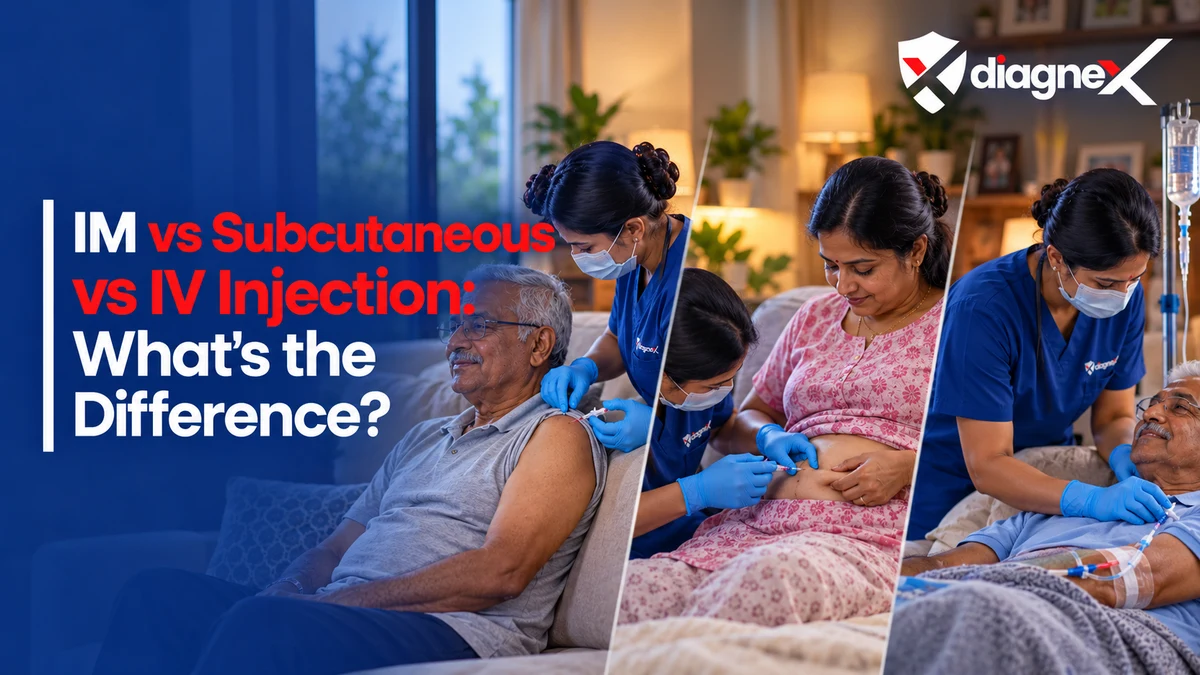
The route can materially change the amount of nursing work involved. A prescribed subcutaneous injection may be relatively quick. A routine IM injection may also fit a short procedure visit. That additional time and complexity can increase the charge. For a route-by-route comparison, see IM vs Subcutaneous vs IV Injection: What's the Difference?
- Cannulation
- Existing line assessment
- Medicine preparation
- Infusion setup
- Rate control
- Longer observation
- IV-site monitoring
- Line-related troubleshooting
2. How Long the Nurse Needs to Stay
The visit fee is not only the cost of “giving the injection.” A routine injection may require a short visit. An IV infusion may keep the nurse at the bedside for much longer. The longer the nurse is clinically required to remain, the more likely the pricing model is to reflect time rather than only the procedure itself.
- Travel
- Patient verification
- Prescription review
- Allergy checks
- Medicine verification
- Preparation
- Administration
- Observation
- Documentation
- Aftercare instructions
- Sharps disposal
3. Whether IV Cannulation Is Required
If the patient does not already have usable IV access, the nurse may need to insert a peripheral cannula before the medicine can be given. Extra attempts if access is difficult. Additional observation. A quote for “IV injection” should therefore clarify whether cannulation is included. A patient with a functioning PICC, port or existing peripheral line may have a different cost structure, depending on the care model.
- Professional time
- Cannula cost
- IV set or extension tubing
- Dressing material
4. Same-Day or Urgent Booking
- Rearrange schedules
- Find a nurse with the right competency nearby
- Coordinate medicines or supplies quickly
- Cover extra travel
- Accommodate a narrow treatment window
Urgent does not mean emergency. A same-day prescribed antibiotic dose, anticoagulant injection or post-discharge medicine can be a legitimate time-sensitive need. Severe breathing difficulty, chest pain, collapse or another emergency should not be treated as a premium home-booking request. For urgent-but-stable care, see Same-Day Nursing Procedures at Home: What Can Usually Be Arranged?
5. Time of Day
- Early-morning visits
- Late-evening visits
- Night visits
- Public holidays
- Very narrow time windows
- This reflects staffing and travel availability rather than the medicine itself
6. Patient Location and Travel
A home injection includes a professional travelling to the patient. Two patients requesting the same IM injection can therefore receive different quotes if the operational travel requirement is different. A provider should confirm locality before promising a visit or a price.
- Distance
- Traffic
- Locality
- Parking or access
- Whether the nurse is already working nearby
- Whether the area has regular service coverage
7. Whether the Medicine Is Included
The nursing visit and the medicine are often separate costs. Some providers expect the patient to purchase the prescribed medicine from a pharmacy. Others may coordinate the medicine and add its actual cost or MRP. The quote should clarify: Is the medicine included?
Is it billed separately? Who is responsible for sourcing it? Does it require refrigeration or controlled storage? Is delivery charged separately? A low “nurse visit fee” can look very different after an expensive medicine is added.
8. Consumables and Single-Use Supplies
- Sterile syringe
- Sterile needle
- Alcohol swab
- Gauze
- Gloves where indicated
- Plaster or dressing
- Sharps container
- IV cannula for IV therapy
- IV set
- Extension tubing
- Saline flush where prescribed and appropriate
- Some providers include standard consumables
- Others charge them separately
For IV treatment, consumables can be a more meaningful part of the total than for a simple IM or subcutaneous injection. CDC and WHO injection-safety guidance supports sterile single-use injection equipment and safe sharps disposal. Consumables should never be reused simply to reduce cost.
9. One Injection vs a Course of Injections
- One injection
- A daily course for several days
- Weekly injections
- A longer recurring schedule
- Plan nurse routing more efficiently
- Schedule the same time each day
- Use the same nurse where possible
- Quote a package or recurring rate
10. Patient Complexity and Monitoring
Two patients can receive the same medicine but need different levels of care. A need for repeated vital-sign monitoring. A first dose that requires closer observation. A recent hospital discharge. A higher risk of bleeding. A need for longer post-injection observation. Complexity does not always mean the visit will cost more, but it can change the time, professional skill and monitoring required.
- A history of serious allergic reaction
- Frailty
- Multiple medical conditions
- Difficult IV access
- A central line or port
What Is Usually Included in a Home Injection Visit Charge?
Inclusions vary by provider. Patients should not assume all of these are included automatically. The safest booking process is to ask for the total expected charge and the exact inclusions before confirming.
- Nurse travel
- Procedure time
- Prescription and medicine verification
- Injection administration
- Standard single-use syringe and needle
- Basic swabs or gauze
- Sharps disposal
- Short observation
- Basic documentation
- Aftercare guidance
What Is Often Charged Separately?
- The prescribed medicine
- Special consumables
- IV cannula
- IV tubing or infusion set
- IV fluid
- Special storage or cold-chain handling
- Doctor consultation
- Prescription review by a doctor
- Laboratory testing
- Longer observation
- Additional injections in the same visit
- Night or holiday surcharge
- Travel beyond the usual service area
Example Cost Scenarios: Why the Same “Injection at Home” Can Price Differently
Scenario 1: One Routine IM Injection
- Short professional visit
- Standard single-use syringe and needle
- Routine travel
- Basic documentation
- No IV equipment
- No prolonged observation
Scenario 2: Same-Day IM Injection
- Urgent scheduling
- Less efficient nurse routing
- Narrow treatment window
- Extra travel
- After-hours timing
Scenario 3: IV Antibiotic With Existing Access
- Longer professional time
- Medicine preparation
- IV tubing or administration set
- Line assessment
- Observation during or after administration
- Documentation
- Possible repeat visits over several days
Scenario 4: IV Treatment Requiring Cannulation
- Cannula
- Dressing
- Additional sterile supplies
- Extra nursing time
- Potential repeat attempts
- Additional site monitoring
Scenario 5: Recurring Subcutaneous Injection Course
- Number of visits
- Medicine cost
- Supplies
- Travel
- Any monitoring
- Whether the patient or caregiver can safely self-administer after training
Is the Cheapest Home Injection Service the Best Value?
- The provider cannot confirm who is coming
- The professional is not competent for the route
- The patient has to source missing supplies after the nurse arrives
The appointment is cancelled because the prescription was not checked beforehand. The family has to pay separately for items assumed to be included. A useful comparison is based on total expected cost and clinical completeness rather than headline price alone.
- Medicine
- Syringe
- Needle
- IV supplies
- Travel
- Observation
- Documentation
- Night surcharge
- Repeat-attempt charges
- Doctor review
What Should You Ask Before Accepting a Quote?
- What is the total visit charge?
- Is nurse travel included?
- Is the medicine included?
- Are the syringe and needle included?
Are IV supplies included if this is IV treatment? Is cannulation charged separately? Is there a same-day or after-hours surcharge? Does the quote include observation? What happens if IV access is difficult?
Is there an extra charge for a second injection during the same visit? Is documentation included? Are repeat-course rates available? Does the price change by locality? These questions reduce the chance of unexpected charges after the nurse arrives.
Does the Type of Medicine Affect the Cost?
Yes, but often indirectly. The medicine itself can have a very different price from the nursing visit. For example, a low-cost generic injectable medicine and an expensive biologic injection may require similar nursing time but have dramatically different medication costs.
- Have a higher reaction risk
- Need monitoring before or after administration
- The quote should separate professional service cost from medicine cost whenever possible
- Need refrigeration
- Require controlled preparation
- Need slower administration
- Require longer observation
Does IM Injection Cost Less Than IV Injection at Home?
Often, but not always. A routine IM injection can be simpler because it usually does not require vascular access, IV tubing or prolonged infusion time. That can increase the service charge. However, the final price still depends on the provider, medicine, duration, location and whether vascular access is already available. For the clinical differences, see IM vs Subcutaneous vs IV Injection: What's the Difference?
- Cannulation
- Line care
- Infusion equipment
- Longer visit duration
- Closer monitoring
- More troubleshooting
Does Subcutaneous Injection Cost Less?
A straightforward prescribed subcutaneous injection can be one of the simpler nurse visits. Some medicines are also designed for patient or caregiver self-administration after training. If professional administration is still needed, cost may remain similar to a routine short nursing visit.
- The patient needs close observation
- The medicine is expensive
- The visit is urgent
- The patient has limited mobility
- The provider travels a long distance
- The medicine requires special handling
Can You Reduce Home Injection Cost Safely?
- Book in advance when the timing is flexible
- Keep the prescription ready before requesting the visit
- Confirm the medicine and route
Have the prescribed medicine available if the provider expects the family to source it. Confirm which supplies are included. Schedule recurring doses together when possible. Ask whether repeat-course pricing is available. Use a short procedure visit instead of a full nursing shift when clinically appropriate. Avoid urgent or late-night booking when there is no clinical need for it. Cost-saving should never compromise the prescription or injection-safety process.
- Reusing needles or syringes
- Using expired or poorly stored medicine
- Changing the route without authorisation
- Skipping required observation
- Asking an unqualified person to administer the injection
- Using leftover medicine from a previous treatment course without confirmation
Short Visit Nurse vs Full-Shift Nurse for an Injection
- The patient is stable
- Only one injection is required
- The medicine and route are clear
Observation is limited. No other nursing tasks are needed. For the full comparison, see Short-Visit Nurse vs Full-Shift Nurse: Which One Is Needed?
- Repeated medicines
- Multiple procedures
- Frequent monitoring
- Catheter or tube care
- IV therapy across several hours
- Complex post-discharge nursing
- Ongoing bedside support
How Same-Day Injection Pricing Can Differ
Same-day service often costs more because it reduces the provider's ability to plan. That does not mean every provider charges an emergency premium. It means same-day availability is a real operational variable. Diagnex should therefore confirm current availability and pricing for the specific requirement rather than publishing a blanket “same-day injection at ₹X” claim.
- Finding a nurse with the right competency
- Re-routing an existing schedule
- Covering longer travel
- Sourcing equipment quickly
- Accommodating a narrow dose window
- Providing evening or night coverage
What About Injection Cost After Hospital Discharge?
Post-discharge injection cost depends on how the treatment plan is structured. The discharge summary should clarify the schedule before the family compares quotes. A bundled post-discharge plan may sometimes be more practical than booking each visit separately. For the broader care transition, see Clinical Procedures at Home After Hospital Discharge.
- One injection
- A daily course
- Several medicines
- IV treatment
- Wound care plus injection
- Monitoring
- Longer nursing support
Injection Cost for Elderly or Bedridden Patients
Older or bedridden patients do not automatically cost more simply because of age or mobility status. A need for more observation. Additional clinical tasks during the same visit. If the patient needs several procedures, the provider should assess whether one short injection visit is still the right model. For more detail, see Clinical Procedures at Home for Elderly Patients and Clinical Procedures at Home for Bedridden Patients.
- Difficult positioning
- Multiple medicines
- A history of reactions
- Frailty
- Complex IV access
- Cognitive impairment
Why a Clear Prescription Can Prevent Wasted Cost
- A nurse arriving but being unable to administer the medicine
- Wrong supplies being brought
- Incorrect route assumptions
- A delay while the treating doctor is contacted
A second visit being required. Medicine being purchased unnecessarily. Confirming the prescription before dispatch protects both safety and cost. For the full prescription guide, see Do You Need a Doctor's Prescription for a Clinical Procedure at Home?
What Diagnex Should Confirm Before Quoting an Injection Visit
- Patient locality
- Medicine name
- Dose
- Route
- Required timing
- Whether the medicine is already available
- Whether this is a first dose
- Allergy or previous reaction history where relevant
- Whether IV access is required
- Expected visit duration
- Observation requirements
- Whether standard consumables are included
- Whether additional supplies are needed
- Whether the visit is one-off or recurring
- Whether the booking is same-day or scheduled
How Diagnex Handles Injection-at-Home Pricing
Diagnex's current service directory includes nursing injections among its clinical-procedure enquiries. The service listing should not be read as a fixed price, guaranteed same-day slot or promise of availability in every locality. Monitoring needs. Repeat-visit schedule.
Professional availability. If you are unsure which service fits, use Find the Right Care. For the booking and safety process, read Injection at Home: What Patients Should Know Before Booking. For injection safety specifically, read Is It Safe to Take an Injection at Home?
- Procedure type
- Route
- Professional time
- Locality
- Urgency
- Medicine and consumable responsibility
Frequently Asked Questions
How much does an injection at home cost?
There is no universal fee. Public Indian listings currently range from a few hundred rupees for some basic home injection visits to ₹1,000 or more at some branded providers, with IV procedures and longer observation generally costing more. Confirm the current provider quote and inclusions.
What affects nurse injection charges?
Is the medicine included in the injection-at-home cost?
Not always. Many providers charge separately for the prescribed medicine. Ask whether the quote includes only the nursing visit or also the medicine and supplies.
Does a same-day injection cost more?
It can. Same-day requests may require urgent scheduling, extra travel or after-hours coverage. Pricing varies by provider and locality.
Is IV injection at home more expensive than IM injection?
Do repeat injections cost less?
Are syringes and needles included?
Can I reduce the cost by using my own medicine?
Do elderly patients pay more for a home injection?
Why shouldn't Diagnex publish one fixed injection price?
The Bottom Line
Injection at home cost is best understood as the price of a clinical visit, not simply the act of giving a medicine. The final charge can reflect the route, nurse time, travel, same-day scheduling, observation, IV access, medicine, consumables and whether the patient needs one visit or a full treatment course. When comparing providers, ask for the total expected cost and what it includes. A ₹300 visit that excludes travel, supplies and medicine may not be cheaper than a ₹700 all-inclusive visit. For Diagnex, the most defensible pricing approach is to quote the actual requirement after confirming the medicine, route, locality, timing and care needs - rather than publishing a universal number that may not fit the patient.
Sources and Market References
Diagnex: Clinical Procedures and Home Nursing Services - current service categories and note that suitability, prescription requirements, professional responsibility and local availability should be confirmed for the specific requirement. Apollo HomeCare: Injection at Home - public service information and current injection-at-home offering. Portea: Injection at Home - public information on home injection services and factors that can influence care requirements.
HCAH: Nursing Procedures at Home - public information on procedure-based home nursing services. CDC: Injection Safety - safe injection and single-use equipment principles. WHO: Injection safety - sterile single-use injection equipment and sharps-safety guidance.
This article provides general pricing information, not a Diagnex quotation. Public competitor prices can change and may exclude medicines, consumables, taxes, travel or other charges. Confirm the current total price and inclusions before booking.