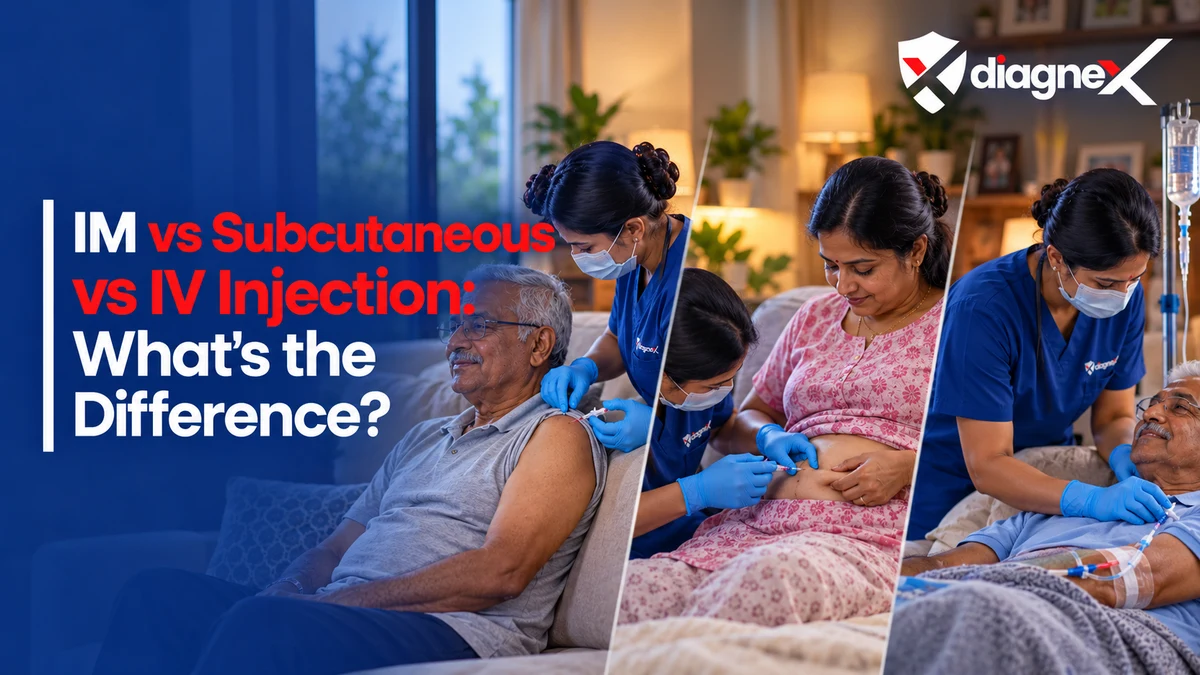
IM, subcutaneous and IV injections deliver medicine to different parts of the body. An intramuscular (IM) injection places medicine into muscle. A subcutaneous injection places medicine into the fatty tissue just beneath the skin. An intravenous (IV) injection or infusion delivers medicine through a vein, placing it directly into the bloodstream.
That difference affects how the medicine is delivered, how quickly it becomes available to the body, what volume and formulation can be used, which professional skills are needed, and how much monitoring may be required. The route is not interchangeable. A medicine prescribed for subcutaneous use should not be changed to IM because a family prefers one site. An IM medicine should not be pushed into an IV line because “it will work faster.” The route is part of the prescription and treatment plan. For patients arranging an injection at home, understanding the difference helps you ask the right questions before booking - but the route itself should be chosen by the prescribing professional.
IM vs Subcutaneous vs IV Injection: The Quick Comparison
- Medicine goes into muscle
- Absorption occurs from the muscle into the bloodstream
Often used when the medicine is formulated for muscle delivery. May be suitable as a short home nurse visit for a stable patient with a clear prescription. Usually requires an appropriately trained professional unless the patient has been specifically trained for a particular medicine.
Many medicines given by this route are designed for repeated administration, and some patients can self-administer after appropriate training. A home nurse may still be useful when the patient is newly prescribed, has limited dexterity, poor vision, cognitive difficulty or prefers professional administration. IV injection or infusion:
Medicine or fluid is delivered through a vein or vascular-access device. It enters the bloodstream directly rather than first being absorbed from muscle or subcutaneous tissue. It may be given as a bolus, slow injection or infusion depending on the treatment. Home IV therapy usually requires more clinical planning, vascular-access management and monitoring than a routine IM or subcutaneous injection.
- Medicine goes into fatty tissue beneath the skin
- Absorption occurs through the subcutaneous tissue
- Common examples include insulin, some anticoagulants, fertility medicines and selected biologic therapies
- IM = muscle
- Subcutaneous = fatty tissue under the skin
- IV = vein
What Is an Intramuscular Injection?
An intramuscular injection places a prescribed medicine into muscle tissue. Muscle has a richer blood supply than subcutaneous fat, so medicines given intramuscularly can be absorbed into the circulation from the injection site. The actual speed of absorption depends on the medicine, formulation, injection site, blood flow and patient factors. Some medicines are specifically formulated for IM administration. A patient should not assume that any injectable medicine can be given intramuscularly.
- Certain antibiotics
- Some vitamin preparations
- Hormonal medicines
- Some vaccines
- Some long-acting or depot medicines
- Other prescribed drugs designed for intramuscular delivery
- The exact medicine matters more than the route label alone
Why Are Some Medicines Given IM?
- The medicine is formulated for muscle administration
- Oral administration is not suitable
- A sustained or depot effect is intended
- The medicine needs absorption from muscle rather than direct IV administration
The patient cannot take the medicine by mouth. The treatment protocol specifies an IM route. The route should follow the product instructions and prescription.
IM Injection at Home
An IM injection at home can be appropriate when: The patient is clinically stable. The medicine is already prescribed. The dose and route are clear. The medicine is suitable for home administration.
The nurse has the appropriate competency. The patient does not need hospital-level monitoring. Required supplies are available. There is a plan for what happens if the patient reacts. Many IM injections can be organised as a task-focused nurse visit rather than a full nursing shift. For the booking process, see Injection at Home: What Patients Should Know Before Booking.
What Are the Main Risks of an IM Injection?
- Pain or tenderness
- Bruising or bleeding
- Local swelling
- Injection-site infection
- Incorrect injection site
- Nerve or blood-vessel injury
- Administration by the wrong route
- Allergic or other medicine-related reactions
- Risk varies with the medicine, site, technique and patient
What Is a Subcutaneous Injection?
A subcutaneous injection places medicine into the layer of fatty tissue just beneath the skin. MedlinePlus describes subcutaneous injection as medicine delivered into fatty tissue under the skin and lists insulin, blood thinners and fertility medicines among common examples. Compared with IV administration, the medicine must still be absorbed from the injection site into the circulation. Compared with IM administration, subcutaneous delivery uses a different tissue layer and is often chosen for medicines specifically designed for that route.
- Insulin
- Some anticoagulants
- Fertility medicines
- Selected hormone treatments
- Some biologic medicines
- Other therapies specifically formulated for subcutaneous use
Why Are Some Medicines Given Subcutaneously?
- The medicine is formulated to be absorbed from subcutaneous tissue
- Repeated dosing is needed
- A prefilled syringe, pen or auto-injector is available
- The patient may be able to self-administer after training
The medicine does not require direct intravenous access. The route is still a treatment decision. A medication intended for subcutaneous administration should not be moved into muscle or a vein unless the prescribing information and treating professional specifically support that change.
Subcutaneous Injection at Home
Subcutaneous injections are among the injection routes most commonly managed outside a hospital. Some patients learn to self-administer medications such as insulin or selected anticoagulants. A family member may also be trained for selected medicines. Training should be medicine-specific and patient-specific rather than copied from general online instructions.
- Poor vision
- Tremor
- Arthritis
- Reduced hand strength
- Cognitive impairment
- Anxiety
- A new medicine
- A recent hospital discharge
- Difficulty understanding the device
- A treating-team preference for supervised administration
Why Injection-Site Rotation Matters
Repeated subcutaneous injections in the same small area can damage tissue and interfere with consistent absorption. MedlinePlus advises rotating subcutaneous injection sites to help keep the skin and underlying tissue healthy. Patients using insulin or another repeated subcutaneous medicine should follow the site-rotation plan given by their treating team. A nurse can reinforce that plan, but the actual schedule should match the medicine and clinical instructions.
What Are the Main Risks of a Subcutaneous Injection?
- Pain or tenderness
- Bruising
- Redness or swelling
- Local infection
- Repeated-site tissue changes
- Incorrect dose
- Wrong medicine
- Wrong route
- Allergic or medicine-related reactions
What Is an IV Injection?
IV stands for intravenous. Because the medicine enters the bloodstream directly, IV administration does not rely on absorption from muscle or subcutaneous tissue. This makes IV delivery clinically useful when the treatment needs direct vascular administration, but it also means errors or reactions can have rapid consequences.
- A peripheral IV cannula
- A PICC line
- A central venous catheter
- An implanted port
- Another appropriate vascular-access device
IV Injection vs IV Infusion
These terms are related but not identical. An IV injection may refer to a medicine given into the vein over a relatively short period. An IV infusion usually delivers medicine or fluid over a longer period through tubing, a pump or a controlled flow system. MedlinePlus describes home IV treatment as including both faster bolus administration and slower infusions, depending on the prescribed therapy. Patients should therefore tell the provider the exact IV treatment rather than simply asking for “an IV injection.”
IV Injection at Home
- The treatment is prescribed
- The patient is stable
- The vascular-access plan is clear
- The professional is competent in IV therapy
The medicine or fluid is appropriate for home delivery. Monitoring needs can be met. Required equipment is available. There is a clear escalation plan. A request such as “start an IV because the patient feels weak” is not equivalent to a prescribed IV treatment plan.
- A post-discharge antibiotic course
- A defined infusion plan
- Treatment through an established vascular-access device
- Selected hydration or medication therapy prescribed by the treating team
Why IV Usually Needs More Planning Than IM or Subcutaneous Injection
- Obtaining or confirming vascular access
- Checking an existing IV device
- Preparing a medicine or infusion correctly
- Controlling administration rate
- Monitoring the IV site
- Watching for infiltration, phlebitis or other access problems
- Recognising rapid medicine reactions
- Managing IV tubing and equipment
What Are the Main Risks of IV Administration?
- Pain or irritation at the IV site
- Infiltration or extravasation into surrounding tissue
- Phlebitis
- Bleeding
- Local or bloodstream infection
- Loss of IV access
- Fluid-related complications
- Dose or rate errors
- Allergic or other medicine reactions
- Complications related to central or long-term vascular-access devices
How Fast Do IM, Subcutaneous and IV Injections Work?
IV administration generally makes a medicine available to the bloodstream immediately because it is delivered directly into a vein. IM and subcutaneous injections require absorption from the tissue into the circulation. That does not mean every IV medicine “works faster” in a clinically useful sense, or that an IM medicine always works faster than a subcutaneous one.
The condition being treated. Some long-acting IM injections are intentionally designed to release medicine slowly. Some subcutaneous medicines are also designed for sustained or repeated use. Patients should therefore avoid choosing a route based on a simple “fastest is best” assumption.
- The medicine
- The formulation
- The route
- The dose
- The injection site
- Blood flow to the tissue
- The patient’s circulation
How Much Medicine Can Be Given by Each Route?
The appropriate volume depends on the medicine, formulation, body site, patient and clinical protocol. In general: Subcutaneous injections usually involve smaller volumes. IM injections may accommodate larger volumes than subcutaneous injections depending on the site and medicine.
IV therapy can deliver medicines or fluids in a wide range of volumes, but the amount and rate must follow the treatment plan. These are clinical considerations, not booking preferences. The nurse should follow the prescribed route and product-specific instructions rather than trying to “fit” a medicine into a more convenient route.
Which Route Is More Painful?
Pain varies widely. An IM injection may cause muscle soreness. A subcutaneous injection can sting or bruise. IV insertion may be uncomfortable, and some IV medicines can irritate the vein. Pain alone should not be used to choose a different route.
- Medicine formulation
- Needle size
- Injection site
- Volume
- Technique
- Patient sensitivity
- Previous scar tissue
- Local inflammation
- Rate of administration
Which Route Is Best for Home Administration?
There is no single best route. The safest route is the one prescribed for the medicine and appropriate for the patient. In practical home-care terms: Subcutaneous injections are often the easiest route for repeated outpatient or home use when the medicine is designed for self-administration or caregiver administration.
IM injections are often suitable for short nursing visits when the patient is stable and the treatment is clearly prescribed. IV treatment generally needs more planning because vascular access, infusion rate, monitoring and complication management matter. Home suitability depends on both the route and the medicine.
Does Every IM Injection Need a Nurse?
Not every IM injection necessarily requires a visiting nurse in every healthcare system or circumstance. However, patients should not assume that an IM injection is suitable for self-administration simply because it is “only an injection.” If self-administration has not been specifically taught and approved for that medicine, professional administration is the safer assumption.
- The medicine
- The route
- The patient’s training
- The injection site
- The treatment protocol
- Local professional and regulatory requirements
- The patient’s physical and cognitive ability
Can Patients Give Themselves Subcutaneous Injections?
Some subcutaneous medicines are specifically designed for patient self-administration. Examples may include insulin, selected anticoagulants, fertility medicines and biologic treatments. Self-administration should follow training from the treating team, pharmacist, nurse or other qualified professional. This article does not teach injection technique. If a patient has not been trained, a home nurse visit may be more appropriate.
- Which medicine and dose to use
- Which device is being used
- How to store the medicine
- How to rotate approved injection sites
- What to do after a missed dose
- Which reactions need review
- How to dispose of sharps safely
Can an IV Injection Be Self-Administered?
IV therapy should not be treated like routine self-injection unless the patient is enrolled in a structured home-infusion pathway and has been specifically trained for the exact treatment and vascular-access device. Many IV medicines require professional administration or oversight. For most patients searching for an IV injection at home, the appropriate next step is to confirm the prescription and arrange the correct professional service rather than attempting the procedure independently.
- Wrong dose
- Wrong rate
- Contamination
- Air entry into the line
- Damage to vascular access
- Infiltration or extravasation
- Serious medicine reactions
- Infection
Why the Prescription Must Include the Route
The route is part of the treatment. The same medicine name may exist in different formulations. A nurse should not assume that an injectable product can be given by any route. If the prescription is unclear or conflicts with the medicine label, administration should be paused and clarified. For a deeper explanation, see Do You Need a Doctor's Prescription for a Clinical Procedure at Home?
- Intramuscular
- Subcutaneous
- Intravenous
- Or delivered by another route
Can the Route Be Changed if the Patient Prefers Another One?
Not without appropriate clinical authorisation. Monitoring needs. The prescribing professional should determine the route. The patient can discuss preferences or previous problems, but the route should not be changed solely for convenience.
- Absorption
- Onset
- Bioavailability
- Dose requirements
- Safety profile
- Tissue exposure
What If the Nurse Cannot Get IV Access?
Difficulty obtaining IV access can happen, especially in patients who are dehydrated, elderly, chronically ill or have had repeated cannulation. The next step depends on the treatment and patient. What should not happen is changing the medicine to IM or subcutaneous administration without authorisation simply because IV access is difficult.
- Another attempt by an appropriately skilled professional
- Using an existing approved vascular-access device
- Rescheduling with a more experienced clinician
- Contacting the treating team
- Moving the treatment to a clinical facility
First Dose: Does the Injection Route Change the Setting?
Sometimes. A first dose of a medicine may need closer monitoring depending on the medicine, route and risk of severe reaction. This can be particularly relevant for selected IV treatments because the medicine reaches the bloodstream directly and some therapies require controlled observation. A first IM or subcutaneous dose can also need additional monitoring if the medicine carries significant reaction risk. The prescribing team or provider should determine whether the first dose is suitable for home administration.
IM, Subcutaneous and IV Injections After Hospital Discharge
- IM antibiotic or other prescribed injections
- Subcutaneous anticoagulant injections
- Subcutaneous insulin
- IV antibiotic therapy
- IV medication through a PICC or other vascular-access device
- Medicine
- Dose
- Route
- Frequency
- Duration
- Timing
- Monitoring
- Follow-up
- For broader post-discharge planning, see Clinical Procedures at Home After Hospital Discharge
Injection Routes in Elderly Patients
Older adults may receive medicines by any of these routes. A route that is technically possible may still need extra review in a frail patient. For elderly-specific planning, see Clinical Procedures at Home for Elderly Patients.
- Thin or fragile skin
- Low muscle mass
- Poor circulation
- Kidney or liver disease
- Multiple medicines
- Bleeding risk
- Dehydration
- Difficulty with self-administration
- Cognitive impairment
- Previous difficult IV access
Injection Routes in Bedridden Patients
A bedridden patient may receive IM, subcutaneous or IV medicines at home depending on the treatment plan. Monitoring needs. Caregiver support. If injections are only one of many daily nursing tasks, a short visit may not provide enough support. For the wider context, see Clinical Procedures at Home for Bedridden Patients.
- Pressure-injury risk
- Mobility
- Existing devices
- Wound care
- Catheter or tube care
Which Route Usually Needs the Most Monitoring?
- The medicine reaches the bloodstream directly
- Vascular access needs management
- Infusion rate may matter
Some reactions can occur quickly. Line-related complications are possible. An IM or subcutaneous injection can also require significant monitoring depending on the medicine and patient. The medicine-specific risk is often more important than the route alone.
When Should an Injection Be Given in a Hospital Instead of at Home?
- The patient is unstable
- The medicine requires continuous or advanced monitoring
- The first dose needs monitored administration
- There is a history of severe reaction
The route or dose is unclear. The patient needs rapid diagnostic backup. The IV treatment has a high risk of complications. Emergency treatment may be needed if a reaction occurs. The home environment cannot support safe delivery. For the broader setting decision, see When Should a Procedure Be Done at Home vs in a Hospital?
Home Injection Safety Applies to Every Route
Regardless of route, safe injection practice still matters. It does not change the need for basic infection prevention. For a deeper infection-control guide, see How Infection Control Works During a Clinical Procedure at Home.
- Appropriate hand hygiene
- Aseptic medication preparation
- New sterile single-use needles and syringes
- Correct patient and medicine verification
- Safe handling of medication containers
- Safe sharps disposal
- Avoiding reuse of single-use equipment
- The route changes how the medicine enters the body
How Diagnex Handles IM, Subcutaneous and IV Injection Enquiries
Diagnex’s current service directory includes nursing injections and IV cannulation among its clinical-procedure enquiries. A service listing does not mean every injectable medicine, route or patient is automatically suitable for home administration or available in every locality. Vascular-access needs.
Local availability. Escalation requirements. If you are unsure what service fits, use Find the Right Care. For the general booking guide, read Injection at Home: What Patients Should Know Before Booking. For same-day urgent-but-stable procedures, see Same-Day Nursing Procedures at Home: What Can Usually Be Arranged?
- The prescription or clinical order
- Medicine
- Dose
- Route
- Patient condition
- Allergy and reaction history
- Professional competency
- Monitoring requirements
Frequently Asked Questions
What is the difference between IM, subcutaneous and IV injection?
Which injection route works fastest?
Can an IM injection be given at home?
Can a subcutaneous injection be given at home?
Can an IV injection be given at home?
Can I change an injection from IM to subcutaneous?
Is IM more painful than subcutaneous injection?
Does IV require a nurse?
Which route is safest?
Do all injection routes use the same needle?
No. Equipment differs by route, medicine, device and clinical protocol. Patients should not select equipment themselves unless specifically trained for a prescribed self-administration plan.
The Bottom Line
IM, subcutaneous and IV injections are different routes with different clinical purposes. IM places medicine into muscle. Subcutaneous administration places medicine into fatty tissue beneath the skin. IV administration delivers medicine directly into the bloodstream through a vein or vascular-access device.
The route affects absorption, administration, monitoring and home-care complexity. For patients, the most important rule is simple: do not choose or change the route yourself. Confirm the prescribed medicine, dose and route, then arrange the level of professional support that matches the treatment.
Sources and Medical References
This article provides general health information and is not a substitute for patient-specific medical advice, diagnosis or treatment. It does not provide technical instructions for self-injection, IV cannulation or medication administration. The medicine, dose and route should be determined by appropriately qualified treating professionals.